
How to Measure a Baking Sheet for Oven Fit: Check the Rim First
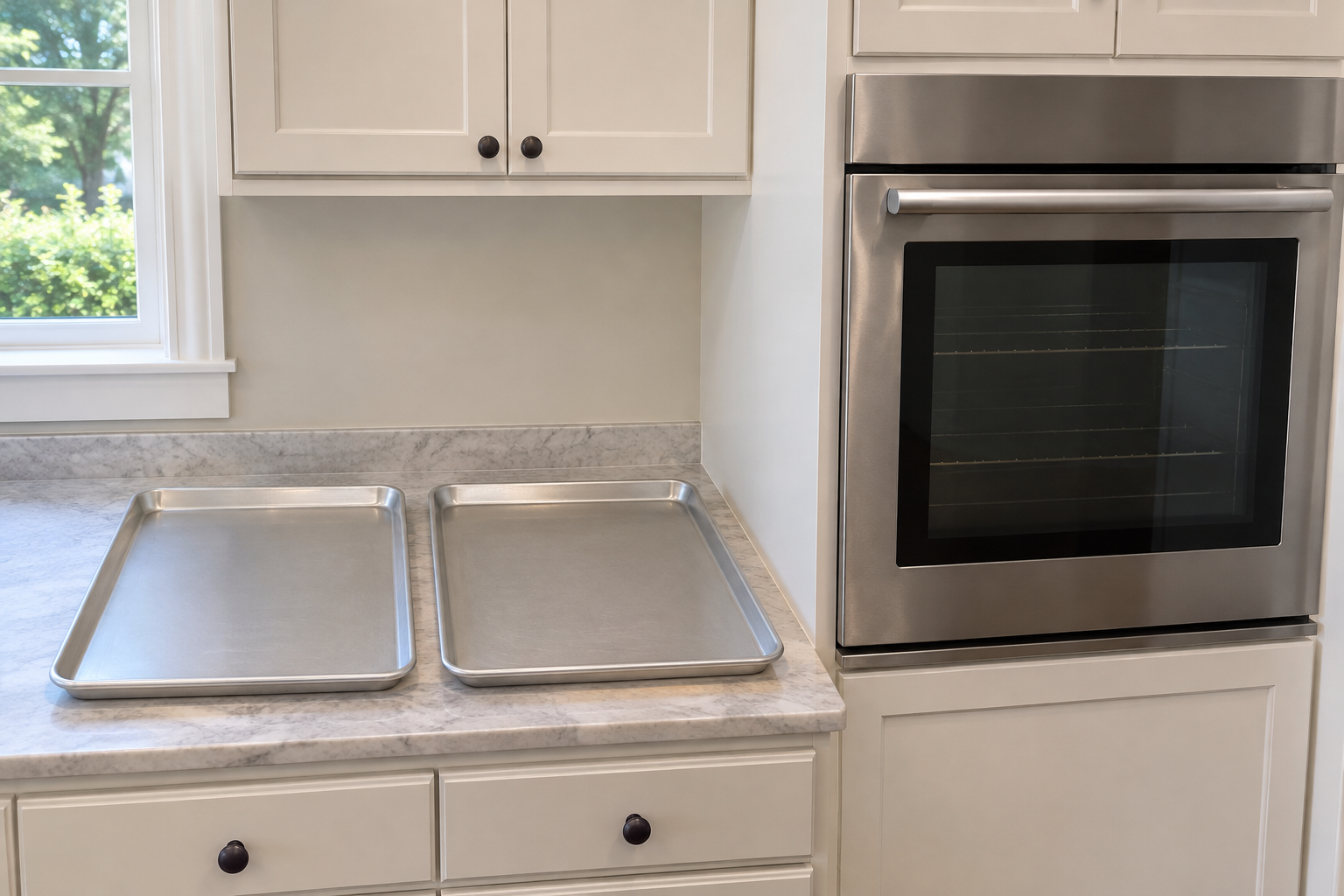
If you are deciding how to measure a baking sheet for oven fit, start with the usable rack width and depth at the intended cooking level. Compare those measurements with the pan’s complete outside length and width, including its rim. A nominal size is not a fit guarantee if a rim, handle, rack shape, or oven wall reduces usable space.
This is an internal pan-fit question, not the same decision as toaster oven cabinet clearance. That guide helps with an appliance’s outside space and use conditions. Here, the object being measured is the baking sheet inside the oven, on a specific rack.
Start with the rack, not the name of the pan
Labels such as quarter sheet, half sheet, cookie sheet, and jelly-roll pan are useful shopping shorthand, but they do not certify a fit in every oven. Product listings may show an interior cooking surface, while the rimmed pan must pass between the oven walls and rest on the rack. Measure your own oven before ordering a replacement or a second pan.
Turn the oven off and let it cool. Pull out the intended rack far enough to measure it safely. With a tape measure held straight, record the narrowest usable left-to-right distance across the rack and the usable front-to-back depth where the pan will sit. If rack side rails, a rear stop, or an oven-wall contour narrows the space, use that smaller measurement. Check the rack position you expect to use, because the cavity shape or rack supports may change what is practical at different levels.
| Measure or detail | Use for the decision | Do not substitute |
|---|---|---|
| Usable rack width | Compare with the pan’s full outside left-to-right span in the intended orientation; repeat after rotating it | The advertised oven width or kitchen cabinet width |
| Usable rack depth | Compare with the full outside front-to-back span, including the rolled rim; repeat after rotating it | The oven door opening alone |
| Pan outside dimensions | Decide whether the whole rimmed pan can sit on the rack | Only the interior baking surface |
| Pan height and any lid or rack | Check the exact accessory and rack position against the oven manual | A different pan’s rating or dimensions |
| Model instructions | Confirm permitted rack positions, accessories, and use limits | A universal clearance rule |
Write down two oven numbers and three pan numbers
For the oven, write usable rack width and usable rack depth. For the pan, find its exterior length, exterior width, and height. If the retailer or maker gives only one set of measurements, ask whether they are exterior dimensions before treating the pan as a match. Measure a pan you already own across the outermost edge of the rim, not across the flat interior.
The distinction can be meaningful. Nordic Ware’s U.S. product page for its Naturals Baker’s Half Sheet publishes both outer measurements, 12.9 by 17.9 inches, and inner measurements, 12.1 by 17.1 inches, with a one-inch height. That is a useful example of why the baking area is not the fit measurement. It does not mean every half sheet has those dimensions, and it does not establish what will fit your oven.
Use a simple orientation check before buying
Compare the pan in both possible orientations. Most rectangular pans are designed to go one way on a rack, but the comparison helps expose a mismatch quickly. The exterior width must be no greater than the usable rack width in the chosen orientation, and the exterior length must be no greater than the usable rack depth. A close numerical match is not a reason to force the pan past a rack stop or against a wall. If your measurement leaves you uncertain, choose another pan size or ask the oven manufacturer about your exact model.
Also check the whole setup you plan to use. A pan with a removable lid, an oven-safe grid, a high domed item, or a second pan changes the object and the space being considered. For example, Nordic Ware states that the lid sold with one of its half-sheet sets is for storage only, not oven-safe. Product-specific instructions control when an accessory is involved.
Check the oven manual for the final use decision
The oven’s owner’s manual is the source for rack positions, approved cookware or accessories, broiling directions, and any model-specific limits. It is not safe to replace those directions with a guessed gap around the pan. There is no single minimum air-gap number in this guide because ovens and their manuals differ.
Look up the exact model number from the oven frame or its documentation, then read the sections for baking, rack placement, and broiling before using a new pan. If the manual specifies a rack position or warns against a configuration, follow it even when the sheet physically fits. A good physical fit answers only one part of the decision.
Choose the size that matches how you cook
A larger baking sheet is not automatically the better choice. A sheet that is easy to place, remove, wash, and store may be the practical option for a compact kitchen. If you are replacing a worn pan, measure the old one and compare its exterior dimensions to the new listing. If the old pan already fits comfortably, that is useful evidence about size, though the new pan’s rim and corners still need their own check.
For storage after you have selected a size, the next decision is where the pan can live without becoming awkward to retrieve or damaging other cookware. The measurement approach in organizing a small kitchen without buying more storage can help you assign a reachable cabinet or vertical slot. That is a storage decision, separate from whether the pan fits the oven.
Common fit mistakes to avoid
- Buying by the words “half sheet” without reading the exterior dimensions.
- Comparing the pan’s baking surface rather than its outside rim.
- Measuring only the open door, not the rack where the pan must rest.
- Assuming a pan that fits one oven will fit a smaller oven or a toaster oven.
- Adding a lid, grid, or another accessory without checking its own instructions.
- Making up a clearance rule instead of consulting the exact oven manual.
Bottom line
How to measure a baking sheet for oven fit decisions are simplest when you treat the rack as the boundary and the pan rim as part of the pan. Record the usable rack width and depth, compare them with the product’s outside dimensions, and then use the oven manual for the approved rack position and configuration. That method is more reliable than a size label and keeps a standard sheet-pan purchase from becoming a return.
Frequently asked questions
Do baking sheet dimensions include the rim?
They may not. A listing can give interior baking-surface dimensions or exterior dimensions. For oven fit, confirm and use the exterior measurement that includes the rim.
Will a half sheet pan fit a standard home oven?
Do not assume so. Compare the exact pan’s outside dimensions with your own usable rack width and depth, then follow your oven manual.
Should I measure the oven opening or the rack?
Measure the usable rack where the pan sits. The door opening can be larger or shaped differently and does not prove the pan will rest properly on the rack.
Can I use a baking-sheet lid in the oven?
Only if the exact product instructions say it is oven-safe. For example, Nordic Ware identifies the lid in its half-sheet-with-lid set as storage-only.
Sources and fact-checking
Official manufacturer material rechecked November 28, 2026. No hands-on testing was performed. Nordic Ware, Naturals Baker’s Half Sheet: published outer and inner dimensions and height for the named product. Nordic Ware, Naturals Baker’s Half Sheet with Lid: identifies the lid as storage-only and not oven-safe. Check the owner’s manual for your exact oven model before use.


댓글 0
첫 댓글을 남겨보세요.