
Pressurized vs. Non-Pressurized Espresso Baskets: Choose by Coffee and Machine
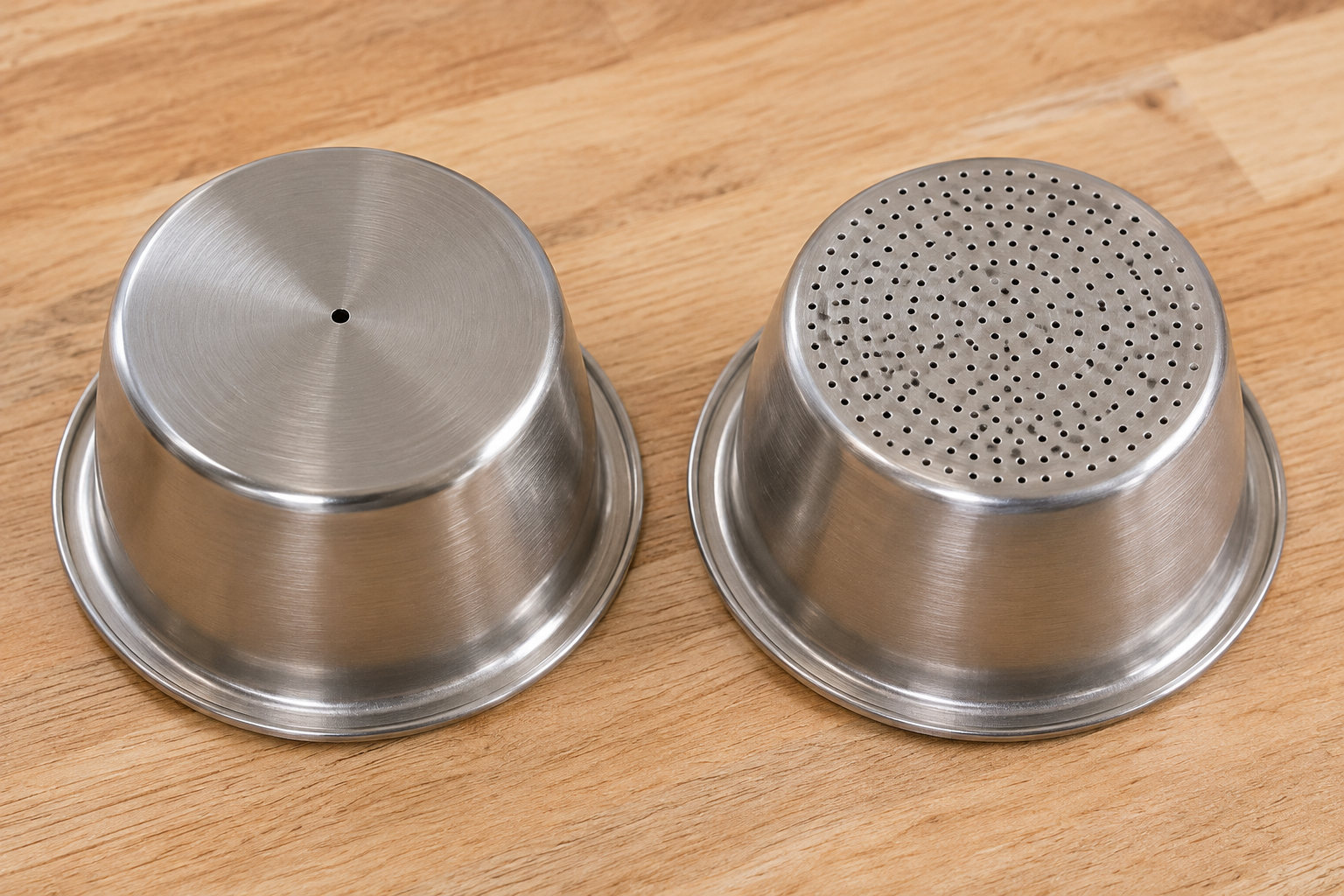
A pressurized vs non-pressurized espresso basket comparison should start with your coffee and machine, not a promise of better flavor. On the cited Breville Barista Express, use the Dual Wall basket for pre-ground coffee and the Single Wall basket when you grind fresh whole beans. Buy a replacement only after its diameter, rim, depth, and machine approval match your exact model.
The terms can vary by brand. Breville calls the two styles Dual Wall and Single Wall. Its U.S. guidance describes a Dual Wall basket as having an inner and outer wall with a small outlet at the base, while a Single Wall basket has perforations across its base. Those names are useful for understanding the design, not proof that two baskets from different makers will fit the same portafilter.
Choose by the coffee you are starting with
For the Barista Express BES870 example, Breville assigns Dual Wall baskets to pre-ground coffee and Single Wall baskets to freshly ground whole beans. That is the most practical first decision because packaged grounds, a grinder setting, and coffee freshness can all change the way a puck behaves. It is not a claim that one basket is universally better tasting or that a particular pump pressure guarantees a result.
If you buy coffee already ground for espresso, start with the basket your machine manual recommends for pre-ground coffee. If you grind whole beans immediately before brewing and want to adjust grind, dose, and tamp, check whether the manual supplies and recommends a Single Wall basket. Use the machine’s own terminology when shopping for parts.
| Decision point | Dual Wall / pressurized | Single Wall / non-pressurized | What to verify first |
|---|---|---|---|
| Cited Breville use | Pre-ground coffee | Fresh whole beans that you grind | Exact machine manual |
| Base construction | Inner and outer wall; small outer-base outlet | Perforations across the base | Look at the basket, not only a listing title |
| Adjustment role | Breville says it regulates pressure and helps optimize extraction despite differences in grind, dose, tamp, or freshness | Breville says it lets the user experiment with grind, dose, and tamp | Do not turn this into a universal flavor promise |
| 1-cup or 2-cup choice | Choose by beverage plan | Choose by beverage plan | Manual’s stated dose and size range |
| Replacement purchase | Not automatically interchangeable | Not automatically interchangeable | Model-approved dimensions and rim shape |
Read the machine manual before treating the names as a fit standard
Pressurized, dual-wall, double-wall, non-pressurized, and single-wall describe basket types, but they are not a universal sizing system. A basket can differ in outside diameter, lip or rim shape, depth, locating features, and 1-cup or 2-cup capacity. A basket that drops into a portafilter can still be the wrong part if it does not seat, retain, or clear the group correctly.
Find the machine model on its label, then open the current U.S. manual or the manufacturer’s parts page. Confirm that the basket type is supported and that the listing names the exact machine or portafilter family. A retailer photo, a similar-looking base, or an online comment is not a compatibility record. If the manufacturer does not document the replacement, ask its support team before ordering.
Use the 1-cup and 2-cup marking as a separate choice
Basket wall type does not decide whether you need a single or double basket. For the cited BES870, Breville says to use the 1 CUP basket for one cup and the 2 CUP basket for two cups or a stronger single cup or mug. Its supplied baskets are designed for approximately 8 to 11 grams in the 1 CUP basket and 16 to 19 grams in the 2 CUP basket. Those are model-specific guide values, not a dose target for every machine.
Breville also says to adjust grind amount and grind size when switching from a single basket to a double basket or the reverse. Make one variable change at a time and record which basket and coffee you used. A small tray or labeled container at the coffee station can keep the pair separate. For grinder maintenance before changing a coffee routine, see coffee grinder burr cleaning without water or guesswork; it explains why only the model-approved removable parts should be cleaned.
Inspect the basket with the portafilter cold and empty
Turn the machine off, let hot parts cool, and follow its manual before removing or installing a basket. With the basket empty, check whether it sits flat, engages the portafilter retaining spring as intended, and can be removed by the documented method. Do not pry, bend the rim, file the base, or force a basket into place. A loose basket, a basket that will not release normally, or a portafilter that will not lock as directed is a stop sign, not a tuning problem.
Keep a replacement basket with the original package and part identifier until compatibility is confirmed. If your machine includes only one basket type, do not assume the other type is an approved upgrade. Some systems support both, while others are designed around one basket family.
Plan the coffee counter around the decision, not more gear
A compact setup can work with one approved basket and a clear routine. Keep the machine manual or a photo of the part number with the coffee supplies. Store baskets dry and protected from dents, rather than loose in a utensil drawer. Before adding a second basket or a grinder, make room for access to the water tank and lid. The coffee maker lid opening height guide is useful for checking overhead clearance before a coffee station becomes crowded.
Clean and maintain the basket only as the manual directs. Do not use sharp tools to open holes, change the outlet, or remove a stuck basket. If grounds, wear, or damage affect normal seating, use manufacturer service or the documented replacement path. This is a parts-compatibility article, not hands-on repair advice.
Common buying mistakes
- Buying by diameter alone: Diameter does not confirm rim, depth, retention, or group compatibility.
- Confusing wall type with capacity: A 1-cup and 2-cup basket are different decisions from Single Wall and Dual Wall.
- Calling every two-wall basket pressurized: Use the terminology and design description from the exact manufacturer.
- Changing coffee, basket, dose, and grinder setting at once: You cannot tell which change caused the result.
- Forcing a replacement: Stop if it does not seat or release as the instructions show.
FAQ
Is a Dual Wall basket the same as a pressurized basket?
For the cited Breville guidance, Dual Wall is the pressurized design and Single Wall is the non-pressurized design. Other makers may use different terms, so verify the manual.
Can I use pre-ground coffee in a non-pressurized basket?
Follow your model manual. Breville’s BES870 manual directs pre-ground coffee to its Dual Wall baskets and fresh whole beans to its Single Wall baskets.
Will any 54 mm basket fit my espresso machine?
No. Diameter alone does not establish compatibility. Confirm the exact model’s approved part, rim, depth, and retention arrangement.
Should I choose a 1-cup or 2-cup basket first?
Choose the basket size for the drink you plan to brew, then choose the supported wall type. For the cited BES870, Breville gives separate single- and double-basket guidance.
Sources and fact-checking
Checked against current official U.S. sources on November 28, 2026. This is research-based guidance, not a claim of hands-on testing.


댓글 0
첫 댓글을 남겨보세요.