
Pull-Out Cabinet Organizer Measurements: Hinges, Opening, and Rails
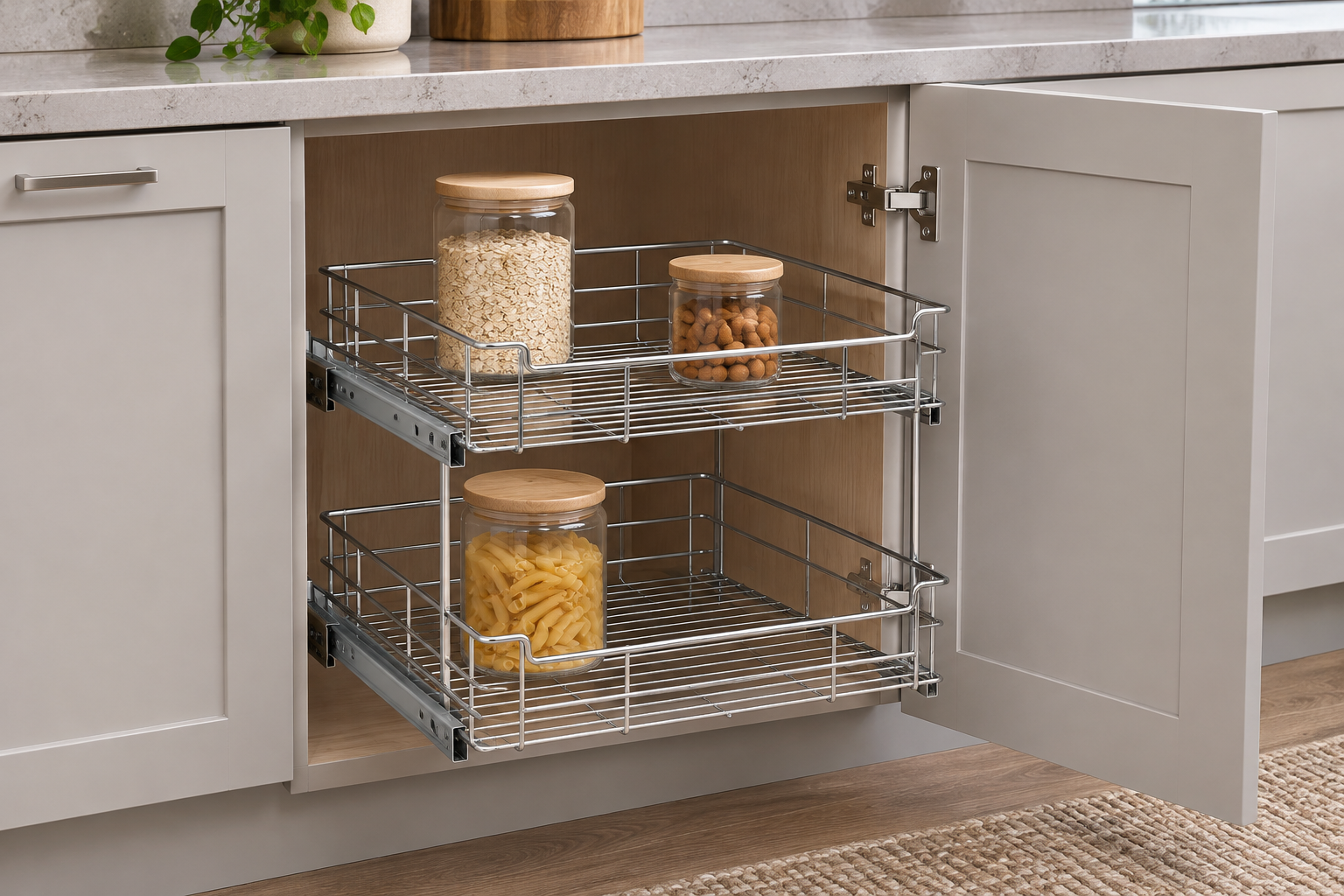
Pull-out cabinet organizer measurements start with the narrowest clear opening, then add hinge, door, rail, and rental checks. A nominal cabinet width is not an installation measurement.
| Measure | Where | Conflict |
|---|---|---|
| Opening width | Narrowest clear front point | Face frame or hinge |
| Usable depth | Front reference to rear obstacle | Back panel or plumbing |
| Interior height | Floor to first obstruction | Fixed shelf |
| Door path | Door open, organizer extended | Hinge or appliance |
Take six cabinet measurements
Measure clear opening width, depth, interior height, mounting surface, fully open door path, and all obstructions. Photograph pipes, outlets, shelf pins, center stiles, toe-kick details, and every internal shelf. Rev-A-Shelf tells buyers to measure width, depth, and height and account for plumbing and hinges.
A product width, basket width, and minimum cabinet opening can differ. Select the exact SKU before comparing the drawing and instructions. Face-frame, frameless, and inset construction can change the usable entry. A product that fits inside the box may still fail to pass through the opening. For the current Rev-A-Shelf CO and 5CW2 assembly, the July 2026 instructions also say to remove any internal shelves before installing the assembly.
Test the hinge and door interaction
Open the door fully and identify where the hinge arm and cup occupy space. The current July 2026 CO/5CW2 sheet directs moving the unit to the opposite side of cabinet hinges to prevent interference. Treat that as model-specific guidance, then extend the selected organizer with the actual door open. This is a clearance test, not a blanket layout rule.
Door-mount brackets add another material check. A thin panel, decorative rail, inset door, or glass feature may not provide the attachment area the instructions require. Do not substitute longer screws or relocate holes by guesswork. Get written approval before drilling rental cabinets.
Read rails and mounting as one system
Slides need the maker’s specified surface, screw, setback, and alignment. A full-extension claim does not make the opening wider. The current CO/5CW2 instructions require checking cabinet opening and basket width for clear pull-out and direct removal of internal shelves before this assembly. Do not cut, alter, or force a structural shelf to make it fit.
Cycle the empty organizer slowly before loading: extend it, close it, operate the door, and watch for rubbing. Add a few normal items and repeat. This reveals conflicts early but does not create a capacity rating. Follow an exact stated limit if the selected product provides one.
Match the product to the access problem
A narrow spice pull-out, two-tier basket, U-shaped plumbing organizer, and door system solve different problems. List the tallest, widest, and most frequently used items first. A removable bin or freestanding insert may be better where drilling is not approved.
Before committing to rails, review no-drill kitchen cabinet organization. If this is under a sink, leave plumbing service access and use the separate under-sink storage guide.
Lay out the installation before any drilling
Place removable tape where the rails, brackets, and extended baskets are expected to sit. With the cabinet door open, trace the organizer’s travel and note the hinge side, fixed shelf, plumbing, and door hardware. Keep all specification pages with the selected SKU, not a different size shown in a search result. If the system includes templates, use them only as the current manual directs. A template cannot correct a wrong cabinet style or an obstructed opening.
Plan the return path as carefully as the pull-out path. A basket can extend cleanly yet still meet a door or hinge while closing. Test it empty and then with ordinary items, stopping at the first rub rather than forcing the slides. Keep service access to plumbing, shutoff valves, outlets, and fasteners. An organizer that makes routine maintenance impossible creates a new problem even if it stores more goods.
Buying decision in plain language
Buy a rail-mounted organizer when the precise variant meets all opening, depth, height, hinge, mounting, and approval checks. Choose removable containers or a no-drill plan when the cabinet cannot be altered. A quote such as “fits 15-inch cabinets” is a starting label, not proof for a particular cabinet.
Use a repeatable final check
Before placing an order, make one short list for the pull-out cabinet organizer: cabinet opening, internal depth, fixed shelf, hinge side, rail mounting surface. Put a date beside each observation and identify which detail comes from the actual home and which comes from the manufacturer. This separates known conditions from assumptions. It also prevents a popular marketplace title, an old review, or a photograph of another variant from becoming the deciding evidence. If a required figure is absent from the official materials, do not fill the gap with an estimate.
FAQ
Should I remove an internal shelf for this organizer?
For the current Rev-A-Shelf CO/5CW2 assembly, the July 2026 instructions say to remove internal shelves before installation. If the shelf cannot be removed with permission, reject that assembly rather than cutting or forcing the cabinet.
Will it clear hinges?
Only a full door-open and extension test can confirm that.
Can I add one in a rental?
Screws often require approval. Check the lease and cabinet ownership.
Do soft-close slides guarantee fit?
No. Clearance, mounting surface, depth, and door path still control.
Sources and fact-checking
Checked against the official sources below on November 27, 2026. This is research-based guidance, not a claim of hands-on product testing.



댓글 0
첫 댓글을 남겨보세요.