
Toaster Oven Cabinet Clearance: Separate Storage From Cooking
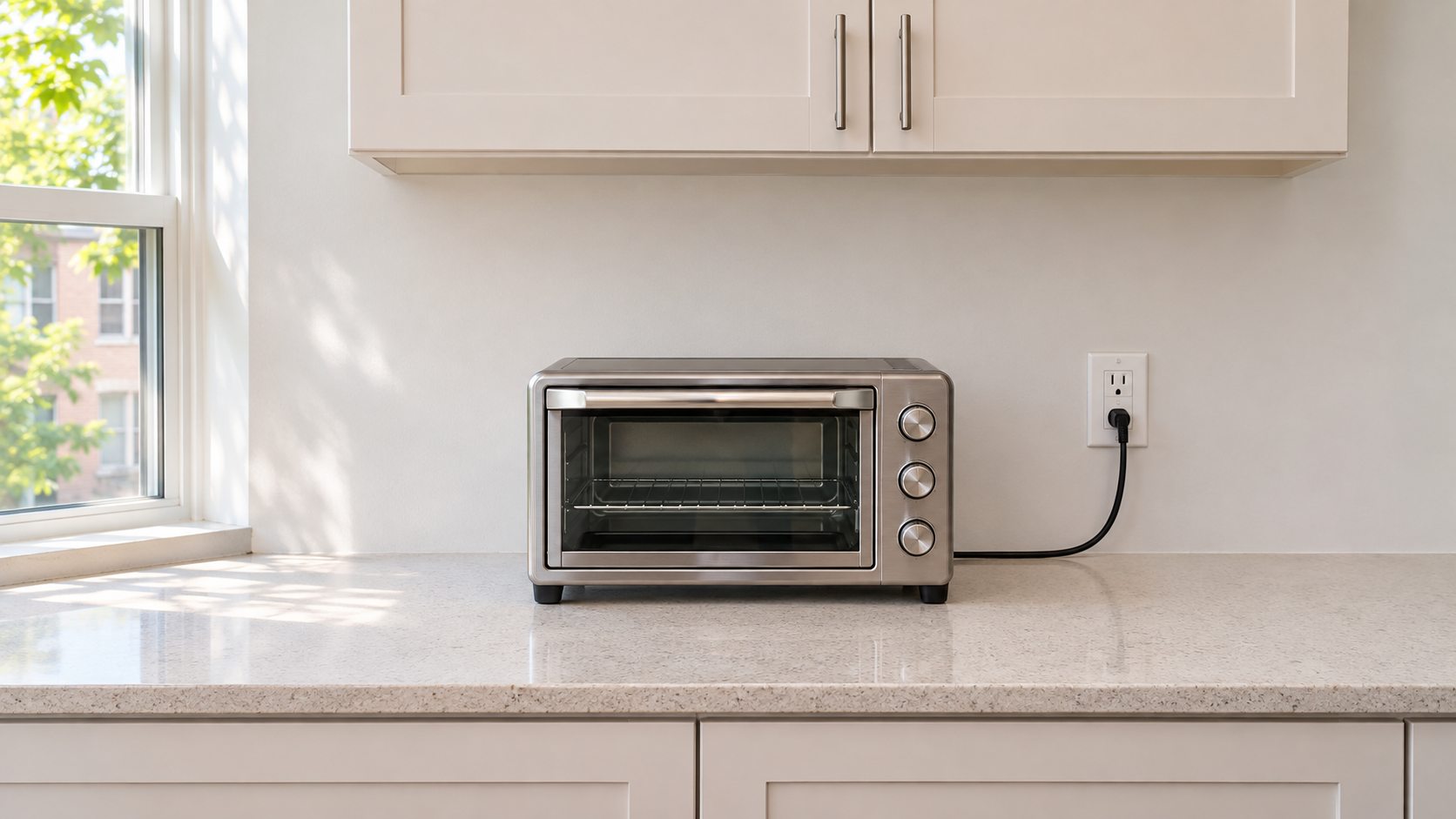
Do not treat a cabinet shelf as a toaster oven location just because the appliance fits inside it. Toaster oven cabinet clearance is model-specific. Begin with the exact model’s instructions, then measure the shelf as an enclosure: the space above, beside, and behind the oven; the front door’s travel; and the landing space for a hot pan. GE’s support guidance for its 2- and 4-slice toaster ovens recommends 4 inches of clearance on all sides so steam can escape without damaging counters, cabinets, or walls. That is a manufacturer recommendation for those GE units, not a universal number for every toaster oven.
A shelf can be a reasonable storage location for a cold, unplugged oven if the manual permits it. It is not automatically an operating location. The deciding question is not “Will it slide in?” It is “Can this exact oven run here with every required gap, its vents uncovered, and its hot door and tray usable?”
Test Toaster Oven Cabinet Clearance Before Choosing a Niche
Start by classifying the proposed location. A clear counter against a wall is different from a cubby with a top panel, side panels, and a back. The same appliance can have a much more restricted heat and steam path in the latter. A pull-out appliance shelf also changes the question: it may create a workable operating surface only when extended, level, stable, and arranged exactly as the manual allows. Do not infer approval from furniture marketing such as “appliance garage” or “microwave shelf.”
Find the full model number before shopping or rearranging. Read its use-and-care guide for placement, clearance, vent, and cord instructions. If it gives dimensions but no operating clearances, that is not permission to invent a gap. Ask the manufacturer or choose a location the manual explicitly supports. A built-in product follows its own installation literature; a countertop toaster oven is not converted into a built-in unit by removing a cabinet door.
| Proposed spot | What to measure | Decision signal | Practical next step |
|---|---|---|---|
| Open counter | Model-required gaps, outlet reach, door depth | All clearances and controls remain usable | Compare the manual to the actual counter |
| Upper-cabinet niche | Top, side, rear and front opening | Panels may block required space or steam path | Use only if the model instructions support it |
| Appliance garage | Door position, walls, vents, cord path | Closed or partly closed doors are not operating clearance | Store cold; operate elsewhere unless approved |
| Pull-out shelf | Extended depth, load rating, surrounding gaps | Must be stable and fully positioned for use | Check furniture instructions and oven manual together |
Measure the Oven at Its Largest, Not Its Box Size
Record the appliance width, depth, and height from the manufacturer specifications, then make a second set of measurements at home. Include feet, handles, protruding controls, and the plug and cord bend. Measure the cabinet opening at the narrowest point. Face frames, hinges, a shelf lip, or a wall outlet can reduce the usable space even when the interior dimensions sound generous.
Next, add the model-specific clearance listed in the manual. Do this on a simple sketch rather than measuring around the oven after it is wedged in. A clearance is empty air, not space occupied by a drawer pull, paper towel holder, or another appliance. Do not cover vents or remove feet to make a measurement work. GE’s guidance also calls for a level surface and says not to place the unit on or near a hot gas or electric burner or in a heated oven.
Trace the Door, Rack, and Hot-Pan Route
Cabinet clearance is only one part of a usable setup. With the oven unplugged and cool, mimic the full routine. Open the door all the way. Pull a rack or tray to the position described in the manual. Where can a person set a hot bake pan without reaching over the open door or turning toward a crowded sink? Keep that landing area clear before the timer begins.
Check vertical movement too. Some toaster ovens have a door that drops forward; others have a rack that moves with the door. A low drawer pull, a counter edge, or a cabinet face can make a theoretically adequate opening awkward to use. Do not solve that by balancing a hot pan on the open door. The point of the dry run is to reject a tight configuration before buying, not to prove that the appliance can be forced into it.
Read the Vent Layout Before You Compare Footprints
A small footprint does not tell you where the oven releases heat or steam. Look for vent diagrams, warnings about blocked openings, and the required clearances in the model’s manual. Compare those instructions with the sides and back of the proposed shelf. A gap visible from the front may still be closed by the back panel. Likewise, a cabinet can be wide enough but too shallow once the plug, cord, and rear clearance are accounted for.
If your larger problem is a shelf installation rather than appliance selection, see our microwave cabinet clearance guide. It explains why a furniture opening and an appliance-approved enclosure are separate ideas. For a different small-counter cooking decision, our air fryer for a small kitchen guide focuses on basket travel and cleanup rather than toaster-oven airflow.
Decide What Stays on the Counter
Choose an operating spot before choosing a storage plan. If the only counter location meets the toaster oven’s instructions but is needed for prep, make it a deliberate shared zone: clear it before use and do not store combustibles or loose papers there. If no location meets the manufacturer requirements, the answer is not a thinner heat mat or a larger extension cord. It is a different appliance, a different layout, or no toaster oven in that kitchen.
After use, let the appliance cool as its manual directs before cleaning or moving it. Store accessories with it only when cool and dry. Avoid treating a cabinet as a shortcut for warm appliance storage. The manual remains the authority for your model’s operation, cleaning, and placement.
FAQ
Can I run a toaster oven under upper cabinets?
Only if the instructions for that exact model allow the location and its required clearances are fully available. GE recommends 4 inches on all sides for its specified 2- and 4-slice models; do not apply that figure to another model without checking its manual.
Does an open-front cabinet count as enough ventilation?
Not by itself. The top, sides, rear, vents, and required clearances still matter. An open front does not change instructions for a countertop model into built-in approval.
What should I measure before ordering?
Measure the narrowest opening, counter depth, full door and rack travel, outlet location, plug bend, and the empty space required by the exact manual. Also reserve a stable spot for a hot pan.
Can I keep the toaster oven in a cabinet when it is not in use?
A cabinet may be suitable for storage only after the oven is cool and unplugged, but the product manual and the cabinet’s load limits still apply. Storage suitability does not establish operating suitability.
Sources and fact-checking
The clearance example comes from GE Appliances’ guidance for its 2- and 4-slice toaster ovens, checked November 25, 2026. Its level-surface and 4-inch recommendation applies to the specified GE units. The measurement method here is research-based, not a hands-on oven test; it does not certify a cabinet or replace the manual for another model.


댓글 0
첫 댓글을 남겨보세요.