
Rice Cooker Steam Under Cabinets: Choose a Counter Spot Before You Cook
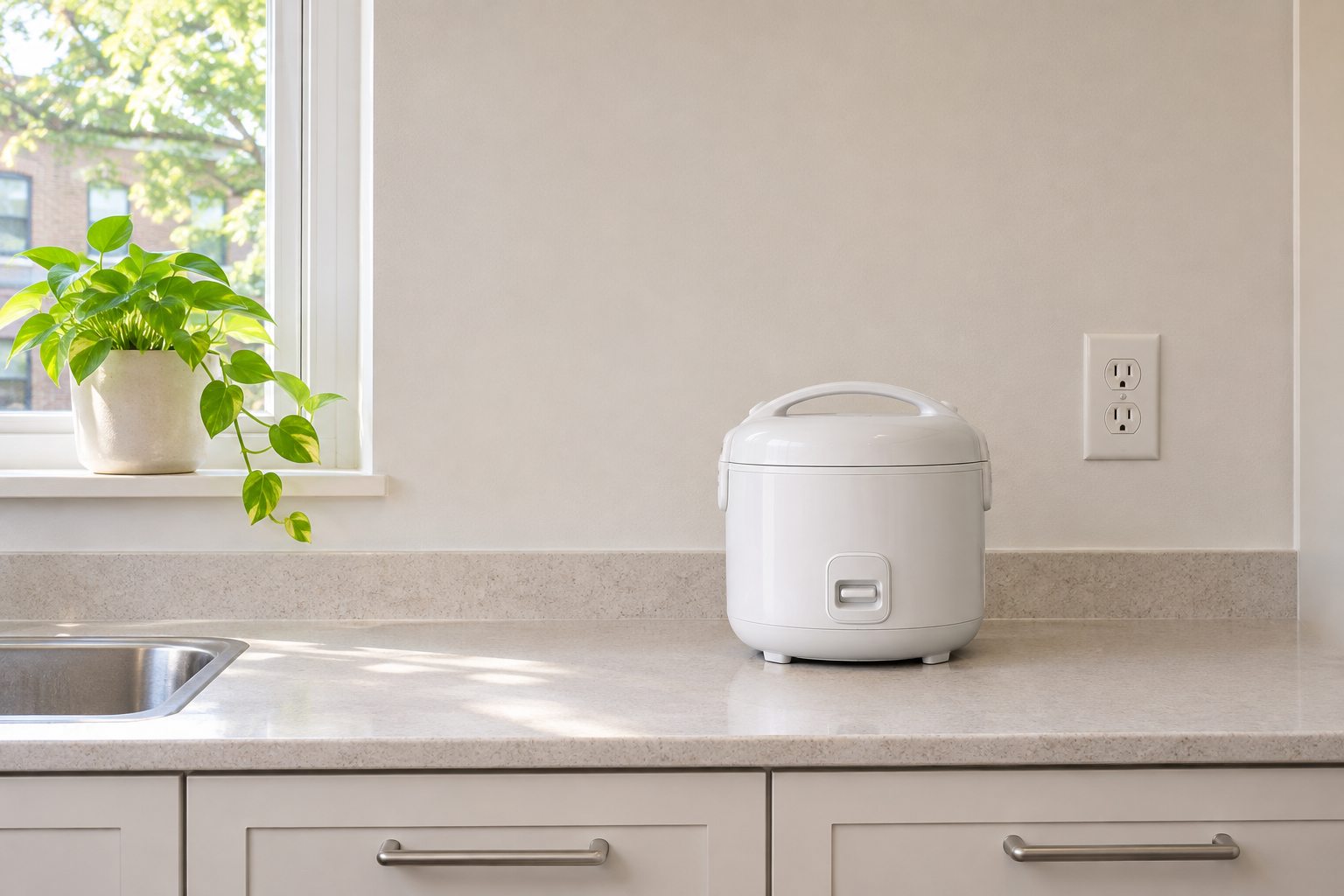
Put a rice cooker where its steam vent and fully opened lid have clear space, not merely where its base fits. Concerned about rice cooker steam under cabinets? Start with the manual for the specific model. A Presto rice cooker guide says to position its unit so it is not directly under cabinets to avoid steam damage. That instruction belongs to the referenced Presto model. Other models may state a distance, a placement restriction, or both; do not substitute a generic gap for the exact instructions.
Rice cookers deserve a different clearance check from dry-heat countertop appliances. The real decision is about a concentrated steam path, the lid’s opening arc, and where hands go when the lid is opened. A cabinet can be high enough for a closed cooker yet still sit in the steam path or prevent a safe lid opening.
Check Rice Cooker Steam Under Cabinets Before Choosing a Spot
Find the vent on the exact model and read its manual’s placement instructions. Some lids release steam from a dedicated vent; others use a different lid construction. Do not assume that turning the cooker sideways solves a restriction. The vent direction, lid hinge, and cord can all limit which direction is practical. Place the unit on the stable, level surface required by its guide, then check what is above and beside the vent during the entire cook and warm cycle.
The Presto guide for its Rice Cooker/Steamer says to use a dry, level, heat-resistant surface and position the cooker so it is not directly under cabinets. It also says steam normally escapes from the cover vent during cooking and warming, and cautions users to keep hands and face away from that vent. This means the operating counter needs more than a flat footprint: it needs an unobstructed steam zone and a safe standing position.
| Counter situation | What to check | Why it matters | Decision |
|---|---|---|---|
| Under upper cabinets | Exact manual and vent-to-cabinet path | Steam can reach cabinet surfaces | Reject if the manual prohibits or the vent points into cabinetry |
| Against a wall | Model-required distance and vent direction | Steam and heat can affect nearby surfaces | Use only when the stated clearance is available |
| Open counter | Full lid opening and hand position | Opening releases hot steam | Keep the lid path and vent zone clear |
| Storage shelf | Lift path and shelf load when cool | Storage and operation are different conditions | Store cool and dry; cook in the approved location |
Measure the Lid at Full Height
Measure from the counter to the highest point of the lid when it is fully open, then compare it with the underside of cabinets, lighting rails, and shelves. Do the same with the lid’s rear hinge clearance: a cooker pushed against a backsplash may not open as intended. Do this cold and unplugged. You are checking access, not simulating a cook under a cabinet.
Make a second sketch with the lid open. Include the lid’s highest point, any rearward movement, the space needed to remove the inner pot, and the place you will stand to serve. For a removable cover, identify where you can set it as the manual directs without crossing the vent or crowding the serving area. These access checks do not turn a prohibited location into an approved one. They help you reject a cooker that would be difficult to use even in a location that meets its placement instructions.
Plan the Moment the Lid Opens
The most important movement happens after cooking. The Presto guide cautions that hot steam escapes when the cover opens and tells users to take care around the vent. Stand where you can open the lid without putting your face or hands in the vent path. Keep a clear route to serve the rice, and do not need to move the hot cooker to make that route possible.
Do not open the lid toward a wall cabinet in the hope that a small gap will dissipate steam. Steam can condense on a nearby surface, and a tight vertical space gives you no comfortable hand position. Also check where the lid will rest open while you fluff or serve. If it contacts a cabinet or forces you to hold it, choose another counter zone.
Keep Water, Cord, and Counter Edges Out of the Compromise
Before each use, the Presto manual calls for the removable pot’s exterior to be dry and clean, and it warns not to add water to the cooker base. The guide also uses a polarized plug and gives extension-cord cautions. These instructions do not create a universal electrical layout, but they reinforce a simple selection rule: choose a counter spot with a reachable outlet and a calm filling routine, rather than carrying a full pot through a crowded kitchen.
Keep the cooker away from the counter edge. Arrange the cord so it does not drape where it can be pulled or tripped over, following the appliance manual. Do not treat a small heat pad, an open cabinet door, or a rotated cooker as a substitute for placement instructions. If the only available outlet is under a cabinet where the manual says not to operate, move the appliance rather than improvising the setup.
Pick a Cooker for the Counter You Actually Have
Before buying, compare the closed dimensions, open-lid height, vent location, cord direction, and the manual’s placement language. If the manual provides a number, add it to your measurements without rounding it away. If it says not to cook under cabinets, plan on an open counter. The Presto warning about cabinets is specific to the cited cooker. Read other models’ instructions separately rather than treating the smallest body as the easiest one to place.
For a different countertop appliance decision focused on storage after cooldown, read electric kettle storage in a small kitchen. If you are deciding between countertop cooking appliances, our portable induction cooktop guide addresses power, pan fit, and outlet checks rather than steam clearance.
FAQ
Can I use a rice cooker under a cabinet?
Check the manual for your exact model. The cited Presto guide says not to position its cooker directly under cabinets to avoid steam damage. A different model’s instructions must be checked separately.
How much space should I leave above a rice cooker?
Use the exact manufacturer instruction and also measure the lid fully open. The correct amount may be a stated distance, a prohibition on cabinet use, or both.
Can I turn the cooker so the vent points away from cabinets?
Only if the manual permits that orientation and the lid, cord, and controls remain usable. Rotation is not a substitute for the required clearances or a safe steam path.
Is it safe to open the lid right after cooking?
Follow the manual and keep hands and face away from escaping steam. The Presto guide specifically cautions that hot steam escapes when the cover opens.
Sources and fact-checking
Presto’s 05812 Rice Cooker/Steamer instructions, read November 25, 2026, support the dry, level, heat-resistant surface guidance and the warning not to position that cooker directly under cabinets. The manual also describes steam during cooking and warming. No clearance number from a different market or model is used here. This guide was researched, not tested on a cooker.



댓글 0
첫 댓글을 남겨보세요.