
Air Mattress Room Fit: Plan the Inflated Footprint and Exit
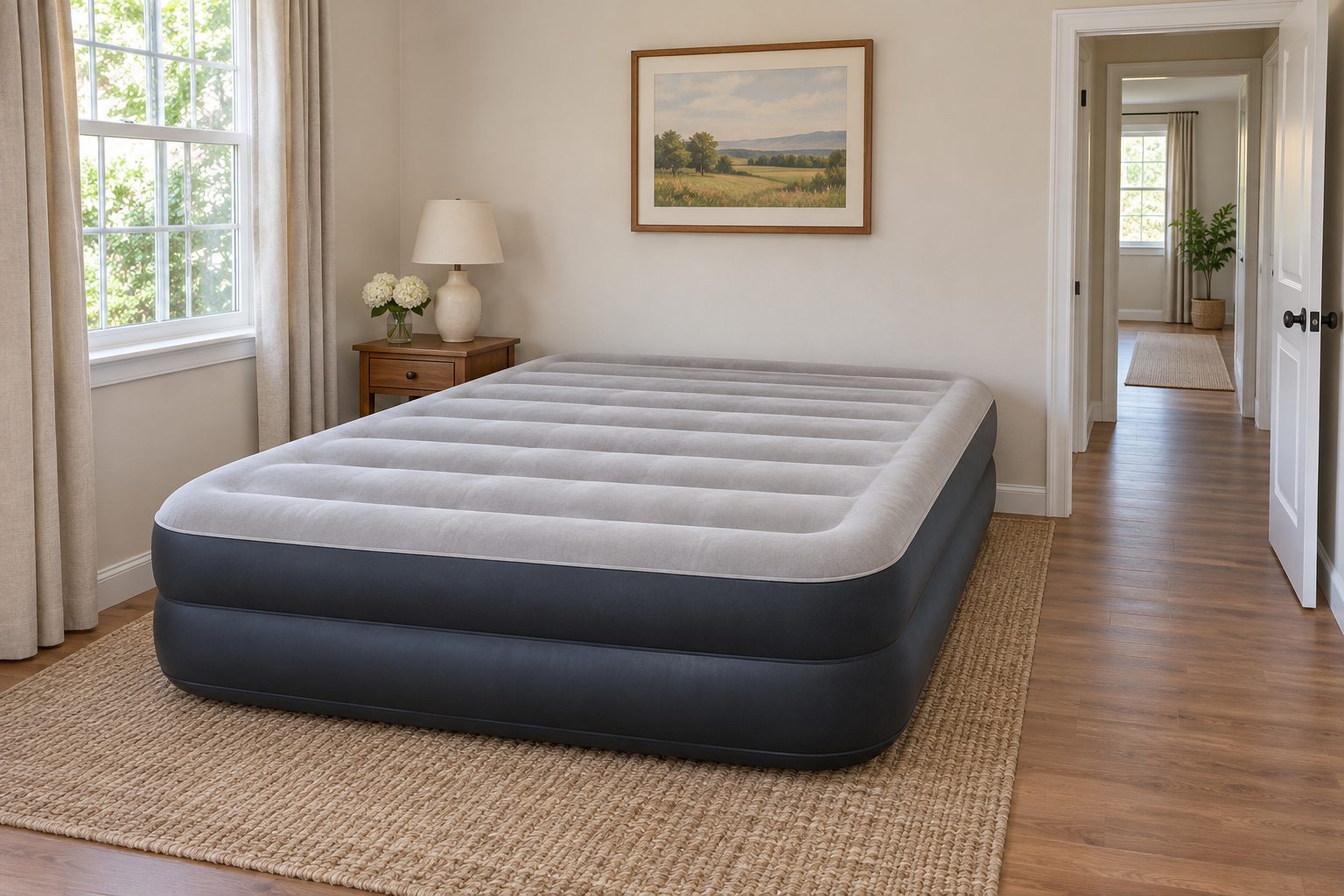
Air mattress room fit is the space you need after the bed is fully inflated, with a safe path around it, a workable entrance, and a plan for deflating and storing it later. Do not size a guest room from the deflated package or the nominal mattress name alone. Place painter’s tape or sheets on the floor at the manufacturer’s stated inflated length and width, then open the room door, walk the route to the bathroom, and locate the pump cord before you buy.
This is a fit-and-safety article, not a general guest-hosting checklist. An air mattress should never be used for infant sleep. The U.S. Consumer Product Safety Commission warns that air mattresses are too soft for sleeping infants and says never to place infants to sleep on air mattresses or other soft surfaces not specifically designed or safe for infant use. The cited Intex manual specifically prohibits babies 15 months old or younger on this product. Do not treat a different age as blanket approval; follow the exact product’s warnings and supervision requirements.
Map air mattress room fit before the guest arrives
Start with the exact inflated dimensions in the model’s specifications, not the dimensions of the carton. Mark the rectangle on the floor with low-tack tape. Include any headboard-like raised edge, built-in pump housing, or cord compartment that projects beyond the sleeping surface. Then test the room at the mattress’s real height: can a guest enter, turn around, reach a light, and exit without climbing across bags or squeezing between the bed and a wall?
Follow the exact model’s minimum spacing before assessing walking room. The AP619D/AP619DP manual currently linked from Intex’s US 64417ED page says to keep the product at least 1 foot (30 cm) from objects such as walls and dressers to prevent child entrapment. That model-specific minimum is not a universal comfortable walkway width. A usable route also has to suit the guest, the door swing, furniture, and any mobility needs. The purpose of the mock-up is to reveal conflicts rather than invent a standard. If a bedroom door strikes the mattress, choose a different orientation or another sleeping arrangement. Do not block a required exit path, and keep the route to the door free of cords, loose bedding, and luggage.
| Room decision | What to check after inflation | Why the deflated package is misleading | Action if it fails |
|---|---|---|---|
| Door access | Full door swing and a usable entry | The package does not show the bed’s footprint | Rotate, relocate, or choose another bed |
| Walking path | Clear route to exit and bathroom | Bedding and pump cord add obstacles | Remove furniture or select another room |
| Pump and outlet | Dry hands, cord route, accessible outlet | Built-in pumps vary by model | Follow the manual or use a compatible alternative only if allowed |
| Storage return | Deflation area, drying, fold and bag route | Inflated size says nothing about safe folding | Reserve a flat clear zone before guests arrive |
Choose the surface and pump position, then read the exact manual
Set up only on a flat surface free of debris, obstructions, and sharp objects. The 2026-listed Intex AP619D/AP619DP manual requires a flat, level, clean area free of sharp objects and within reach of an outlet. It also says not to set up near stairs, doors, sharp edges, or breakable objects. It also says not to overinflate. Do not translate that into a rule for a different airbed or pump: use the pressure, inflation, and electrical instructions supplied with the exact model.
If the bed has a built-in electric pump, identify the outlet before the bed is unfolded. Keep hands dry while connecting electrical equipment, route the cord where it cannot become a trip hazard, and do not run it through a doorway or under the inflated mattress. An extension cord is not a default solution; follow the manufacturer’s electrical directions. Let the mattress reach the desired firmness, then turn the control to the specified off or closed position. Temperature and use can change how an airbed feels, so reassess it according to the manual rather than repeatedly overinflating it.
Keep this separate from a general guest setup
Intex’s US 64417ED product page lists an approximate inflated size of 60 by 80 by 22 inches and includes a carry bag. Those are figures for that model, not all queen airbeds. Mark its full inflated rectangle and height, then apply the exact manual’s spacing and access requirements. A guest-hosting checklist cannot replace that fit test. The related small-apartment guest setup guide covers the broader hosting plan. Use it after, not instead of, a room-clearance test.
Keep bulky bags and laundry outside the marked footprint before inflation. Choose a bedside light or charging plan that does not send a cord across the exit path. If the only usable layout puts the mattress beside an unprotected drop, squeezed against a door, or over a damaged floor area, the practical answer is to change the accommodation plan. Good hosting does not require turning a tight room into an obstacle course.
Plan the deflation and storage stage before purchase
The last morning is part of the fit decision. You need a clean, dry, open area to deflate the bed and fold it without forcing it around furniture. Intex’s storage directions say to deflate as instructed, make sure the airbed is clean and dry, lay it flat with the sleeping surface facing up, fold it loosely, avoid sharp bends, corners, and creases, and store it in a dry place. Those directions explain why a tiny closet may hold the final bag but still be a poor place to do the packing.
Measure the storage location after you know the packed dimensions from the manufacturer. Do not assume a carry bag means the airbed will fit under a particular bed or on a high shelf. Consider who will carry it, whether the bag has a secure path to the closet, and whether the storage area stays dry. If the guest space is also your living or work area, the studio apartment zone plan can help you decide what must move and what must remain accessible while the bed is in use.
Non-negotiable safety boundaries
- Never use an air mattress for infant sleep. Follow CPSC safe-sleep guidance and use a product designed for that purpose.
- For the cited Intex models, keep at least 1 foot (30 cm) from walls, dressers, and similar objects as the manual requires; preserve a usable exit route as well.
- Do not block a room entrance or exit route with the inflated bed, cord, or luggage.
- Keep the bed away from sharp objects and set it on the surface the manufacturer specifies.
- Do not overinflate or operate the pump beyond the model’s instructions.
- Do not place the cord where it will be pinched, wet, crossed in a walkway, or trapped under the mattress.
- Deflate, clean, dry, and store the bed only as its manual directs.
Use a paper layout to compare rooms without inflating twice
If you are choosing between rooms, cut or tape a paper outline using the model’s stated inflated dimensions. Put a small marker where the pump and cord would be. This low-risk layout test can show whether a closet door, dresser drawer, or bedroom door conflicts with the bed before anyone carries it in. It also makes clear whether a guest has a direct route to the door without stepping over the mattress.
Once the layout works, repeat the check when the actual bed is inflated because a manufacturer’s dimensions, room trim, bedding, and the selected firmness can change the practical fit. Keep the result modest: the goal is adequate access, not filling every remaining inch with luggage or furniture.
FAQ
How much room should I leave around an air mattress?
Follow the model’s minimum first. The cited Intex AP619D/AP619DP manual requires at least 1 foot (30 cm) from objects such as walls and dressers. Then test the actual inflated bed for door swing, exit access, and the guest’s movement; that minimum alone does not prove the room works.
Can an infant sleep on an air mattress?
No. CPSC says never to place infants to sleep on air mattresses or other soft surfaces not specifically designed or safe for infant use.
Can I put an air mattress in front of a bedroom door?
Do not use a layout that blocks opening the door or creates an obstructed exit path. Test the fully inflated footprint with the door moving normally.
How should I store an air mattress after guests leave?
Follow the exact manual. The Intex manual cited here says to deflate it, ensure it is clean and dry, fold it loosely without sharp creases, and store it in a dry place.
Sources and fact-checking
The example uses Intex’s US 64417ED product page and its Manuals tab, checked November 25, 2026. The linked 2026-listed AP619D/AP619DP manual was downloaded in the browser and read for its 110–120 V models, 1-foot spacing requirement, setup, inflation, and storage instructions. Infant-sleep guidance was checked against CPSC’s air-mattress warning. This is documented room planning, not an airbed test; use the manual for the exact bed.



댓글 0
첫 댓글을 남겨보세요.