
Coffee Maker Lid Opening Height: Plan for Filling, Steam, and Carafe Access
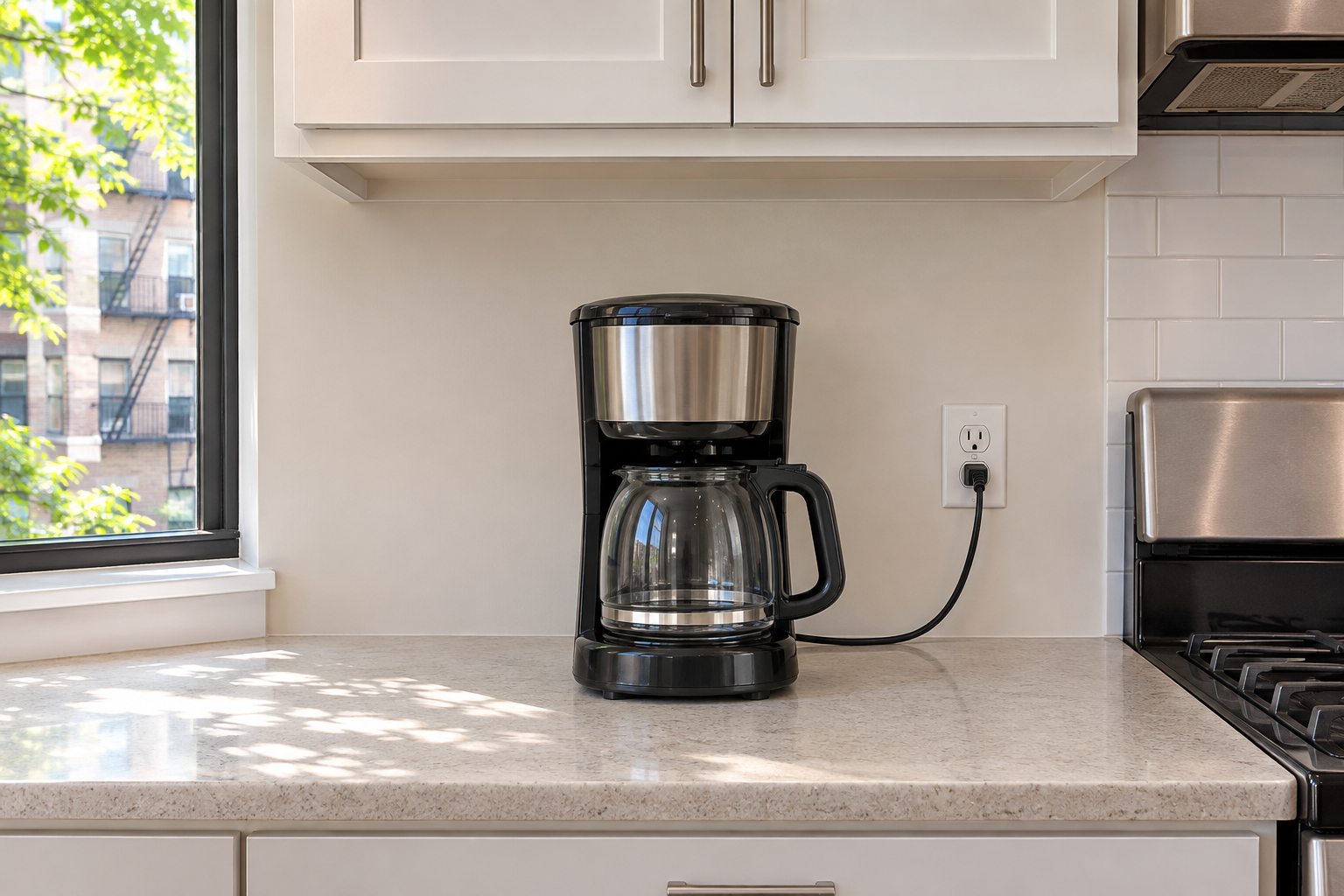
A coffee maker that fits below a cabinet can still be the wrong machine for that location. Coffee maker lid opening height matters when you refill the reservoir, not just when you store the brewer. First read the exact model’s manual, then test the ordinary morning sequence: lift the lid, add water, place the filter or pod, remove the carafe, and let the machine cool. Two current Hamilton Beach FlexBrew manuals state that the coffee maker must not be placed in a cabinet when in use. An enclosed cabinet or appliance garage is different from an open counter beneath a wall cabinet; that warning alone does not supply a clearance number for the latter.
The key buying decision is whether you need a machine that lives in the open or a place to store one between uses. Under-cabinet height is only one measurement. Water access, moving parts, steam, cord routing, and the direction you carry a full carafe are what make a coffee station practical.
Distinguish an Enclosed Nook From an Open Counter
Look up the model number before using a shelf or an appliance garage as a brewing spot. Read the safety, setup, and cleaning sections, not just the product page. The Hamilton Beach Smart FlexBrew Trio 49911 manual says “Do not place coffee maker in a cabinet when in use.” The FlexBrew Advanced 5-in-1 49965F manual gives the same instruction. Their manuals also say to operate on a flat surface away from the counter edge and warn that scalding can occur if relevant lids or brew-basket parts are opened during the brew cycle.
Those examples show why a generic “under-cabinet clearance” number can mislead. A manufacturer may prohibit cabinet use rather than prescribe a top gap. Do not translate a storage nook into an operating nook by leaving the door open. If your selected model has different instructions, follow those instructions exactly. If the guide is unavailable or unclear, choose an open location or contact the maker before use.
| Coffee routine | Space that must remain usable | What can rule out an upper cabinet | Buying implication |
|---|---|---|---|
| Carafe drip brewer | Lid lift, water fill, basket access, carafe pullout | Cabinet blocks lid or limits safe removal | Compare open-lid height, not closed height alone |
| Single-serve brewer | Reservoir fill, pod-holder movement, mug access | Manual prohibits cabinet operation | Choose a clear counter station |
| Shared morning station | Path from sink to machine and machine to mugs | Carafe path crosses a prep zone | Reserve a dedicated counter strip |
| Occasional use | Safe lift in and out after cooldown | Heavy machine or inaccessible shelf | Store cold and brew only in an approved spot |
Measure Coffee Maker Lid Opening Height With Your Water Pitcher
With a candidate machine, record closed height, width, and depth from its specifications. Then find the dimensions that often go unlisted: height with the reservoir lid fully open, depth with a swing-out basket or pod holder open, and the room needed to pour water without striking the cabinet. If you fill from a pitcher, include the pitcher’s height and tilt. A water reservoir may be removable on one model and fixed on another, which changes the whole station.
Measure the underside of the cabinet at its lowest point, including trim and under-cabinet lighting. Measure the counter from the wall to the front edge. Confirm there is room to grasp and lift the carafe by its handle without brushing the cabinet face or reaching across the warming plate. A machine can be short enough to slide beneath a cabinet yet impossible to fill there.
Map the Steam and Hot-Liquid Route
Brewing involves hot liquid and, on many machines, a heating element or warming plate. Keep hands away from the area where the maker directs steam, and do not open the lid or brew basket during the cycle when the manual warns against it. The Hamilton Beach manuals note scalding risks from lifting designated lids or holders during brewing and say the warming plate may remain hot after the machine is off.
For a counter below wall cabinets, first check the model’s placement and steam instructions; the enclosed-cabinet warning is not a universal ban on that arrangement. Then map the route a filled carafe takes to the mug area. There should be an unobstructed hand path and a level surface to set the carafe down. Do not plan to thread a hot carafe through a narrow gap between the brewer and a wall. Keep the cord from hanging over the counter edge or touching hot surfaces, consistent with the manuals’ cord guidance.
Test the Station Without Brewing
Before committing, do a cold rehearsal. Place the unplugged machine where it would sit. Open every lid and holder. Set an empty carafe in and remove it. Pretend to pour water from your normal container. Open the nearest cabinet and drawer. This reveals collisions with a cabinet door, faucet, backsplash outlet, or pull handle without introducing heat.
Now look at the outlet. The product’s plug should reach it without tension, pinching, or an improvised cord route through a cabinet. The 49911 and 49965F manuals explain that their polarized plugs are intended to fit a polarized outlet one way and warn against modifying the plug; follow the electrical instructions for the exact machine. A close outlet is not enough if the cord will cross a wet work zone or a walkway.
Separate Storage From a Daily Brewing Location
If counter space is tight, choose the smallest compromise that preserves approved operation. A cabinet or appliance garage may hold a cooled, unplugged machine between uses if the manual and shelf can support that storage. It does not make the same enclosure a place to brew. A simple tray can define a counter station, but it does not override a manufacturer instruction or create missing clearance.
For a related choice about where an appliance can wait between uses, see electric kettle storage in a small kitchen. If your issue is sharing a limited counter without remodeling, our small rental kitchen setup guide can help you assign a prep and appliance zone without changing cabinets.
FAQ
Can I brew coffee under a wall cabinet?
Check the exact model’s placement, steam, and access instructions. The cited Hamilton Beach manuals prohibit operation in a cabinet; that is not the same as giving a clearance rule for an open counter beneath a wall cabinet.
How much space does a coffee maker need above it?
There is no universal number. Measure the fully open lid, water-filling method, and any moving brew parts, then follow the manufacturer’s placement directions for that machine.
Can I keep a coffee maker in an appliance garage?
Possibly for storage after it is cool and unplugged, if the appliance manual and cabinet can accommodate it. Do not assume the garage is safe for brewing, especially when the manufacturer says not to use the machine in a cabinet.
What is the most commonly missed measurement?
Open-lid height. Also test how you fill the reservoir and remove the carafe. A machine’s closed height alone does not describe the space required to use it.
Sources and fact-checking
Placement, scalding, cord, and warming-plate cautions were checked November 25, 2026 in the official Hamilton Beach 49911 guide and 49965F guide. Their prohibition is operation in a cabinet, not a published universal gap below a wall cabinet. This is a documentation-based fit guide, not a product test.


댓글 0
첫 댓글을 남겨보세요.