
Emergency Flashlight Storage: Choose a Light You Can Find
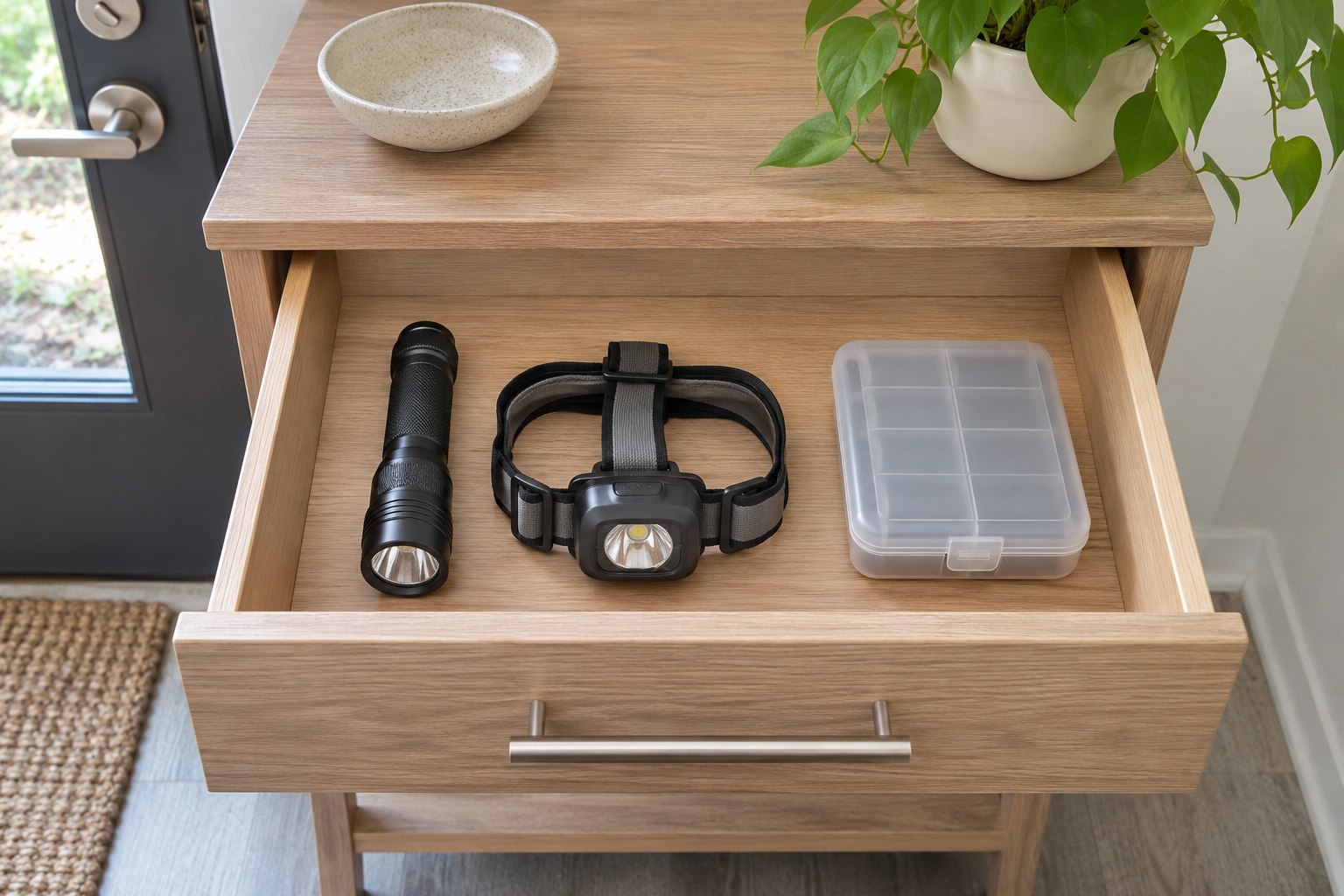
Good emergency flashlight storage starts with where you’ll reach when the room goes dark. Give the working light a fixed spot you can reach without crossing a cluttered floor, keep it out of children’s reach, and make sure another adult knows where it is. Choose a handheld if you’ll pass it to someone else; choose a headlamp if you’ll need both hands. Buy either only when you know how you’ll power it before and during an outage.
Ready.gov lists a flashlight and extra batteries among its basic emergency kit supplies. That’s a useful starting point, not a requirement to bury the only light under everything else in the kit. If the light is supposed to help you find the kit, put it somewhere you can locate first.
Emergency flashlight storage starts within reach
Think through two ordinary moments: waking at night and coming home to a dark apartment. From the bed, could you find the light without walking to the entry? From the door, could you reach the same spot without stepping over bags? A secure bedside drawer may work for the first situation and an adult-accessible entry cabinet for the second. If your layout calls for two lights, give each a distinct home rather than letting both migrate to the kitchen.
Try the reach in daylight. Stand or sit where you’d start and put your hand on the proposed location without searching through other objects. Don’t practice walking in the dark. If reaching requires a stool, moving a heavy bin or finding a tiny key stored somewhere else, try a different location. In a home with young children, an adult-controlled compartment accessible to the intended user matters more than being able to see the flashlight on an open shelf.
Shop for the task at the other end of the beam
For moving from a bed to the common area, a handheld with an easy-to-identify switch can do the job without adjusting a strap. It can be passed to a roommate or aimed at a shelf without turning your head. For clipping on a dog’s leash or carrying a child while retrieving supplies, a headlamp leaves both hands free. Check that the band adjusts to its wearer, the lamp stays oriented as intended and its switch is easy to find by touch.
Look beyond the largest brightness number. Compare the beam shape you want, the mode the lamp starts in, how many button presses it takes to reach steady light, and the listed run time for that particular mode. Don’t assume the brightest setting delivers the longest advertised run time. A bag-friendly lockout may prevent accidental activation but be a poor match for someone who can’t remember the unlocking sequence when startled awake.
| First job | Option to consider | Condition before you buy |
|---|---|---|
| Find the kit and hand off the light | Handheld with a distinct on/off control | The intended user can locate the switch and grip the body comfortably. |
| Use both hands to carry or fasten something | Headlamp with an adjustable strap | The strap fits the wearer and the lamp can be retrieved without untangling it. |
| Restore light without a working outlet | Model with user-replaceable cells | You can stock the exact size and chemistry and open its compartment as directed. |
| Keep a frequently used light ready | Rechargeable model with a charge indicator | You have the specified charging equipment and a fallback if the outage interrupts charging. |
Read the battery line all the way to the chemistry
A size such as AAA describes only part of the purchase. For example, the Streamlight Stylus Pro penlight in the cited instructions uses two AAA alkaline batteries, inserted positive end first. Its tail button gives momentary light with a light press and constant light when pressed until it clicks. These details apply to that penlight, not to similarly named rechargeable products. A drawer full of cells marked AAA isn’t an adequate plan if none match the chemistry called for.
Check whether the light needs a tool to open its compartment and who can use that tool. For a replaceable-cell light, note the approved battery description when you order spares. For a rechargeable light, read the instructions for its charging supply, cable, indicator, permitted charging conditions and storage guidance. Don’t attempt to charge disposable alkaline cells. A port that looks familiar is not enough to establish that your charger is approved.
Ask what happens if the light is nearly empty when the power fails. Can it use a manufacturer-approved alternate power source, or will you rely on a separate ready light? Don’t budget for a last-minute charge from the same dead wall outlet. If the model requires attention while charging, choose a place and routine that let you follow those directions. No single top-up interval or percentage makes sense for every battery system.
Put a boundary between fast access and child access
A flashlight for adults doesn’t need to sit loose in a low basket next to a child’s toys. Select a spot the intended adults can reach, with a closure that keeps young children from the light and its spares. Check the battery door before selecting a tiny keychain backup. CPSC warns about swallowing button or coin batteries and advises keeping products with accessible cells away from children. A damaged coin-cell compartment is a reason to remove the device from use, not to put it back on the hook.
Store replacement cells securely, not loose alongside keys or scattered around the lamp compartment. Don’t confuse the button-cell warning with the battery type in the Stylus Pro example: those are separate buying decisions. For organizing spare cells and returns rather than choosing a light, use the household battery storage guide.
Leave the next person a working flashlight
Show household members which light stays where and how to select steady illumination. If you already have a small-apartment emergency supply area, tell them where that area is relative to the first light. “The flashlight is in the front right of the hall cabinet” is more useful than “somewhere near the supplies.” Mark the compartment in a way the intended user recognizes, including by touch if helpful.
Choose an existing household reminder for a brief function check and follow any maintenance interval in the manual. Also check after someone borrows the light: turn it on, confirm the expected mode, inspect the compartment or charge indicator as appropriate, then return it to the assigned spot switched off as directed. A momentary beam confirms it switches on; it doesn’t prove how long it will run. Replace cells or recharge as instructed and replenish spares you actually used.
If one person keeps borrowing the outage light for trips to the basement, give that everyday job its own light or change your return routine. Emergency flashlight storage has succeeded when the next person can find usable light without a phone, a working outlet or someone else at home to explain the plan.
FAQ
Should my only flashlight stay in my go-bag?
Only if you can reach and identify it easily where you normally start. If the packed bag is hard to reach from the bed, give the first-reach light a different home.
Should I remove the batteries between outages?
Follow the instructions for that light and its batteries, including any rules for extended storage. If they call for removal, plan for the installation step or choose another ready light.
Does a phone flashlight count as a backup?
It can provide light when available, but the phone may be elsewhere or needed for calls. A separate flashlight gives you a way to find supplies without depending on the phone charge.
Will a rechargeable headlamp work while plugged in?
Only count on that function if its instructions explicitly allow it. When choosing an outage light, plan for use away from an outlet rather than assuming pass-through operation.
Sources and fact-checking
Sources checked November 19, 2026. This is a research-based guide, not a hands-on product test.
- Ready.gov: Build a Kit: Lists a flashlight and extra batteries as basic kit supplies.
- CPSC: Button Cell and Coin Battery Information Center: Describes child ingestion hazards and precautions for loose cells and products with accessible battery compartments.
- Streamlight: Stylus Pro operating instructions (PDF): The English instructions specify two AAA alkaline batteries, polarity and momentary versus constant-on switch operation.




댓글 0
첫 댓글을 남겨보세요.