
Slow Cooker Minimum Fill: How to Pick a Size for Two
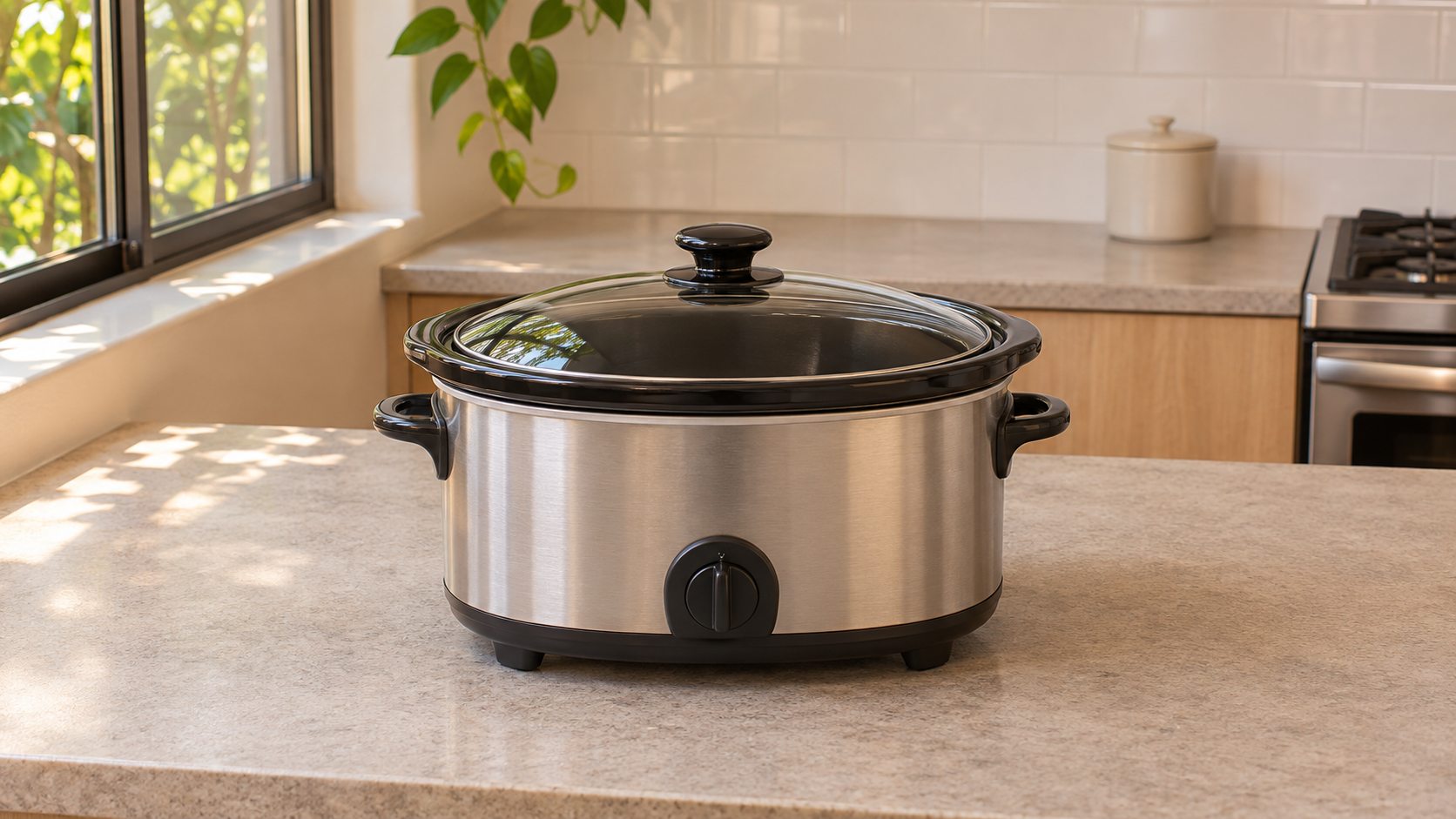
Slow cooker minimum fill guidance is the practical starting point for choosing a size for two: select the smallest model that can hold your normal recipe within its stated operating range, not simply the smallest appliance on the shelf. Start with the volume of a two-serving meal plus any planned leftovers. Then check the exact manual. Crock-Pot’s general guidance says its slow cookers should be between one-half and three-quarters full for best results, but that is brand guidance, not a universal rule for every slow cooker.
There is no single quart size that fits every two-person household. The right choice depends on whether “dinner for two” means two bowls tonight, dinner plus lunches, or a sauce, dip, or side dish. A larger cooker may be useful for batch cooking, but a small recipe can sit below a manufacturer’s preferred fill range. A compact cooker can be easier to store, but it may leave no room for leftovers.
Decide what two servings means in your kitchen
Before looking at product listings, write down one meal you actually make. Include the liquid, vegetables, protein, and any ingredients that will be added later. Pour the finished recipe into a measuring jug or a large bowl to learn its approximate volume. Do the same for a batch that includes tomorrow’s lunches. This is more useful than guessing from plate count because soups, braises, beans, and shredded meat occupy very different volumes.
Use that result as a screening tool rather than a fill line. A nominal “2-quart” capacity describes the vessel, not a promise that every recipe should reach the rim. The food needs headroom, the lid must sit correctly, and the appliance’s instructions control. If the listing names a model but does not provide its manual, treat its capacity as incomplete purchase information.
| Your usual plan | Capacity range to compare | What to verify first | Likely trade-off |
|---|---|---|---|
| Two small portions, few leftovers | Capacity that fits the measured dinner batch | Manual’s minimum-fill guidance and crock dimensions | May be too small for a doubled recipe |
| Dinner for two plus lunches | Capacity that fits the measured dinner-and-lunch batch | Whether the usual batch stays within the stated fill range | Takes more cabinet space |
| Occasional guests or freezer portions | Capacity matched to the planned larger batch | How often you will make a large enough batch | Small meals may not suit the model’s guidance |
| Dips, sauces, or a side dish | Model-specific | Manual, intended use, and serving method | A meal-sized cooker may be unnecessarily large |
Use slow cooker minimum fill as a purchase filter
Slow cooker minimum fill advice matters because slow cooking is not just storage with heat. The amount of food, the shape of the crock, and the lid all affect the cooking environment. Crock-Pot says one-half to three-quarters full is best for its slow cookers. On a 2-quart vessel, that range is roughly 1 to 1.5 quarts; on a 3-quart vessel, it is roughly 1.5 to 2.25 quarts. Those arithmetic examples only translate the brand’s general guidance. They do not replace the instructions for a particular model.
Check the manual before assuming a recipe can be halved without changes. A recipe from a large slow cooker may leave a very shallow layer in a smaller or wider crock. Conversely, a compact cooker can be overfilled by ingredients that expand or release liquid. Do not use the maximum capacity on a retail filter as the sole decision point. Look for the printed maximum line if the vessel has one, and keep the instructions that came with the appliance.
Measure the appliance when the lid and cord count
Capacity does not reveal counter fit. Measure the planned parking spot from wall to counter edge and from side to side. Compare those dimensions with the manufacturer’s overall depth and width, rather than the inner-crock dimensions. Then open a cabinet door, refrigerator door, or drawer next to that spot. A slow cooker that technically fits can still block the route needed to prep or serve food.
Also choose a storage home before purchase. Measure the cabinet shelf height with the lid on, and account for handles. A heavy ceramic insert stored above shoulder height is an awkward everyday tool. If it will live on the counter, decide whether its cord reaches the intended outlet without crossing the sink or a cooking surface. Do not rely on an extension cord unless the manufacturer explicitly permits it.
If you are choosing the cooker for freezer portions, plan the containers too. Our freezer container headspace guide helps with the next decision: selecting freezer-suitable containers and leaving the room their contents need.
Plan the batch, leftovers, and cleanup together
A good size lets you cook the quantity you can chill and use, not merely the quantity that fits. Decide where the insert will cool, where containers will go, and whether your refrigerator has space for leftovers before choosing a larger unit. If you make stock, beans, or chili in larger batches, that extra volume may be intentional. If you mainly want an unattended weeknight meal, a smaller batch may match your routine better.
Cleaning is model-specific too. Crock-Pot says to unplug and allow the slow cooker to cool before cleaning, and its FAQ distinguishes removable crockery from the heating base. Follow the manual for the insert, lid, and base rather than putting a component in a dishwasher based on its appearance. A crock is heavy and breakable; leave enough clear counter space to set it down safely when serving and washing.
For the broader end-of-day workflow, pair this decision with a short kitchen reset routine. It is a useful check on whether the cooker’s footprint and cleanup fit a busy small kitchen.
Reject these common buying shortcuts
- “Two people means two quarts.” Portions and leftovers are not standardized. Measure one real batch.
- “Capacity equals usable recipe volume.” Check the model’s fill limits and headroom.
- “A larger cooker gives more flexibility.” It can, but only if you will make batches large enough for its guidance.
- “The crock is the product size.” Handles, lid, base, cord, and storage height determine whether it fits your home.
Who should choose smaller, and who should size up?
Choose the smaller practical option when you routinely cook one dinner for two, have limited storage, and can make a recipe that meets the model’s instructions. Size up when planned leftovers, shared meals, or freezer portions are a regular part of your cooking, not a hypothetical use once a year. If your recipes alternate widely, it may be more useful to choose one capacity for your common batch and use another cooking method for occasional large meals.
FAQ
Is a 2-quart slow cooker enough for two people?
It can be, if your measured recipe fits the specific model’s instructions and your desired leftovers. Compare the recipe volume with the model’s guidance, not just the “2-quart” label.
Can I run a slow cooker less than half full?
Do not assume that is appropriate. Crock-Pot’s general FAQ says one-half to three-quarters full is best; check the exact manual for the model you are considering.
Should I buy a 3-quart cooker for two people?
A 3-quart model can make sense for dinner plus leftovers. First test whether your usual recipe volume falls within its stated fill guidance.
How do I measure a slow cooker for a small counter?
Measure the entire base, handles, and lid footprint against the intended spot, then check nearby doors, drawers, outlet access, and the storage shelf.
Sources and fact-checking
The fill-range example is from Crock-Pot’s official general-information FAQ, checked November 25, 2026. Its one-half-to-three-quarters guidance is for best results with that brand. The capacity calculations illustrate that range; they are not a tested recipe, cooking-time instruction, or universal household-size chart. Check the exact model before cooking.


댓글 0
첫 댓글을 남겨보세요.