
Electric Kettle Storage: Counter or Cabinet in a Small Kitchen?
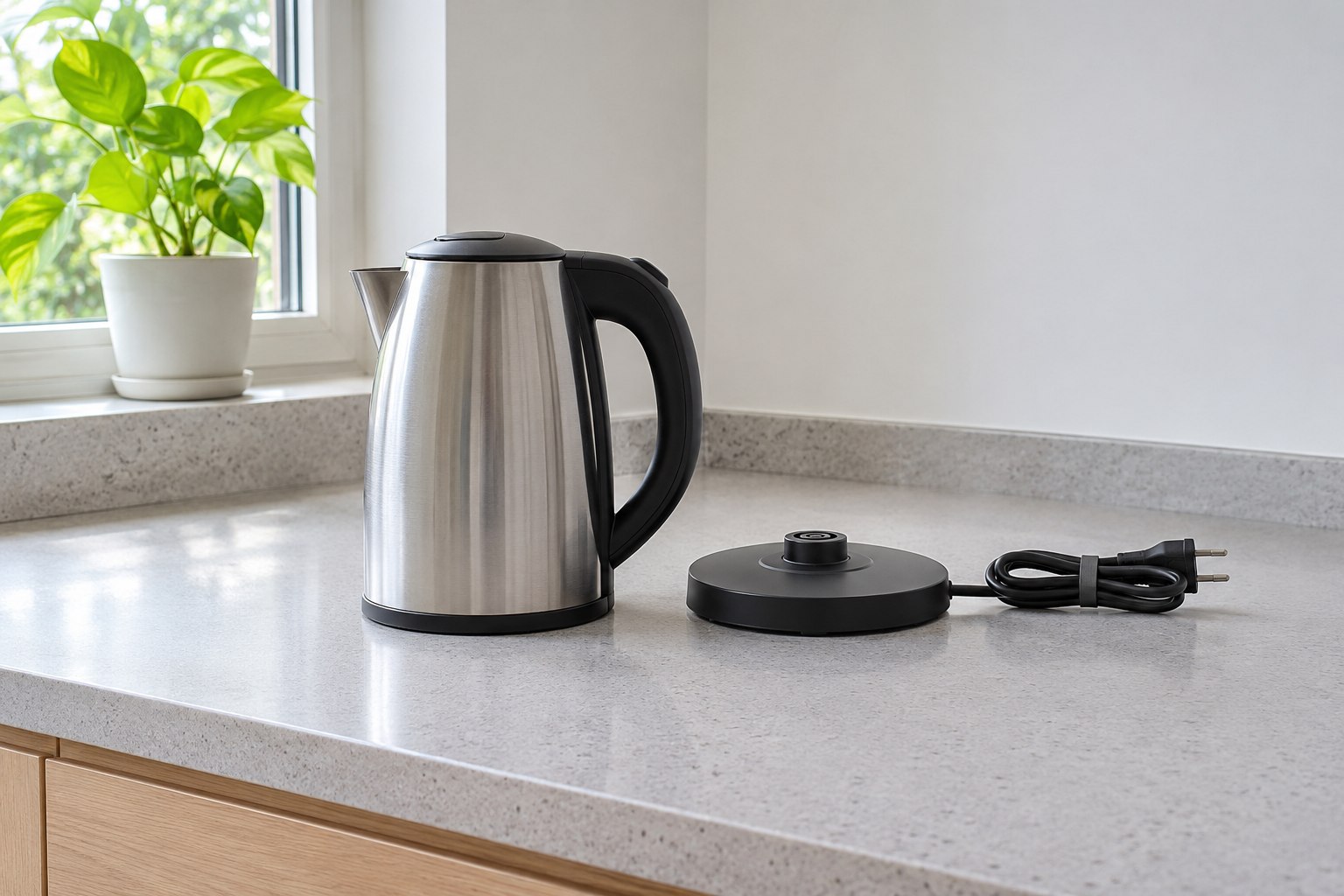
The best electric kettle storage spot depends on what happens after you pour. If you make tea every morning and the base has a suitable outlet and a clear, dry counter, leaving the kettle there unplugged may be easier than putting it away. If you use it only occasionally, an accessible shelf can work once the kettle is empty, fully cool and dry. In either case, decide where you can actually boil water before buying a kettle that fits beautifully in a cabinet.
Follow a Mug From the Sink to the Table
Set an empty mug where you usually prepare a drink. Where would you fill the kettle? Where would you lower it onto its base, grasp the handle and pour into that mug? You need a clear spot for the cup as well as the base. If the cup has to sit in the sink or at the front edge of a crowded counter, a narrow kettle alone won’t fix the layout.
Look up the placement instructions for the model under consideration. For example, the OXO Cordless Glass Electric Kettle booklet calls for a dry, level surface well away from the counter edge, with space above and around the kettle. It specifically says not to use this model under cabinetry. A shelf could therefore be an excellent home for this kettle when cold and a poor place to turn it on. Sliding it forward a little is not a solution if it ends up near the edge or still under the cabinet.
Measure the Parts Your Hand Has to Pass
Check the full height with the vessel seated on its base, and the width from the tip of the spout to the back of the handle. Then measure the cabinet opening, not just its roomy interior. A face frame, low shelf lip or large hinge can change what you can carry straight through the doorway. If the shelf is adjustable, ask what would lose its spot if you move it. A small appliance that displaces your everyday plates may belong elsewhere.
For counter use, add room to get your hand comfortably around the handle and lift the vessel straight off the base. Check how the lid opens at the sink. A broad opening may help with filling, but it does little good if the raised lid collides with a low faucet. If you prefer to fill from a pitcher, leave enough room to tip the pitcher without wetting the plugged-in base. For the OXO model, fill the kettle off its base, between the marked minimum and maximum levels.
| Routine | Where it waits | What could rule it out |
|---|---|---|
| Tea every morning | Upright on its unplugged base at a suitable counter spot, if permitted. | Upper cabinets cover the only boiling spot, or the cord crosses the sink. |
| Tea a few times a week | On an easy-reach shelf after emptying, cooling and drying. | No room to lift the kettle out without moving a stack of dishes. |
| Shared prep counter | Boil in a permitted location and reserve that spot through cooldown. | A roommate needs the same spot as soon as the water is poured. |
| Occasional guests | Keep the cold kettle and its own base together in a reachable cabinet. | The cabinet is usable but there is no suitable outlet at the operating spot. |
“Cordless” Still Leaves a Plug to Place
On a cordless-base kettle, the vessel lifts away for pouring, but the base plugs into the wall. Before ordering, find the cord length for the exact model. Lay a piece of string along the route from the proposed base position to the outlet. Measure around the backsplash corner if that is where the cable actually has to go. Reject a route that hangs over the front edge, touches a hot surface or passes where someone could snag it while pulling out a drawer.
Read the electrical label rather than judging by the size of the kettle. OXO’s US booklet specifies a 110V/120V outlet and a 1,500-watt kettle. It directs the user to plug the kettle into its own wall outlet and not use another high-wattage appliance on the same circuit. Two receptacles on different walls do not establish that you have separate circuits. If the circuit serving the spot is uncertain, ask the property manager or a qualified electrician before choosing a setup that depends on running appliances together.
Electric Kettle Storage Starts After Cooldown
Automatic shutoff is not the same as being ready for storage. In the OXO instructions, the after-use steps include unplugging the power cord and emptying excess water. Use the handle, keep the lid closed when pouring, and pour slowly. Leave the kettle on a suitable stable surface while it cools. OXO calls for complete cooling before storage; it does not give a universal number of minutes for putting a kettle away. Don’t free up prep space by lifting a still-hot kettle into a crowded cupboard.
Once cool, follow the cleaning instructions and dry the kettle. For the OXO example, rinse the interior, wipe the exterior, and keep the power base, plug and cord out of water. The booklet permits storing the vessel upright on its own base, with the cord wound into the wrap underneath and nothing stacked on top. If a different model has no wrap, check its manual rather than winding the cord tightly around the handle. When shopping online, a photo of the underside can be more informative than a picture of the kettle beside a teacup.
Buy for the Morning You Actually Have
If your cutting board needs exactly the same strip of counter as the kettle, picture them there together at breakfast. You might keep the kettle if you normally make tea before starting food prep and have room to leave it while it cools. If you put the cutting board down immediately after pouring, cupboard storage alone won’t resolve the conflict. Try reassigning daily and occasional kitchen tools before buying a stand or cart to hold another appliance.
For an occasional tea drinker, check the minimum fill marking as well as maximum capacity. A large vessel may fit the shelf yet ask you to heat more water than you want for a single cup. Conversely, if you serve a full table, consider whether you can comfortably lift and pour the amount you expect to use. Favor a kettle that suits those ordinary tasks over one with extra settings but an inconvenient handle or base. If putting it away is part of your evening kitchen reset, give it a shelf you can reach without rearranging dinnerware.
FAQ
Can I store a cordless kettle on its power base?
Yes for the OXO model discussed here: its instructions allow upright storage on the base once unplugged, cool and clean. For another kettle, check the storage section. Keep the correct base with the vessel, particularly if you own more than one kettle.
Can I keep the kettle in an appliance garage?
Cold storage and boiling are separate decisions. Measure the opening and check the manual for storage position. If the kettle cannot operate under cabinetry, take it out to an approved open spot before plugging it in; opening the garage door is not equivalent.
Do I need to leave water inside for the next cup?
Not for the OXO example. The maker says to empty excess water when finished. Refill within the marked range the next time you use it. That makes the routine independent of guessing how much water was left yesterday.
Can I store cups inside the empty kettle to save space?
Keep the interior clear instead. A mug can knock against the glass or interfere with a removable filter, and you would have to remove it before every fill. Group cups on an adjacent shelf rather than inside the kettle or balanced on its lid.
Sources and fact-checking
Sources checked November 19, 2026. This is a research-based guide, not a hands-on product test.
The OXO Brew Cordless Glass Electric Kettle instruction booklet (PDF) documents the example in this guide. Pages 2 and 3 cover placement and cord precautions; pages 8 through 11 cover the outlet, emptying, cooling, cleaning and storage. Check your own model’s instructions rather than transferring its power rating or placement rules to another kettle.



댓글 0
첫 댓글을 남겨보세요.