
Steam Mop for Vinyl Floors: Check the Floor Maker First
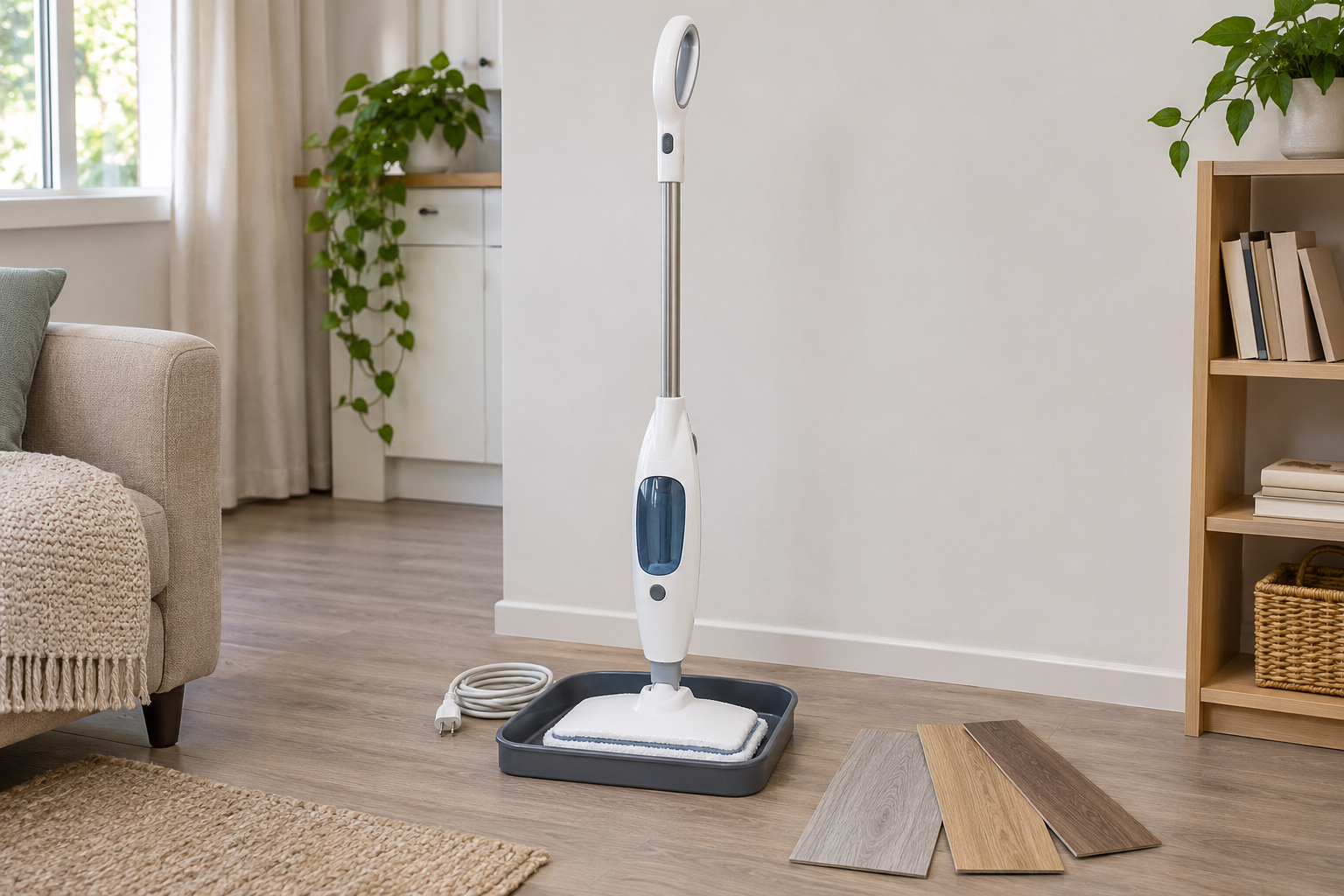
Do not buy a steam mop for vinyl floors until you have the care instructions for the exact flooring product. A mop maker’s broad vinyl claim does not establish that your floor permits steam. Karndean’s US guidance does not recommend steam mops or steam cleaners, while COREtec says to avoid steam unless the flooring manufacturer’s cleaning guidelines specifically approve it. For an unidentified rental floor, use its approved non-steam method while you obtain the details.
Identify the floor, not just the wood-look pattern
A printed wood appearance does not tell you whether the surface is vinyl, laminate, engineered wood, or something else. Even within vinyl, installation systems and care instructions differ. Ask the property manager for the manufacturer, collection, product number, and care sheet rather than relying on a verbal description such as waterproof plank.
Look for records from installation, an extra carton, or documentation already supplied with the apartment. Do not lift an installed plank or pry at a seam to identify the product. If the manager cannot identify it, ask what cleaning method they authorize and keep that answer with your rental records.
The practical point is simple: you are trying to select a cleaning method, not prove which floor looks most like a product online. A matching photograph is not sufficient evidence for steam approval.
Two permissions must agree
The floor’s instructions determine whether steam is permitted on that installation. The appliance’s instructions determine where and how the steam mop may be operated. You need both. If either rules the combination out, do not proceed.
A setting labeled low or delicate is not a universal exception to a floor’s no-steam guidance. Nor does a hidden-area test grant warranty approval. Testing can reveal an immediate visible problem, but the absence of one does not establish the long-term compatibility of a prohibited method.
In its US care FAQ, Karndean recommends a soft broom, damp mop, and pH-neutral cleaner and says it does not recommend steam equipment. COREtec’s US LVP cleaning guide says to refrain from steam mopping unless that method is specifically approved in the manufacturer’s cleaning guidelines. These statements support a permission-first decision, not a claim that every vinyl product has identical rules.
Use this approval table before shopping
| What you know | Purchase decision | Next useful step |
|---|---|---|
| Exact floor guide prohibits steam | Do not buy steam for this floor | Choose a permitted damp-mopping setup |
| Floor product is unidentified | Do not assume steam compatibility | Request product and care records |
| Floor guide explicitly allows specified steam use | Check the exact appliance and restrictions | Save both manuals and follow the narrower conditions |
| Mop listing says suitable for vinyl | Insufficient evidence on its own | Read the floor manufacturer’s guide |
| Floor has loose seams or visible damage | Pause aggressive cleaning | Document and report condition before treatment |
Waterproof is not a cleaning instruction
Waterproof describes a product claim under defined conditions. It does not independently approve every combination of heat, moisture, cleaner, and dwell time. Do not convert a marketing description into permission for an appliance the care guide excludes.
Also avoid claiming a particular outcome after one accidental use. A floor may look unchanged, or it may show a problem; neither observation alone establishes what happened beneath it. If you have already steamed an uncertain floor, stop, let it cool and dry normally, photograph any change, and contact the floor maker or property manager.
Do not try to flatten lifting edges with extra heat, scrape a softened surface, or glue a rental-floor seam as a cleaning fix. Such work is a repair decision. Record the condition using the same careful approach described in the rental photo checklist so the discussion is based on clear information.
Build a smaller non-steam cleaning kit
For a floor whose instructions permit it, start with a suitable broom or dust mop, a washable flat-mop pad, and the recommended cleaner. COREtec advises removing dirt with a broom, dust mop, or vacuum without rotating beater bars, then using a damp mop for residue. Match those directions to the actual floor rather than transferring them blindly to another brand.
Measure the narrowest place you need to reach: beside the toilet, under a cabinet toe kick, or between a table leg and wall. A large mop head can be efficient in an open room but awkward in a tight bathroom. Check the handle’s stored height and whether the pad is easy to remove without touching the dirty surface.
Choose enough washable pads to avoid depending on a single dirty one. Check laundering instructions and whether replacements are sold separately. Include a place to dry used pads before storage. The machine you do not buy may save space, but only if the alternative kit also has a realistic home.
Use less guesswork with the cleaner
Follow the floor maker’s recommended product and the cleaner label’s dilution. More cleaner is not necessarily a stronger approved method. A dull or sticky-looking surface can need diagnosis rather than another dose of detergent.
COREtec advises against products containing detergent, vinegar, wax, citrus, or floor polish in the cited guide. That is why a homemade vinegar mixture should not be treated as a universal vinyl-floor solution. Read the particular care sheet before using a household recipe.
Keep supplies labeled and separate from food storage. Use the under-sink storage plan to preserve access to plumbing and contain bottles, but do not crowd damp pads into a closed space. Follow safety warnings for children and pets and keep people off a damp surface as appropriate.
If your exact floor does allow steam
Save the written approval and identify every condition it includes. Check the allowed appliance type, pad, settings, movement, and any exclusions for damaged or recently installed flooring. Do not invent a dwell time from another product’s sanitizing claim.
Read the mop’s power, filling, cooling, and storage instructions before buying. Verify the cord can reach the permitted work area without an improvised arrangement. Make room to cool the appliance where people cannot touch hot components or trip over the lead.
For a mixed-floor apartment, mark where the approved method changes. A tool that is permitted in one room is not automatically suitable across the next doorway. If switching tools is more work than ordinary damp mopping, the steam mop may not be worth its storage space.
FAQ
Does a sealed vinyl floor automatically allow steam?
No. Sealed is not a substitute for the exact flooring care instructions. Check written approval for the product.
Will one steam-mop use definitely ruin vinyl?
A definite outcome cannot be established from that fact alone. Stop using steam on an uncertain floor and document any visible change.
Can I rely on the steam mop’s sanitizing claim?
Not to override flooring restrictions. Any appliance claim has its own test conditions, which may be unsuitable for your floor.
What if my landlord says only that the floor is waterproof?
Ask for the manufacturer and care sheet or an approved cleaning method. Waterproof alone does not answer the steam question.
Sources and fact-checking
Checked November 19, 2026: Karndean US FAQ and COREtec US LVP cleaning guide (both HTTP 200; full pages read). This is a care-compatibility guide, not a hands-on appliance review or a determination of warranty coverage for your installation.


댓글 0
첫 댓글을 남겨보세요.