
Clothes Steamer for Small Apartment Living: Fit the Full Routine
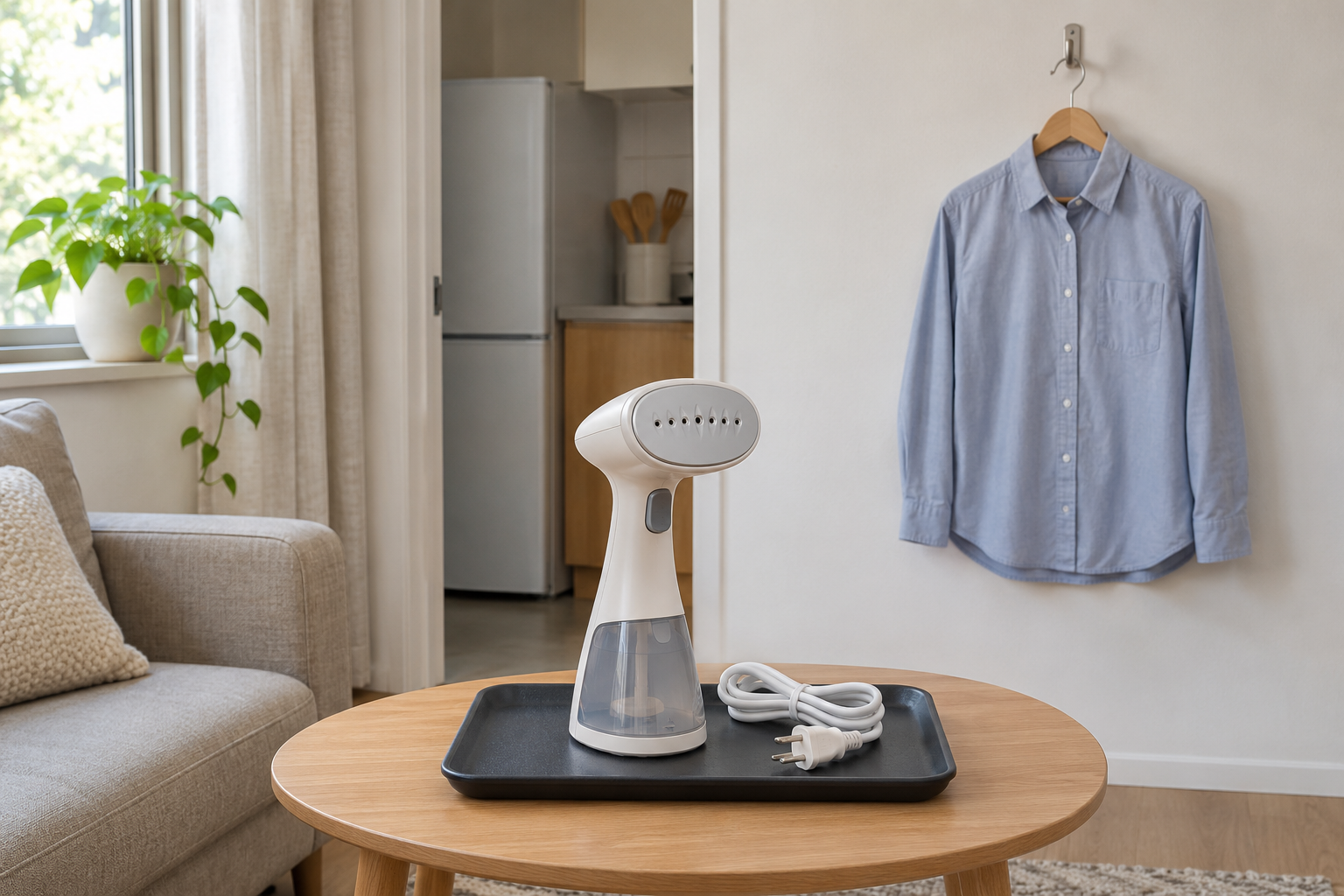
A clothes steamer for small apartment living should fit three places: the spot where you use it, a protected place where it cools, and its final storage shelf. A compact handheld model may suit occasional wrinkle touch-ups, but it still needs a suitable hanging arrangement and an outlet within approved reach. If you cannot provide those, a small folded appliance can be inconvenient despite its modest dimensions.
Start with the clothes you actually wear
Look at your normal week. Are you smoothing a single shirt before work, refreshing a permitted garment after storage, or preparing a large batch of structured clothing? The first job may suit a handheld unit. The last deserves a closer comparison with an iron, an appropriate professional service, or a larger garment-care setup.
Read garment care labels before treating steam as a universal shortcut. Trims, prints, linings, and coatings can change the decision even when the main fabric looks familiar. If the label or maker excludes the treatment, do not use a hidden-area test as permission to ignore it.
Steaming also is not the same task as laundering. Do not assume wrinkle treatment removes a stain or makes dirty clothing ready to put away. Keep washing and put-away steps in your small-space laundry flow rather than allowing the steamer to become a holding area for unresolved clothes.
Lay out a station without drilling
Pick a sturdy hanging point that supports the garment and allows comfortable access. Include the length of a dress or trouser leg rather than planning only for a short shirt. Keep the working area clear of people, pets, cords, and objects that should not receive heat or moisture.
A door hook looks convenient, but check both the hook’s fit and the surface behind the garment. The Conair GS36 instructions specifically caution against damaging a door with steam. A rental door’s finish is not something to test casually.
A suitable freestanding arrangement can avoid a permanent alteration, though it uses floor space. If you consider a folding drying rack, verify that it is stable and appropriate for the garment and the steamer’s instructions. A rack designed only for lightweight drying may not be a suitable steaming station.
Match the design to the whole session
| Design or feature | What it can simplify | What still needs checking |
|---|---|---|
| Compact handheld | Occasional single-garment work and shelf storage | Filled weight, wrist comfort, cooldown spot |
| Folding handheld | Smaller stored shape | Handle lock and dimensions when open |
| Larger standing unit | A dedicated garment-care session | Tank access, hose storage and permanent footprint |
| Removable tank | Filling without carrying the whole appliance | Grip, opening size and secure reattachment |
| Continuous-steam control | Less trigger holding on some models | Safe stopping and handling instructions |
| Included accessory | A specific garment-care task | Approved fabrics and attachment cooldown |
Check outlet reach before choosing wattage
Trace the lead from the outlet to the working position with the garment hanging. Allow for your hand movement rather than stretching the cable tight. Do not plan around an extension cord unless the exact instructions permit one.
The cited Conair GS36 manual prohibits extension cords. It also advises against operating another high-wattage appliance on the same circuit to reduce the likelihood of overload. Those directions matter in an apartment where the convenient outlet may share a circuit with other equipment.
A nearby outlet is not necessarily on a different circuit. If the intended setup causes trips or you are unsure about electrical conditions, do not solve the problem with adapters or repeated resets. Ask building maintenance or a qualified electrician as appropriate. Choose a different location or routine when the approved connection cannot work.
Check the actual US model’s voltage and instructions as well. A product promoted for travel is not automatically appropriate for every electrical supply. Do not infer compatibility from a plug shape or a marketplace title.
Hold the filled appliance in mind
Compare the weight as used, not just the empty body. Water and accessories add to what your wrist supports. If possible, evaluate the grip and balance without treating a brief empty-unit lift as proof of comfort through a session.
Tank capacity creates a trade-off rather than a simple bigger-is-better ranking. A small tank can mean more refills; a larger one can add weight. Manufacturer runtime depends on its stated conditions, so do not convert a tank volume into a guaranteed number of shirts.
Check the fill opening and cap arrangement. Can you remove and reinstall the tank without spilling near electrical parts? Can you read the fill line? Can you obtain the type of water the manual specifies without adding a supply that has nowhere to live?
Use the manual’s method, not a viral shortcut
The GS36 instructions call for distilled water and unplugging before filling or emptying. They also say never to steam clothing while someone is wearing it and not to put a hand in front of the steam. Follow the instructions supplied with your own model if they differ in design or operation.
Hang the garment rather than holding it against your body. Keep hands away from the steam path. Do not assume a glove or accessory makes every hand position acceptable. Test an inconspicuous area as directed and stop if the material reacts poorly.
Conair’s GS36 method calls for keeping the unit moving and about one inch from the item. That distance is model-specific guidance, not an instruction for every steamer or an invitation to press a steam head against an unknown fabric. Consult the exact manual for attachments, orientation, and contact rules.
Reserve the cooldown footprint
A steamer may be small enough for a drawer only after it is fully cool. Identify a stable permitted resting place before you turn it on. Do not place a hot nozzle on a painted surface, soft furnishing, or its own cord.
The GS36 manual says to let the unit cool completely before storage and not to store it with water. It also calls for coiling the cord loosely rather than wrapping it around the unit. Folding the handle does not eliminate these steps.
Leave time for the garment to be ready for storage under its care instructions too. A morning routine that requires immediate appliance packing and rushing a treated item into a crowded closet may not suit the process. An evening session can be easier to accommodate when the working area is shared.
Buy only the accessories that solve a real problem
Add the price of required water supplies, compatible attachments, and a suitable hanging arrangement to the appliance price. Check replacement-tank availability and the warranty documents. Do not buy a large accessory bundle merely because it makes the package look better value.
The right clothes steamer for small apartment use is one that fits your garments and your full routine. If you mostly need crisp pressing, have nowhere suitable to hang clothes, or cannot leave a hot appliance undisturbed to cool, a handheld steamer may be the wrong purchase.
FAQ
Can I steam a shirt while wearing it?
No. The cited Conair instructions expressly prohibit steaming clothing worn by you or another person because of burn risk.
Can I use an extension cord in a small apartment?
Follow the exact manual. The GS36 instructions prohibit extension cords, so choose an approved outlet location instead.
Does a folding handle mean I can pack it immediately?
No. Let the appliance cool fully and complete the emptying and storage steps before folding or packing it as instructed.
Will a steamer replace my iron?
Not for every garment or desired finish. Compare your care labels and need for structured pressing rather than assuming the two tools are interchangeable.
Sources and fact-checking
Checked November 19, 2026: Conair GS36/GS36X US instruction booklet (HTTP 200; both PDF pages extracted and read). The booklet is an existing manufacturer manual, not a claim of a newly released model. Instructions quoted apply to that family; verify the booklet supplied with any purchase. No hands-on experience, universal fabric safety, or sanitizing outcome is claimed.


댓글 0
첫 댓글을 남겨보세요.