
Furniture Sliders for Hard Floors vs. Carpet: Match the Pad
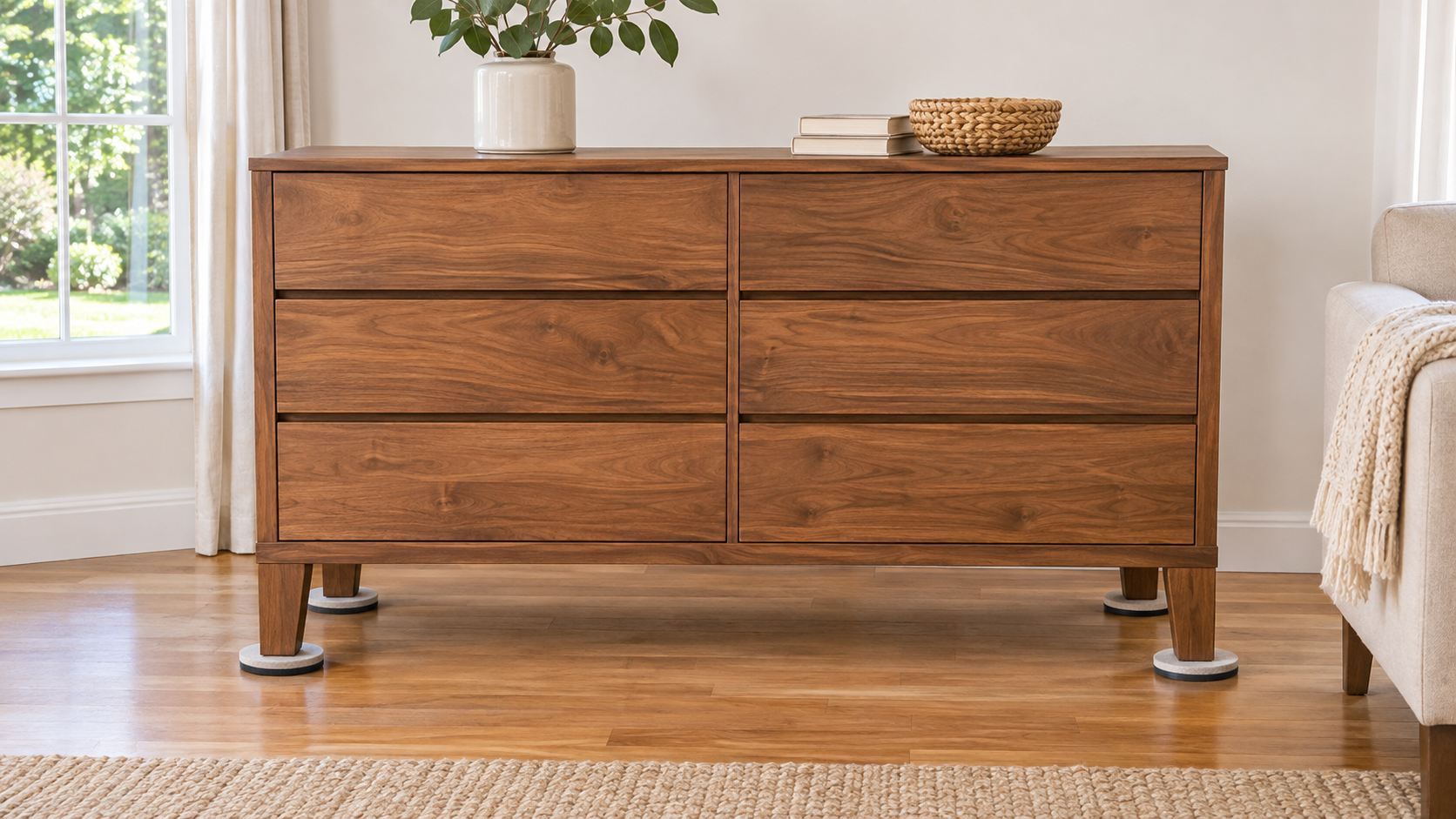
The comparison question “furniture sliders hard floor vs carpet” is a surface-matching question before it is a moving question. Start with the manufacturer’s stated floor category, then inspect the furniture’s feet, the condition of the floor or carpet, and the whole route. Expanded Technologies says its Slide-All felt versions are designed for hard floors and its plastic versions for carpet. That naming is a useful starting point, not a promise that any slider will prevent marks, dents, snags, or damage on every floor, rug, furniture leg, or load.
Choose a slider only after you can identify what touches the floor. A broad, flat furniture foot gives a pad a different contact area than a small angled leg, a wheel, a broken glide, or a leg with an uneven bottom. The important decision is whether the slider can sit centered and stable under every contact point while the item remains controlled. If it cannot, do not force the move by adding a mismatched pad or pulling harder.
Furniture sliders hard floor vs carpet: make the surface match
Hard flooring is not one material. Wood, laminate, vinyl, tile, stone, and a finished floor with a rug each have different manufacturer care instructions and different conditions. Read the floor maker’s guidance first, especially for a new finish, a damaged area, or a surface with seams or transitions. Then read the slider package or product page for its stated intended surface.
The maker’s Slide-All page distinguishes felt versions for hard floors from plastic versions for carpet. The distinction tells you which product category the maker assigns to each surface; it does not establish that the product is suitable for every subtype of hard floor or every rug. Avoid treating a hard-floor slider as a blanket approval for a delicate finish, or a carpet slider as a tool for crossing a threshold, stair, or loose runner.
| Decision point | What to verify | Reason to stop or change plan |
|---|---|---|
| Hard floor | Floor maker’s care guidance; a slider specifically labeled for hard floors; clean, dry contact area | Loose finish, grit, moisture, or uncertain compatibility |
| Carpet or rug | A slider labeled for carpet; pile, backing, edge, and transition condition | Loose rug, curled edge, snag risk, or change in level |
| Furniture foot | Flat, sound contact surface and enough slider area under each point | Damaged, tapered, wheeled, or unstable feet |
| Route | Clear, level path from start to finish | Thresholds, stairs, crowded turns, or a path that needs lifting |
Check feet, load, and contact area before placing anything underneath
Do not choose by furniture category alone. A couch, dresser, bed, table, or armchair may have feet that vary in size and shape. Do not improvise a tilt to place sliders under a tall, anchored, or unstable piece. Empty and clear it, then use the furniture and slider instructions or arrange professional help. Follow the furniture maker’s reanchoring directions before the piece returns to use. If the legs flex or the feet cannot be inspected, pause; a slider cannot repair a loose joint or stabilize a wobbly piece.
Count every point that carries the load. The total furniture weight is not a substitute for checking how that weight is distributed. A piece may appear to rest on four corners while a center leg, caster, or uneven floor transfers part of the load elsewhere. Do not assume a package’s “heavy furniture” language supplies a load rating for your layout. Use only a stated rating that applies to the exact product and setup, and do not convert a number from another slider, furniture pad, or moving device into an approval.
Clean both the floor and the bottom of the feet before placement. Small grit, staples, or debris can change the contact and can be dragged along with the furniture. Confirm that an adhesive product is permitted for the furniture finish and is fully seated according to its instructions. Adhesive attachment is not a guarantee against release, residue, or finish change. When the furniture will be used in place after moving, follow the product directions on whether sliders should remain attached.
Measure the route, not just the room
A slider can make a controlled adjustment across a continuous level area; it does not make a bulky item safe to pull through every part of an apartment. Walk the intended route before moving. Remove small objects, cords, pet bowls, and loose rugs. Measure the narrowest turn, check that doors can be managed without trapping the furniture, and identify any change in flooring. A threshold is a separate handling problem, not a reason to keep pulling.
Keep the move short and deliberate. Follow the furniture and slider instructions for any approved move; do not pull on drawer pulls, legs, or removable parts. Keep people clear of the direction of travel and never position anyone where the item could trap a foot or hand. Do not slide furniture on stairs. Stop before a stair, a change in level, a damaged floorboard, or a rug edge, then choose a different handling method or get qualified moving help.
Use the product labels as limits, not a damage guarantee
“For hard floors” and “for carpet” are product-use labels, not warranties for a particular floor. A floor’s condition, dirt, foot geometry, furniture weight distribution, and route all matter. Do not say that felt will protect all wood floors, that a smooth base will not snag any carpet, or that a slider makes a heavy item safe for one person to move. Those conclusions require facts the product labels do not provide.
Be especially cautious with freshly refinished floors, loose planks, raised tile, frayed carpet, antique furniture, particleboard legs, and furniture that is already unstable. Ask the floor installer, property manager, or furniture maker when a surface or finish has a specific care requirement. In a rental, document existing floor damage before a move-out rearrangement and do not assume a protective accessory overrides the lease or building rules.
Decide when sliders are the wrong purchase
Skip sliders for a move that includes stairs, an uncontrolled tilt, a narrow turn that forces lifting, or furniture that cannot stay stable over its feet. Do not use them to cross a gap, bridge a threshold, or compensate for inadequate help. A furniture slider is not an appliance dolly and should not be substituted for one. For a route involving a large appliance, read our appliance dolly rental checks before reserving equipment.
For a smaller rearrangement, a slider may be reasonable only if the exact floor category, furniture contacts, and level route all check out. If the route ends at a new apartment, pair that decision with a move-out photo checklist so pre-existing conditions are recorded before furniture moves again.
Common buying mistakes to avoid
- Choosing from a generic “heavy furniture” claim without inspecting the feet and load distribution.
- Using a carpet-labeled slider on a hard floor, or a hard-floor-labeled slider on carpet, because it is already in the closet.
- Dragging grit, a loose rug, or a damaged foot across the route.
- Assuming adhesive means permanent, residue-free attachment on every furniture finish.
- Trying to cross a threshold, stair, or level change without a separate handling plan.
- Calling a surface label a promise that there will be no scratch, dent, snag, or other damage.
FAQ
Are felt furniture sliders for every type of hard floor?
No. Slide-All felt versions are designed for hard floors, but that is not a universal compatibility statement. Check the floor maker’s care guidance, the exact slider instructions, surface condition, and furniture feet.
Can I use carpet sliders on an area rug?
Only if the exact product is labeled for that surface and the rug is stable. Check the rug edge, backing, pile, and any level change; do not use a slider to cross an unsecured rug or threshold.
How do I know if the sliders are large enough?
Inspect every load-bearing contact point and use the exact product’s instructions or rating if one is provided. Do not infer a safe capacity from furniture type, pad diameter, or another brand’s label.
Will sliders guarantee that my floor will not be scratched?
No. No such guarantee is made here. Cleanliness, surface condition, foot shape, load distribution, and the product’s stated use all affect the result.
Sources and fact-checking
Checked against the official sources below on November 27, 2026. This is research-based guidance, not a claim of hands-on product testing.


댓글 0
첫 댓글을 남겨보세요.