
Retractable Clothesline Mounting: Measure Reel and Receiver Fit
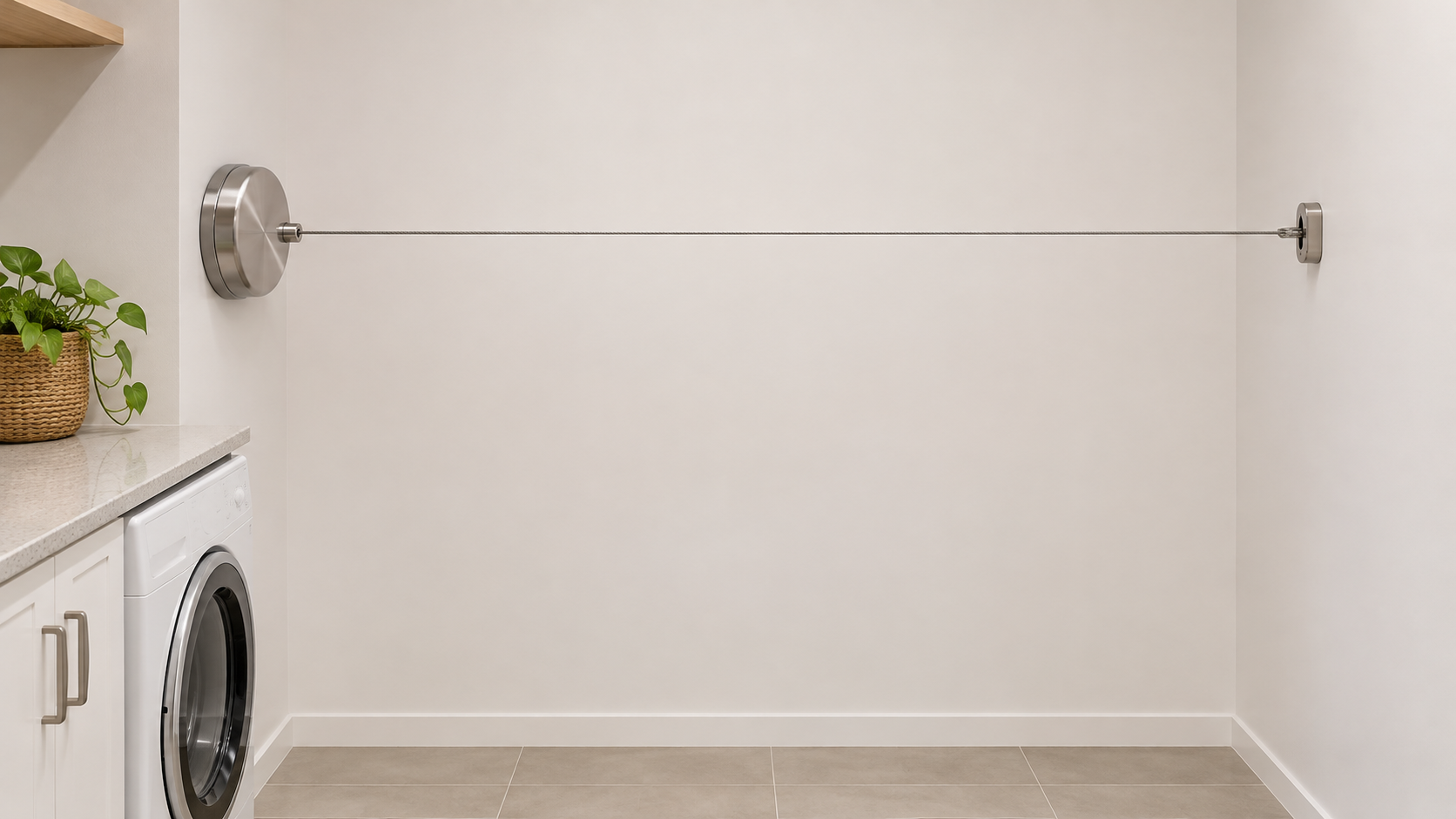
Retractable clothesline mounting for Honey-Can-Do DRY-01101 begins with two wall locations, not a ground stake or a rotary dryer frame. The official US product page describes a compact reel housing with an 8-foot braided nylon line that extends to, and hooks into, an opposing-wall latch. Measure the straight wall-to-wall route for both pieces, get permission for permanent installation, and find the product-specific installation instructions before you buy. Do not transfer mounting, anchor, load, or clearance figures from another clothesline with a different mechanism.
Identify the two parts of this system
DRY-01101 is a reel-and-receiver arrangement. Honey-Can-Do says the line automatically retracts into a stainless-steel and iron housing; the extended line hooks to a latch on the opposing wall. That means the first sketch needs two positions: the reel housing and the receiver latch. A single suitable-looking wall is not enough. Do not plan this as if the product opens arms from one plate, wraps around a post, or connects to a ground anchor.
Write down the proposed reel wall, the opposing receiver wall, the line’s direct path, and every opening or fixture below and beside it. The manufacturer lists the product dimensions as 3.75 inches wide by 3.75 inches high by 96 inches long. The 96-inch figure identifies the stated product length; it is not a published claim about a permitted installation span, line load, mounting height, or clearance around wet laundry. Leave those questions to the model-specific directions and the actual room.
| Check | What to record | Why it matters |
|---|---|---|
| Reel location | Proposed wall and housing position | The line originates at the reel |
| Receiver location | Opposing wall and latch position | The page says the line hooks there |
| Straight route | Wall-to-wall path with doors/windows operated | The line needs a usable connection path |
| Property approval | Written permission for both mounting points | The product is described as permanent installation |
| Documentation | Current model-specific installation directions | The product page does not state wall type, fasteners, capacity, or required clearance |
Measure a realistic room route
Use a tape measure or removable painter’s tape to map a straight route between the proposed housing and opposing latch. Work with nearby doors and windows in their normal positions. Check the route at the height you would use, then check it again from the floor for everyday circulation. The goal is not to create a universal distance rule. It is to determine whether both wall points and the connecting line can exist in the same room without crossing a doorway, exit route, appliance door, cabinet access, or regular path.
The product page names bathrooms, laundry areas, balconies, and dorms as potential places for permanent installation. Those are examples, not an assurance that every surface in those spaces is appropriate. A balcony, for example, may be governed by a lease or building rule; a bathroom may have fixtures and doors that change the available route. Treat the actual layout and written building rules as decisive.
Resolve the permanent-installation question first
Honey-Can-Do describes permanent installation, so a renter should obtain written approval before drilling or attaching either the reel housing or the receiver latch. Ask about both exact locations, not simply whether a clothesline is allowed. Keep the response with the product model, receipt, and current instruction link. A landlord’s approval does not supply technical installation details, and a product listing does not override a lease or building policy.
The official product page I reviewed does not publish a wall-substrate requirement, supplied fastener list, line capacity, or an installation-clearance dimension. Those omissions matter. Do not choose anchors, claim that drywall or masonry is approved, estimate a load, or use a different clothesline’s hardware rule to fill the gap. Before permanent installation, obtain and follow the DRY-01101-specific assembly or installation information through Honey-Can-Do’s manual/support route. If that information is unavailable for your wall and layout, choose a non-permanent alternative instead of guessing.
Use the stated line feature accurately
The listing calls the line braided nylon and says it retracts automatically into the compact housing. Those facts describe the product mechanism; they do not establish how many garments it can support, how taut it should be, or whether a particular item is suitable. Avoid translating “8-foot” into a load claim or a full-laundry promise. Check the manual for permitted use and any care instructions before loading the line.
When measuring, account for the whole use cycle: approach the reel, extend the line, reach the receiver latch, hang and remove items, unhook the line, and allow it to retract as directed. The floor, doorway, and appliance controls should remain usable in that cycle. If the receiver can only be placed across a passage or the line would interfere with a normal door swing, that location fails the practical fit test even if the 96-inch measurement seems close.
Keep this separate from a folding drying rack
A folding rack is freestanding and its key questions are its open footprint, airflow, and storage position. This Honey-Can-Do model instead has a wall-mounted reel and an opposing latch, with permanent attachment at two points. Do not use one product’s measurements to assess the other. If permission is not available or the two-wall path does not work, use the existing folding drying rack footprint and airflow guide as the next decision, rather than treating a rack as an installation substitute.
For a rental, keep permission and product records with the documents you use to manage the tenancy. The lease document checklist can help keep that written approval accessible. It does not approve the installation or replace the product’s instructions.
Buying decision
This reel-and-latch clothesline is worth considering only when you can identify both wall locations, map a clear straight route, obtain permission for permanent attachment, and obtain the exact installation instructions before work begins. It is not appropriate to infer a wall type, a hardware choice, a span allowance, or a load limit from its materials, dimensions, or a different product. A simple freestanding rack is the better choice when those required facts cannot be confirmed.
FAQ
Does DRY-01101 need an opposing wall point?
Yes. The official product page says to extend the line and hook it to an opposing-wall latch.
Is its 96-inch length a confirmed installation span?
No. It is a listed product dimension, not a published clearance, wall-spacing, or load instruction.
Can I use another clothesline’s mounting instructions?
No. A different mechanism is not a substitute. Use DRY-01101-specific instructions only.
Can a renter install it?
Because the listing describes permanent installation, get written approval for both mounting points before drilling or attaching anything.
Sources and fact-checking
Checked against the official sources below on November 27, 2026. This is research-based guidance, not a claim of hands-on product testing.





댓글 0
첫 댓글을 남겨보세요.