
Measure a Mattress for a Moving Bag: Size and Fit
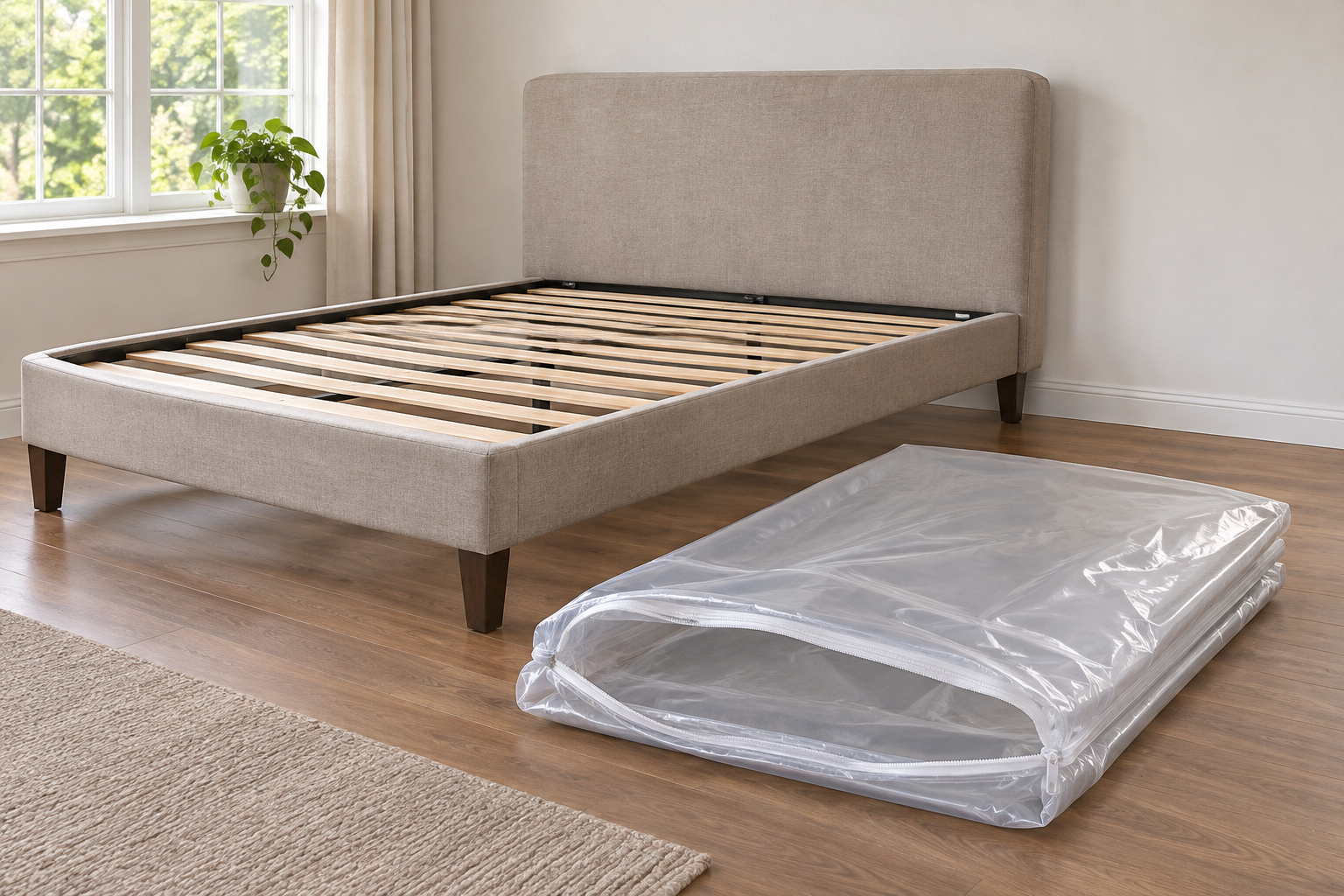
To measure a mattress for a moving bag, record its length, width, and thickness at the highest point, including any topper that will travel with it. That means more than matching “queen,” “full,” or “king” on a package. Measure your mattress’s real length, width, and current thickness, including a topper if it will travel on the mattress. Then compare those measurements with the bag’s listed dimensions and opening location. KleerGuard’s queen pillow-top bag, R502017, is listed at 60 by 17 by 99 inches and fits a mattress up to 17 inches deep. A mattress labeled queen that is thicker than that is not a match simply because its name matches.
Decide whether you need protection for a move, a period of storage, or both. These are not identical claims. The cited KleerGuard bag is described for moving or storage and for protection against dust, spills, and stains. Neither statement turns a plastic bag into a moisture-control plan, a long-term condition guarantee, or a substitute for a dry, appropriate storage environment.
Measure a mattress for a moving bag: record the real dimensions
Remove sheets and measure the bare mattress on a flat surface. Record length, width, and height at the thickest point. Include any permanently attached pillow top. If a removable topper will remain on during the move, measure that combined stack; if it will be transported separately, size the bag for the mattress alone. Do not rely only on the bed frame size, the original retailer label, or a nominal mattress category.
Compare all three measurements with the bag specification, not just the width. A bag can look wide enough lying flat yet have insufficient depth for the mattress thickness. The cited KleerGuard queen listing gives a 17-inch depth boundary. Treat that as a product-specific limit, not a standard for every queen bag or mattress cover. Check the exact current bag listing for another size or brand.
| Measurement or feature | What to compare | Decision if it does not match |
|---|---|---|
| Length and width | Actual bare mattress against bag dimensions | Choose a bag that states compatible dimensions |
| Thickness | Thickest mattress point, including any topper traveling inside | Do not force the mattress into a shallower bag |
| Opening | Which end opens and whether your route lets the mattress enter straight | Choose another bag or a different handling plan |
| Second component | Mattress versus box spring or foundation | Use a separate bag when the product directs it |
Check the opening before you buy
A bag’s closed dimensions do not explain how easily the mattress enters. Look for the location and type of opening. The bag’s product listing may state its entry design; check that detail before purchase because it affects how a mattress can be guided into the bag in a tight bedroom or hallway.
Plan a clean, open staging area large enough to guide the mattress in without dragging it across debris. The move route still needs its own check: door opening, hallway turn, elevator, stairwell, and truck access. Do not wrestle a mattress into a bag in a doorway or at the top of stairs. If the product has a closure method, follow its instructions; do not assume another brand’s tape, seal, or handle method applies.
Keep mattress and box spring decisions separate
One bag is not automatically for an entire bed set. A mattress, box spring, foundation, adjustable base, or slatted platform may have different dimensions and packaging needs. Check the exact bag listing and each component separately. Read the specific item’s instructions instead of treating “box spring” as a catchall for every base.
Separating components also helps prevent a misleading size calculation. A bag sized for one mattress is not made deeper by placing another component inside it. If the second component is damaged, wet, or structurally different, stop and make a separate plan rather than enclosing the pair together.
Choose move protection or longer storage conditions honestly
For a move, the main question is whether the bag fits, stays intact as directed, and can be handled without creating a trip or pinch hazard. For storage, add questions about the storage space itself: is it clean, dry, accessible, and suitable for the mattress maker’s instructions? Plastic around a mattress does not answer ventilation, moisture, pest, support, or duration questions by itself.
Use the mattress manufacturer’s care and storage directions if available. Do not make a health, mold-prevention, waterproofing, or long-term preservation claim from the bag material alone. The cited KleerGuard description identifies 2 mil polyethylene and a scope of protection against dust, spills, and stains; it does not justify broader performance promises in this guide.
Plan the route and handling around the bag
Measure the bagged mattress route before the day of the move. A bag can change grip and visibility, especially around corners. Keep the carrying path clear, do not block an exit, and avoid placing the mattress where it can slide or fall. Do not pull it by thin plastic, use it as a person-carrying sling, or drag it across rough pavement unless the exact product says that is appropriate.
For the wider move sequence, see our four-week apartment moving checklist. If bedding and related items need sorting before packing, the bedding storage system can help separate what travels from what should be laundered, donated, or stored. Neither guide validates a bag size.
Skip these common assumptions
- “Queen” on the bag does not prove it fits a queen mattress with a thick pillow top or topper.
- A bag’s outside dimensions do not replace a check of the actual opening.
- A mattress and box spring do not share one bag when the listing calls for two.
- Move protection does not automatically establish suitable long-term storage conditions.
- A plastic bag is not a handle, a drag sheet, or proof that the route is safe.
- Do not use one brand’s example to size a bag from another brand.
Make a fit record before shopping
Keep the three mattress measurements, the topper decision, and the bag listing together in your moving notes. Take the measurements again if you buy a new topper or change from a box spring to another foundation. The simple record is more reliable than trying to recall a nominal bed size in a store aisle. It also makes it easier to reject a bag that is only close to the required dimensions.
On moving day, inspect the bag before use for tears, missing closure parts, or the wrong size. A damaged or mismatched bag should be replaced rather than patched into a load-bearing solution. Packaging protects the item only within its stated use; it does not remove the need for a clear route and controlled handling.
FAQ
What size mattress bag do I need for a thick queen mattress?
Measure its real length, width, and thickness, then choose a bag whose product listing explicitly accommodates those measurements. The cited KleerGuard queen bag is for mattresses up to 17 inches deep.
Do I need a separate bag for the box spring?
Check the exact bag listing. The cited KleerGuard source does not establish a two-bag rule, so do not assume a single bag covers two components.
Is a mattress moving bag waterproof?
Do not assume that. KleerGuard describes the cited bag as protection against dust, spills, and stains. Check the exact listing and storage conditions rather than calling the bag waterproof.
Can I use a moving bag for long-term mattress storage?
Only after checking the exact bag and mattress-maker instructions and the storage environment. A bag does not by itself establish suitable long-term storage conditions.
Sources and fact-checking
Checked against the official sources below on November 27, 2026. This is research-based guidance, not a claim of hands-on product testing.


댓글 0
첫 댓글을 남겨보세요.