
Appliance Dolly for Apartment Move Planning: Rental Checks
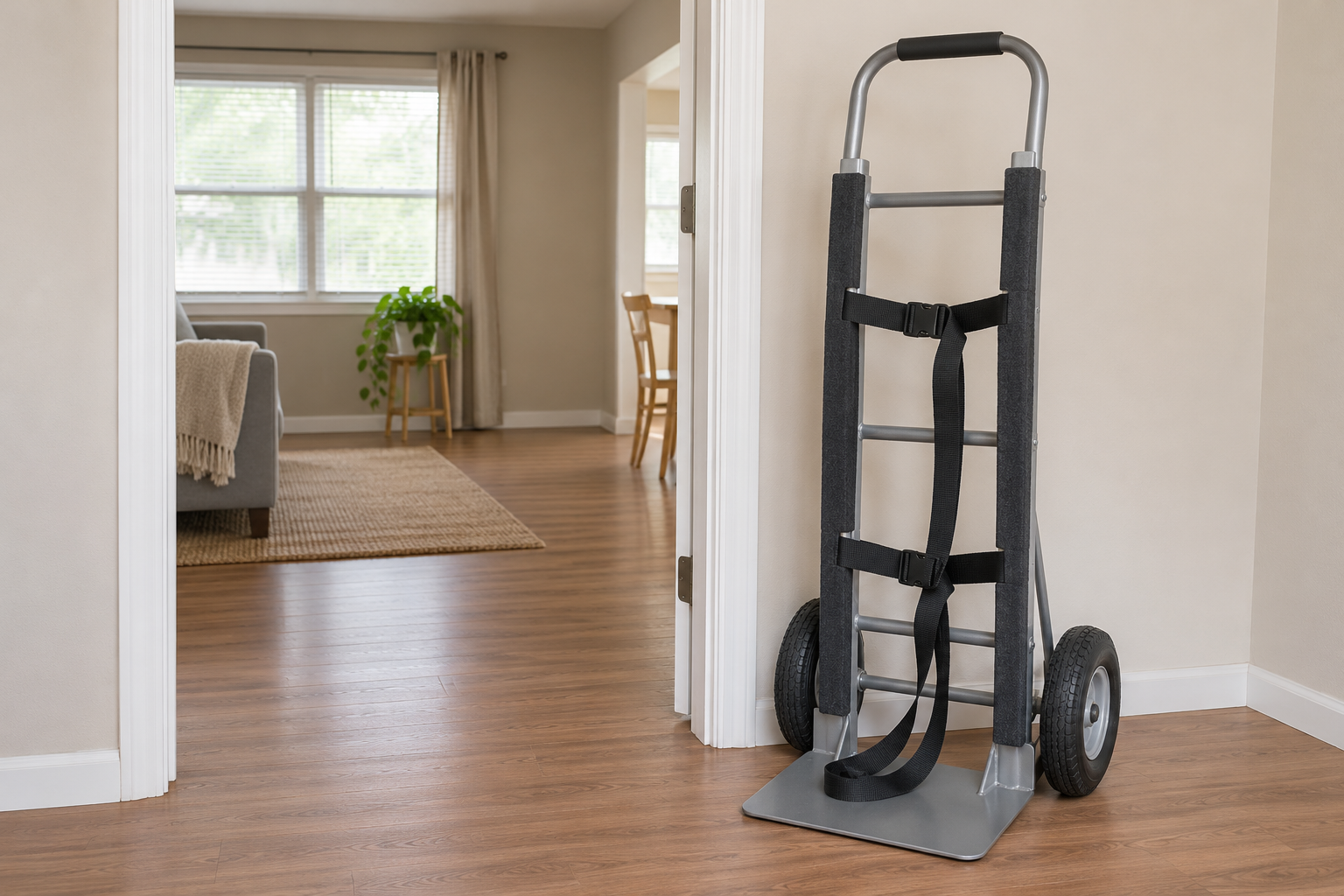
An appliance dolly for apartment move preparation is useful only after you confirm that the appliance is yours to move, the route works, and the equipment suits the actual load. A dolly’s capacity label does not tell you whether a refrigerator will turn through a hallway or whether you can control it on a ramp.
For most renters, the sensible order is permission, appliance instructions, route measurements, then equipment reservation. Reverse that order and you may pay for a rental that never gets past the kitchen doorway.
Confirm ownership and disconnection responsibilities first
Do not move a landlord-owned refrigerator, washer, range or dishwasher without authorization. Ask who handles disconnection and reconnection, whether building staff must be present, and whether a professional is required. A transport tool does not qualify someone to disconnect gas, hardwired electricity or plumbing.
Find the appliance model number and download its moving or installation instructions. Look for transport orientation, required preparation, loose-part protection, approved handling points and any restart requirements. A washer may need model-specific transport preparation; a refrigerator may have restrictions different from another refrigerator of similar size.
Keep these details with your building access rules in a moving organizer. Having the manual available at pickup is more useful than remembering a general tip from a video.
Measure the route as a series of turns
Record appliance width, depth, height and documented weight. Include protruding handles and any parts that may be removed only as the manual permits. Then measure the usable opening at each door, not the decorative frame width.
Walk the entire route at both addresses: kitchen exit, interior hall, apartment door, elevator, lobby, loading point and destination room. Look for door closers, thresholds, low lights, sharp turns and a landing too small to rotate a loaded hand truck. Check the equipment’s own dimensions and the clearance needed when it is tilted into its operating position.
GE’s official refrigerator moving instructions specifically advise measuring doorways, entryways, halls and corners at both locations. A straight-line doorway measurement alone is not a complete route check.
Ask the building about elevator reservations, interior dimensions, capacity, padding requirements, loading hours and approved floor protection. Do not assume an elevator described as a service elevator can accept every appliance and crew combination.
| Option | Potential fit | What can rule it out |
|---|---|---|
| Utility hand truck | Loads within its intended design | No appliance restraint, unsuitable frame or inadequate capacity |
| Appliance hand truck | An appliance the exact model is intended to carry | Poor straps, wrong load geometry or incompatible route |
| Furniture dolly | Suitable items supported on a platform | No controlled method to tilt or secure a tall appliance |
| Professional appliance movers | Complex access, heavy loads or specialized preparation | Confirm scope, building approval and disconnection responsibilities |
Reserve the exact equipment, not just “a dolly”
Ask the rental counter for the specific model, rated capacity and operating instructions. Compare the appliance’s documented weight with the equipment’s limit, including any accessories as directed by the rental provider. Do not use a generic online capacity claim as the specification for the unit handed to you.
Confirm whether restraints and protective rails are included, how the strap locks and releases, and what the provider allows on slopes or stairs. A stair feature in a product description is not a guarantee that your crew can handle a loaded appliance on your building’s staircase.
Ask about reservation availability, pickup and return times, late charges, taxes, deposits and whether the equipment must return to the same location. Compare the actual local quote with the time and storage cost of buying. This guide does not assume a nationwide rental price.
Make pickup an equipment inspection
Inspect the frame, toe plate, wheels, axle, padding, strap and locking mechanism with the rental staff. Look for damaged parts, frayed webbing, missing pieces and wheels that do not roll normally. Ask for a demonstration if you cannot identify how the restraint is secured.
The OSHA material-handling eTool identifies poorly functioning wheels and awkward postures as handling concerns. It also discusses using elevators or ramps to avoid stairs and uneven ground. This is workplace guidance, not an approval of a particular residential moving plan, but it reinforces why equipment condition and route choice belong in the preparation stage.
Do not take damaged equipment because your elevator slot is about to start. Resolve the defect or change the moving arrangement. Photograph the rental condition if the provider permits it and keep the agreement accessible.
Follow appliance-specific handling, not a universal tilt rule
GE advises trucking its refrigerators from the side, since loading from the front or rear may cause damage. Its moving guidance also distinguishes refrigerator types: some must remain upright during transport. That is a reason to check your own appliance instructions, not to apply one manufacturer’s rules to every appliance.
Secure loose shelves and parts as directed and protect the exterior with an appropriate covering. Have the rental provider explain the correct restraint arrangement. Do not place a strap across a delicate control or handle simply because it is the easiest height to reach.
This article is a preparation checklist, not a substitute for training in loading, stairs or ramp handling. If you lack suitable help, cannot maintain control, or cannot follow the equipment instructions within the route, arrange professional service. No capacity margin makes an uncontrolled load acceptable.
Plan arrival before the truck leaves
Make sure the destination space is ready and the receiving building knows the schedule. Keep walkways clear and protect surfaces using building-approved methods that will not create a loose, slippery layer.
Check the manufacturer’s restart and reconnection instructions. GE’s refrigerator guidance ties some waiting requirements to how the refrigerator was transported; it does not justify one universal waiting period for every model. Do not plug in a moved appliance based solely on a rule remembered from another move.
Use the four-week apartment moving checklist to book access and help early enough that equipment pickup is not the first time anyone reviews the route.
FAQ
Can I substitute a furniture dolly for an appliance hand truck?
Only if the equipment is intended for that load and the full handling method is appropriate. A flat platform and a strapped appliance hand truck are not automatically interchangeable.
Does a high capacity mean I can move an appliance alone?
No. The equipment rating is not a rating of your strength, balance or ability to control the load. Arrange suitable help or professional movers.
Should I remove refrigerator doors to make it fit?
Only follow the exact manufacturer procedure and obtain any required owner approval. Door removal may involve connections or alignment work beyond a simple unscrewing task.
Can I keep the dolly inside the rental truck overnight?
Check the rental agreement, securement instructions and return deadline. Do not assume the truck rental and equipment rental have identical terms.
Sources and fact-checking
Reviewed November 19, 2026. GE refrigerator moving guidance supports the refrigerator-specific examples. OSHA’s pushing, pulling and carrying guidance supports the handling-hazard discussion. Neither source establishes a universal appliance weight limit, rental price or safe residential stair procedure. No rental equipment was tested.






댓글 0
첫 댓글을 남겨보세요.