
Door Draft Stopper for Apartments: Measure Before You Buy
A door draft stopper works only when it matches the gap, the door, and the floor beneath it. A thick model can drag, block a latch, or prevent a fire door from closing, while a thin model may leave most of the draft untouched. The useful buying question is not which stopper looks warmest. It is which design can move safely with your exact door.
For an apartment, begin with a removable option and treat adhesive or screw-mounted sweeps as a lease question. If the draft seems to come from the sides or top rather than the threshold, a bottom stopper may not solve the actual leak. This guide separates the main designs and shows what to measure before buying.
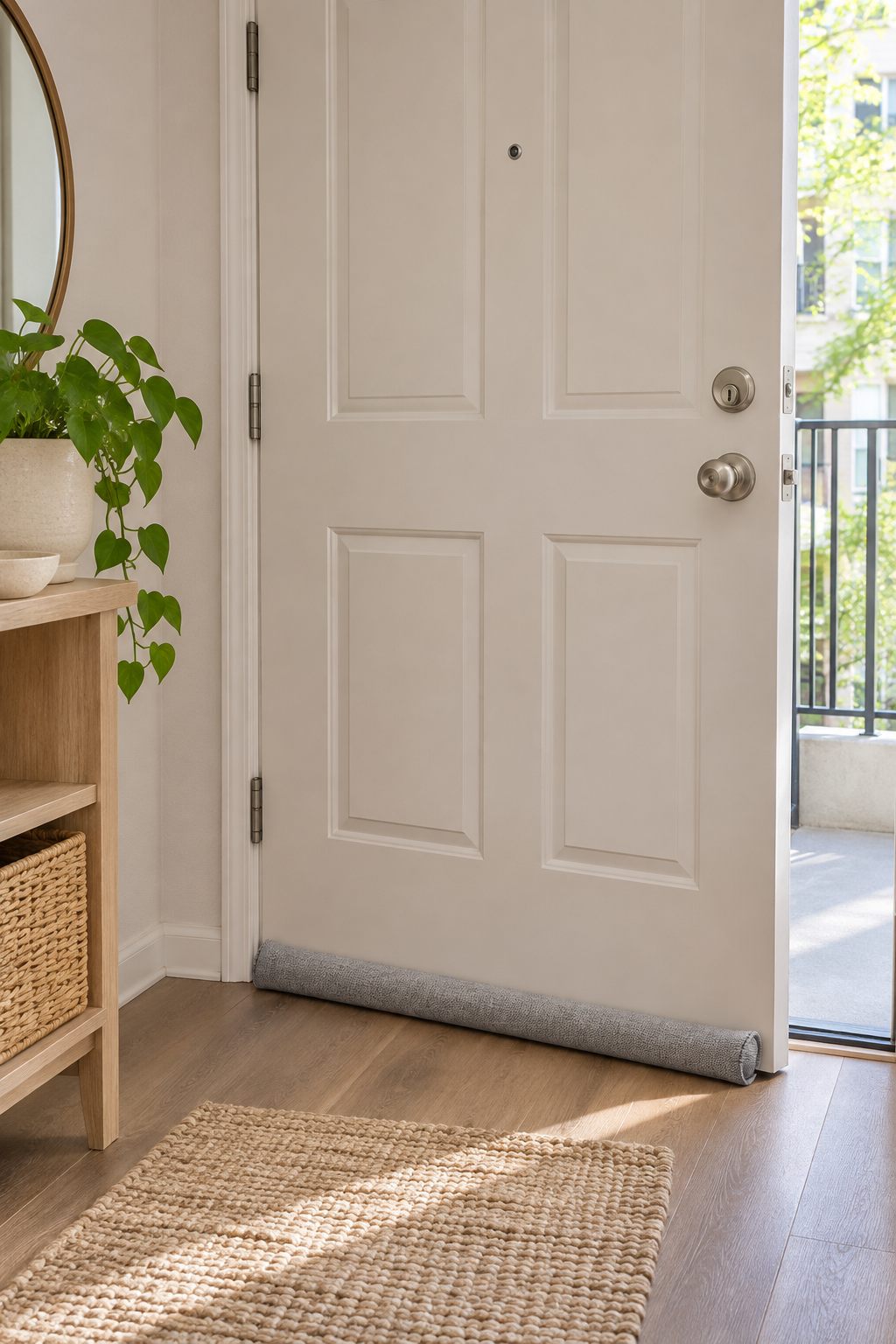
What a door draft stopper can and cannot do
A draft stopper reduces air movement through a gap at the bottom of a closed door. It does not repair a warped frame, replace damaged weatherstripping around the jamb, or correct a door that does not close properly. Use a tissue or the back of your hand to locate the air movement before choosing a product.
The U.S. Department of Energy includes draft stoppers among simple renter actions for reducing air movement at doors. That supports the basic use case, but it does not guarantee a particular product will lower a bill by a specific amount. Room exposure, climate, door construction, and the rest of the building envelope all matter.
- A loose fabric draft snake rests on the floor and moves separately from the door.
- A double-sided slide-on model travels with the door and seals both sides of the lower edge.
- An adhesive sweep attaches to the door face and may require curing time and careful removal.
- A screw-mounted sweep is more permanent and needs the correct hardware, clearance, and permission.
Compare the four common designs
Use the table to narrow the category before comparing price or color.
| Design | Best fit | Main tradeoff | Renter check |
|---|---|---|---|
| Loose fabric stopper | A mostly stationary exterior or interior door | Must be moved back after the door opens | Choose enough length to cover the full gap without blocking the walkway |
| Double-sided slide-on | A smooth floor and a consistent under-door gap | Can drag on rugs or bind on uneven thresholds | Measure door thickness and the tallest point of the floor path |
| Adhesive sweep | A smooth approved door surface | Removal can affect paint or finish | Check the lease and follow surface preparation and removal instructions |
| Screw-mounted sweep | A door that needs a durable fixed seal | Requires holes, correct fasteners, and exact clearance | Get permission when required and confirm the door is not a rated assembly you should alter |
Do not use the word “removable” as a substitute for reading the installation instructions. Some slide-on products contain rigid inserts, and some adhesive models are marketed as removable even though the surface condition determines how cleanly they release.
Measure the gap in more than one place
Close the door normally and measure the space beneath it near the hinge, at the center, and near the latch. Floors and thresholds are not always level. Buy for the smallest operating clearance, not only the largest visible opening, or the stopper may catch as the door moves.
Also measure the full door width and thickness. A loose fabric stopper should reach the corners without extending far into the walking path. A slide-on model needs a channel that fits the lower edge without compressing so tightly that it scratches the finish.
Check the complete door swing
Open the door through the range you use every day. Look for a rug edge, transition strip, raised threshold, floor vent, or baseboard that changes the clearance. A stopper that works while the door is closed can fail after the first few inches of travel.
If the door is part of your exit route, preserve reliable closing and a clear path. The U.S. Fire Administration advises keeping doors and windows unblocked. A product that rolls into the walkway or keeps the door from operating normally is the wrong fit, even if it reduces a noticeable draft.
Match the product to the real source of the draft
Hold a tissue near the bottom, sides, and top of the closed door on a windy or cold day. If the movement is concentrated along the jamb, review the building maintenance issue instead of stacking multiple bottom stoppers. Renters should report damaged seals, loose thresholds, or doors that do not latch to the property contact.
For a broader cold-weather setup, combine this check with the small-apartment winter preparation plan. The goal is a small targeted fix, not a pile of seasonal products that creates new storage and safety problems.
Choose materials you can clean and store
Entry doors collect grit, moisture, pet hair, and outdoor residue. Look for a removable washable cover or a surface that can be wiped according to the label. A heavily filled fabric tube may be stable but awkward to wash and slow to dry.
Plan where a loose stopper will go when the door is open. If it has no home, it will end up across the walkway. A shallow basket or wall-free landing spot can work, but keep the route through the entry clear. The small-entryway cleaning routine can help you judge how much floor-level equipment your space can support.
Know when a product is not the next step
A draft accompanied by water entry, visible frame damage, daylight around a closed exterior door, a loose lockset, or a door that will not close should be documented and reported. Do not hide a maintenance problem behind a removable accessory.
If the concern is security rather than comfort, use the renter security system checklist to separate monitoring and entry habits from weather sealing. A draft stopper is not a door reinforcement device and should never be described as one.
Run a five-minute fit test before installing
Test the operating conditions before removing an adhesive liner or trimming material.
- Place a rolled towel at the threshold to simulate the proposed thickness.
- Open and close the door slowly, watching the hinge side, latch side, threshold, and rug edge.
- Confirm the door still closes and latches without extra force.
- Walk through carrying a bag and make sure the temporary stopper does not enter the path.
- Photograph the door surface and reread the product’s installation and removal directions.
If the towel catches, reduce the thickness or choose a loose stopper that does not travel with the door. If the door itself behaves incorrectly, stop and report the maintenance issue.
Common buying mistakes
- Buying by door width without measuring the changing floor clearance.
- Assuming every metal, wood, or painted door accepts the same adhesive.
- Using a thick slide-on model over a rug or raised transition strip.
- Blocking a self-closing or frequently used exit door.
- Claiming noise, odor, pest, smoke, or energy performance that the exact product has not been tested to provide.
Frequently asked questions
Should the stopper be exactly as wide as the door?
It should cover the useful lower gap without projecting into the walkway or rubbing the frame. Follow the product’s sizing method because loose tubes, slide-on channels, and sweeps use different measurements.
Can a renter use an adhesive door sweep?
Only after checking the lease, surface instructions, and removal method. Adhesive performance and paint risk depend on the exact door finish and product, so a no-contact fabric stopper is the lower-commitment starting point.
Why does the door become harder to move after installation?
The product may be too thick, the floor may rise along the swing, or the channel may be too tight for the door. Remove it rather than forcing the hinges or latch.
Will a door draft stopper lower my energy bill?
It can reduce air movement at a compatible gap, but no universal savings amount applies. The rest of the window and door leakage, weather, HVAC system, and building construction affect the result.
Sources and fact-checking
This guide was checked against the following current sources. Product dimensions, load limits, materials, mounting instructions, warranties, and return terms still need to be verified on the exact listing before purchase.
- U.S. Department of Energy — 5 Tips for Energy-Saving Renters — supports checking air leaks and using draft stoppers as a renter-friendly measure
- U.S. Fire Administration — Home Fire Escape Plans — supports keeping doors, windows, and escape routes unblocked


댓글 0
첫 댓글을 남겨보세요.