
Robot Vacuum Threshold Height: Measure Doorways Before Buying
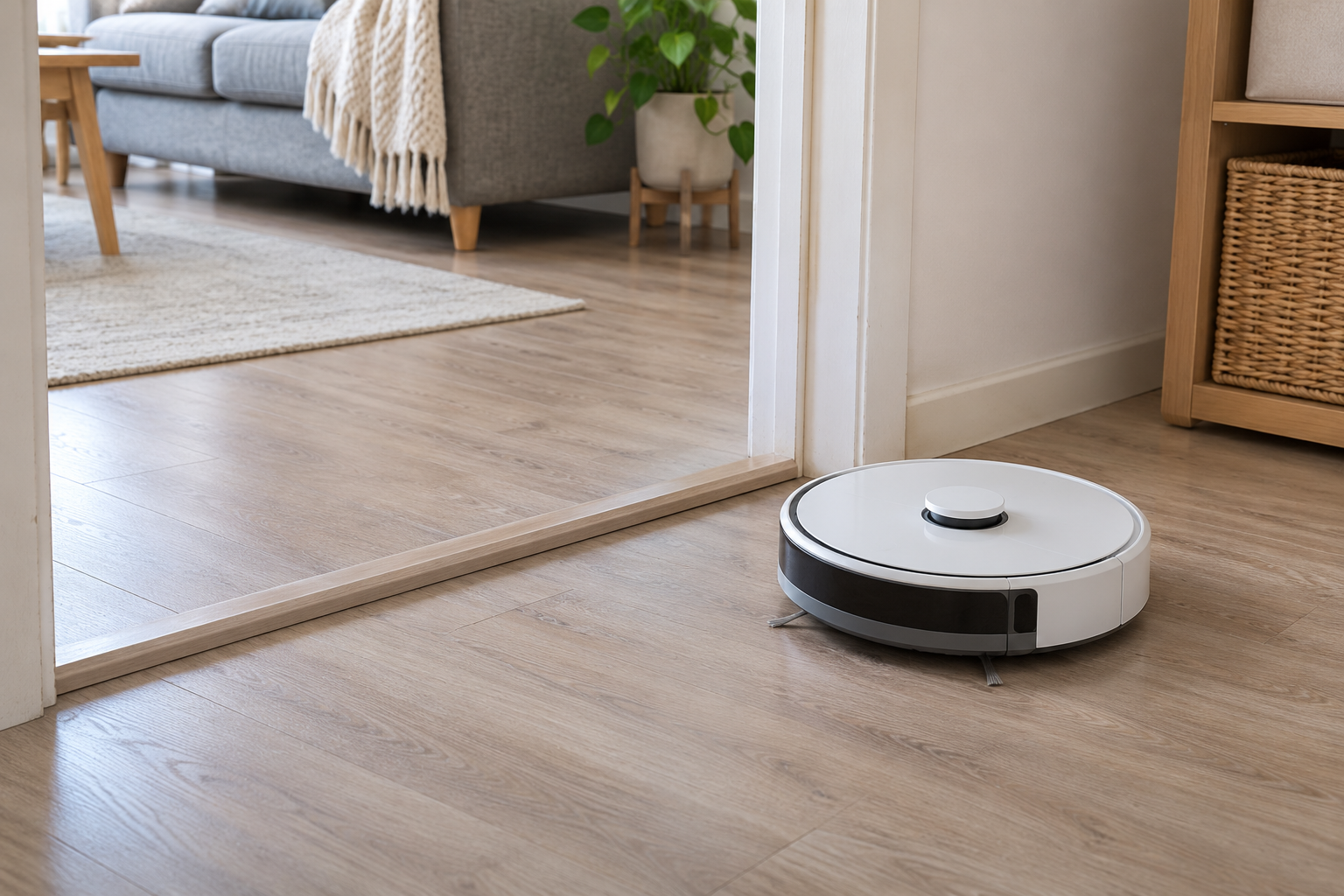
robot vacuum threshold height is a model-specific limit, not a universal number. Measure every doorway the robot must cross, including the rise from each side, the width of the raised strip, and its edge shape. Then compare those measurements with the exact manufacturer’s specification and its conditions. A robot that reaches a room but cannot return to its dock does not provide dependable whole-apartment coverage.
Draw the route before comparing robots
Start at the proposed dock location and trace the path to each room you want cleaned. Mark bathroom transitions, kitchen edges, rug borders, and any raised strip in a hallway. One difficult doorway can matter more than the total size of the apartment.
Separate essential rooms from optional ones. If a seldom-used room has a high sill, manual cleaning there may be a reasonable trade-off. If the only route between the dock and the kitchen crosses that sill, threshold capability becomes a purchase requirement. Decide that before paying for features unrelated to the bottleneck.
Record more than the tallest point
Place a rigid straightedge on the lower floor beside the transition and measure vertically to the top of the obstruction. Repeat from the other side. A strip can sit above two floors of different heights, so a measurement from one side alone does not describe the return trip.
Measure at several places across the doorway rather than assuming the profile is uniform. Note whether the edge is abrupt, rounded, or beveled; whether the top is narrow or broad; and whether the material is firm, loose, textured, or slippery. Photograph the side profile with your measurements for a specific support question.
Keep units consistent. Record millimeters if the manufacturer uses millimeters; preserve the original specification instead of comparing rounded inch conversions. If your measurement sits at the stated maximum, treat the fit as uncertain until the maker confirms the conditions and a supervised trial succeeds.
Use this doorway worksheet
| Feature to record | Why it changes the decision | Question for the manufacturer |
|---|---|---|
| Rise from room A | Describes the first approach | Is this an approved single vertical edge? |
| Rise from room B | Describes the return route | Does the rating apply in both directions? |
| Strip width and profile | A narrow ridge differs from a broad platform | Was the rating measured on this shape? |
| Floor and threshold surface | Traction conditions may differ | What surfaces were used for the claim? |
| Mop configuration | An installed attachment changes the setup | Does the rating apply with this mop fitted? |
| Door clearance | A proposed ramp must not stop door movement | What ramp arrangement is supported? |
Separate threshold height from body height
The measurement that lets a robot fit under a sofa is not its climbing rating. Body height describes overhead fit. Threshold capability describes movement across an obstacle. A low robot is not automatically a good climber, and a taller robot is not automatically able to cross a raised doorway.
Likewise, suction specifications do not establish climbing ability. Read the mobility claim, operating manual, and any footnotes separately. A headline figure may apply to a particular obstacle profile or configuration rather than a single sharp step of the same nominal height.
The Narwal US threshold guide advertises up to 40 mm, approximately 1.6 inches, for its Flow model. The page explicitly says its threshold performance is based on internal engineering specifications and controlled tests, with actual results varying by surface, edge angle, and environment. That is a manufacturer claim for one model, not a safe default for all robots or every 40 mm obstacle.
Plan the supervised trial before the return window closes
Keep the packaging and read the return conditions before the first cleaning session. Begin with a clear, dry route and the configuration you expect to use. Watch the robot approach, cross, clean the far side, and return. Do not push it over the strip to count an assisted crossing as success.
Repeat from the other direction. Check whether it hesitates, repeatedly strikes the edge, becomes suspended on the ridge, or abandons the route. Observe a normal return-to-dock sequence as well as a room-cleaning sequence. A saved map does not prove physical access.
Keep children and pets away during this evaluation. Do not alter cliff sensors or cover them to force a crossing. A raised interior strip and an actual drop are different hazards. Exclude unsafe areas with the method supported by the manufacturer, and do not assume a virtual boundary replaces every physical precaution.
A ramp is a flooring decision too
A removable ramp may make a transition more gradual, but its height is only part of the fit. Check its width, slope, stability, underside material, and whether the door still opens and latches. It must not become a loose obstruction in a walking route.
Ask the property manager before attaching anything permanently or changing the threshold. Do not remove a strip that has an unknown building function. If the doorway also needs a door draft stopper, consider both products together: a draft blocker can become another obstacle, and a ramp can interfere with the door sweep.
A ramp also consumes floor area on the approach. In a narrow hall, that footprint may make the arrangement impractical even if it helps the robot. Avoid homemade stacked rugs or loose boards as a shortcut. If you cannot create a stable, permitted route, keep that room outside the robot’s assignment.
Decide whether partial automation is enough
There is no requirement that one robot clean every surface. You can choose a lower-cost or simpler model for the accessible area and clean the isolated room manually. Compare that honest routine with the extra price and storage demands of a more complex robot and dock.
Also check the dock’s required surrounding space and service access in the manual. A convenient transition rating does not compensate for a dock squeezed into a place where you cannot remove its containers. Use the under-bed cleaning guide for spaces that still need a separate reachable tool.
The best robot vacuum threshold height for your home is therefore not the biggest advertised number. It is the documented capability that fits your actual route, with acceptable behavior in both directions and no unsafe modification to the apartment.
FAQ
Can a robot climb a threshold that exactly matches its maximum rating?
Possibly, but the rating may depend on a specific profile and surface. Treat a boundary match as uncertain and ask the manufacturer about your measurements.
Will a new map fix a doorway the robot cannot cross?
Mapping can help navigation, but it does not change the physical obstacle. Diagnose the profile and supported configuration first.
Can I carry the robot into a blocked room?
Only if its instructions support that routine. Check how it starts, locates itself, and returns; you may need to retrieve it manually.
Should I buy the tallest ramp available?
No. Choose a stable, compatible profile that fits the doorway and walking route. A larger ramp may obstruct the door or create a trip problem.
Sources and fact-checking
Checked November 19, 2026: Narwal US threshold guidance (HTTP 200; full article read). Only its own model claim and stated limitations are used here; cross-brand rankings and generalized performance promises are not adopted. This guide is not a hands-on robot test.


댓글 0
첫 댓글을 남겨보세요.