
Fireproof Document Bag: What the Label Does Not Guarantee
A fireproof document bag should be treated as one storage layer, not as a guarantee that irreplaceable papers will survive a home fire. Many soft bags are more accurately described as fire-resistant. Heat exposure, duration, seams, zipper design, water, falling debris, and the location of the bag can all affect the outcome.
Before buying, decide which records need originals, which can be certified again, and which should also exist in an encrypted digital or off-site copy. The strongest plan is redundant: an organized pouch for access, protected storage for selected originals, and recoverable copies elsewhere.
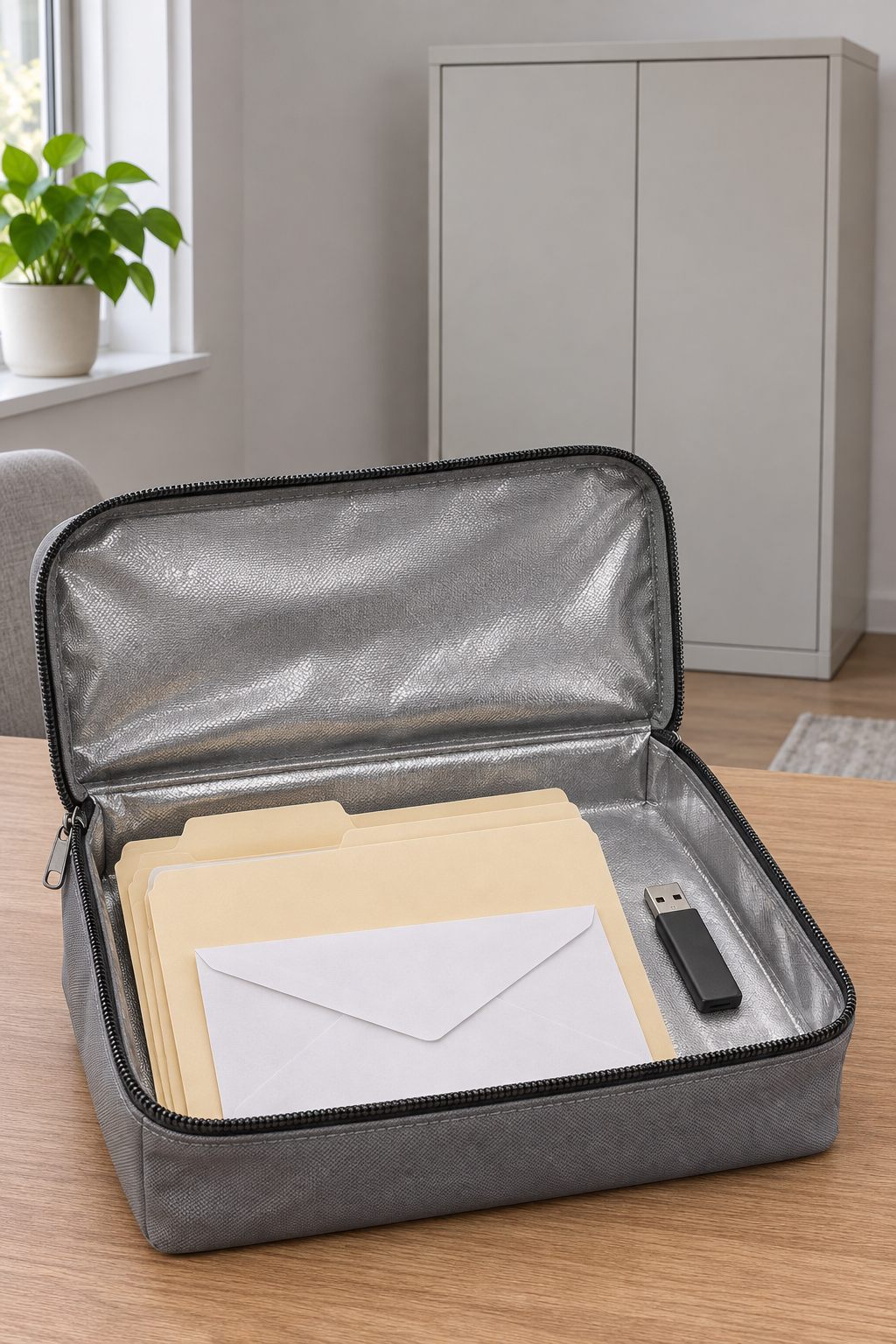
Read past the word “fireproof”
Look for a named independent test, a standard number, the test temperature and duration, and whether the whole bag or only a material sample was evaluated. A maker’s temperature claim without a method does not show how the zipper, seams, closure, and contents performed together.
Also separate fire resistance from water resistance. Fire response can involve sprinkler water, hoses, rain, and prolonged moisture. A water-resistant coating is not automatically waterproof, and a zipper may be the weak point.
- Soft pouch: portable and easy to organize, but protection depends heavily on construction and exposure.
- Locking organizer bag: adds privacy and sorting, but a small lock does not create a security safe.
- Fire-rated safe: heavier and less portable, with its own classification, anchoring, humidity, and capacity questions.
- Off-site or digital copy: protects access when the home and physical container are unavailable.
Compare document protection layers
Use more than one layer for records that are hard to replace.
| Layer | Useful for | Main limit | What to verify |
|---|---|---|---|
| Organizer pouch | Keeping a small emergency set together | May provide little tested fire protection | Capacity, closure, privacy, portability |
| Fire-resistant bag | Adding a heat and water exposure layer | Soft construction and claims vary widely | Named test, duration, temperature, seams, zipper |
| Classified safe | Selected originals and valuables | Cost, weight, access, humidity, installation | Exact fire/water classification and interior rating |
| Off-site or digital copy | Recovery when home storage is inaccessible | Privacy, account access, version control | Encryption, authentication, backup location, update date |
Do not place every household record in one portable bag. Concentrating identity documents, cash, passwords, and account information can create a theft and privacy risk.
Choose the documents before choosing the bag
Ready.gov recommends gathering critical personal, household, medical, insurance, and financial information and keeping important records accessible after a disaster. Build a one-page inventory first. Mark each item as original, certified copy, ordinary copy, or digital record.
The small-apartment emergency documents folder provides a broader filing system. The bag should hold only the subset that benefits from physical portability or added protection.
Check internal dimensions, not product photos
Letter-size paper, legal-size documents, passports, deed packets, photo sleeves, external drives, and binders need different clearances. A padded or multi-pocket organizer may have much less usable depth than the outside dimensions suggest.
Make a stack of the intended contents, measure it, and add room for the closure to operate without crushing corners. Overfilling can stress seams and prevent the zipper or flap from closing as designed.
Look for complete-system evidence
A product that names a laboratory or standard gives you something specific to verify. Confirm that the exact model, size, and construction are covered. Do not transfer a safe rating, a fabric rating, or a different model’s test to the bag you are buying.
A claim such as “withstands 2,000°F” is incomplete without duration, test setup, interior temperature, pass criteria, and the tested component. Use careful language: the bag may add resistance under certain conditions, not make the contents invulnerable.
Plan for water, humidity, and handling
Papers can be damaged by moisture even without a fire. Store only dry documents, avoid damp basements and leaky under-sink areas, and inspect the pouch periodically. If the bag has a coated fiberglass surface, follow the handling and cleaning directions rather than brushing loose fibers with bare hands.
The National Archives emphasizes preventing damage when storing family papers and photographs. For sentimental records, use appropriate sleeves and storage conditions instead of assuming a fire bag is also an archival container.
Build redundant access
Ready.gov suggests storing important documents in a safe-deposit box, external drive, or cloud. Use the method appropriate to the record and protect sensitive files with strong authentication and controlled sharing.
Keep the location and update date in the renter emergency documents folder. During a move, include the record inventory in the apartment moving binder rather than placing the only copies in a moving box.
Decide where the bag will live
A bag hidden so deeply that nobody can find it is not useful in an evacuation. A bag left beside an exterior door may be easy to steal. Choose a location known to authorized household members, away from obvious water sources and daily clutter.
Do not delay evacuation to retrieve documents. People leave first. The physical record system is for preparedness and recovery, not for re-entering or searching during a fire.
Run a document-layer audit
Complete the audit before deciding the size or price tier.
- List every intended record and classify the copy type.
- Measure the paper stack and devices without compressing them.
- Verify the exact bag’s test evidence, closure, water claim, and warranty.
- Create protected digital or off-site copies where appropriate.
- Record the storage location and schedule a six-month review.
If the listing provides no verifiable test information, buy it only as an organizer or portability layer and describe it that way.
Common buying mistakes
- Treating “fireproof” as an absolute guarantee.
- Using a fabric temperature claim as proof for the entire bag.
- Ignoring zipper, seam, water, and overfilling limitations.
- Keeping the only copy of every record in one portable container.
- Storing sensitive records without a theft and privacy plan.
Frequently asked questions
Are fireproof document bags actually fireproof?
Protection varies, and soft bags can fail under severe or prolonged exposure. Look for exact independent test evidence and treat the bag as one layer rather than a guarantee.
Should I put passports and Social Security cards in the bag?
Only as part of a broader privacy and recovery plan. Consider theft risk, access needs, off-site copies, and the specific record-replacement process.
Is a fire-resistant bag the same as a rated safe?
No. The construction, test method, interior temperature limits, duration, capacity, and installation are different. Compare exact classifications rather than category names.
Where should the bag be stored?
Choose a dry, known, reasonably secure location that does not require anyone to delay evacuation. Avoid obvious water sources and inspect the contents periodically.
Sources and fact-checking
This guide was checked against the following current sources. Product dimensions, load limits, materials, mounting instructions, warranties, and return terms still need to be verified on the exact listing before purchase.
- Ready.gov — Financial Preparedness — supports gathering critical records and maintaining off-site, external-drive, or cloud copies
- U.S. National Archives — Family Archives — supports damage prevention and appropriate handling and storage for family papers and photographs



댓글 0
첫 댓글을 남겨보세요.