
Air Fryer for Small Kitchen: Capacity, Footprint, and Safety
An air fryer for small kitchen use should be sized by usable food area and open-drawer clearance, not by quart capacity or the smallest countertop footprint alone. Measure where hot air exits, how far the basket pulls out, what a single uncrowded layer holds, which outlet will power it, and whether every greasy part is practical to clean.
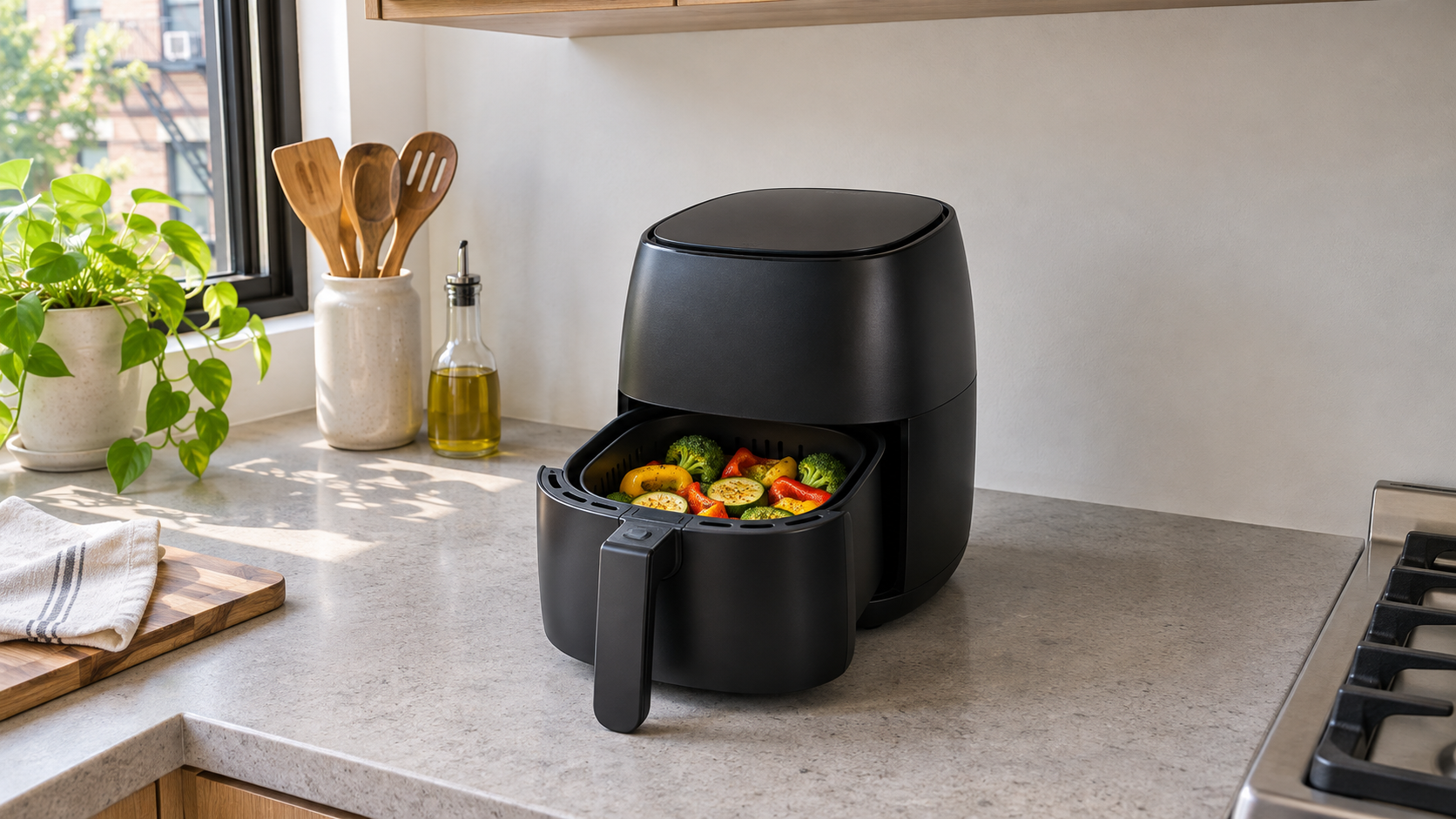
An air fryer is a compact convection oven. It can cook quickly, but the U.S. Department of Agriculture warns that overcrowding can prevent adequate air circulation and lead to uneven or undercooked food. Capacity should match the meal, not only the counter.
Measure the appliance open, hot, and in use
Trace the closed footprint on the counter, then add the basket or door in the fully open position, the handle, and a heat-safe landing spot for hot food. Check the manual for rear, side, and overhead clearance. A machine may fit under a cabinet while stored but require a different position during cooking.
Compare the flat basket or tray area that can hold food in one layer. A deep quart number can hide a narrow base that forces stacking. If your usual meal is wings, vegetables, or frozen foods for two people, estimate whether it fits without blocking airflow. Repeated small batches may erase the time advantage of a compact unit.
| Specification | Useful question | Small-kitchen tradeoff | Verify |
|---|---|---|---|
| Quart capacity | How much volume fits in the basket? | More volume can mean a wider or taller appliance | Usable base area and recommended fill |
| Basket or oven style | Do you prefer a pull-out basket or shelves? | Basket is simple; oven style may need more cleaning | Open-door space, tray positions, and crumb access |
| Rated wattage | What electrical load does the unit draw? | High power can cook faster but shares circuit capacity | Nameplate, grounded outlet, and other appliances |
| Cleaning parts | Which food-contact pieces are removable? | More accessories add versatility and washing | Dishwasher claims, coating care, and hidden grease paths |
Nine buying checks for an air fryer in a small kitchen
1. Measure closed and open dimensions
Record width, depth, height, handle projection, basket travel, door swing, and overhead space. Include the counter zone needed to set down a hot basket or tray. If the appliance must be moved for every use, measure the storage route and its weight, and never plan to carry it while hot.
2. Compare usable food area
Look for interior dimensions, basket-base measurements, or clear photos with food in one layer. USDA advises against overcrowding because hot air needs to circulate. A taller basket is not automatically more useful than a wider one. Match the shape to the food you cook rather than choosing the largest quart number that fits the budget.
3. Match batch size to the household
Write down one typical meal and estimate the uncrowded amount. If a two-person dinner requires three batches, the smallest model may not save time or energy. If you usually reheat one portion, a large oven-style unit may occupy too much counter and take longer to clean. Choose the repeated use case, not a holiday exception.
4. Check the circuit and outlet
Read the rated watts and amps, locate a grounded wall outlet, and identify other high-draw appliances on the circuit. Do not run an air fryer through an extension cord or power strip unless the manufacturer explicitly approves that arrangement. Avoid simultaneous use with a microwave, kettle, toaster oven, or induction burner when the circuit cannot support both.
5. Confirm ventilation and cabinet clearance
Hot exhaust can affect walls, cabinets, curtains, and objects stored above the machine. Follow the exact manual for clearance and do not operate the unit in a closed appliance garage. Make sure grease-laden exhaust is not directed at a smoke detector, paper towel roll, or power cord. Keep anything combustible away from the hot appliance.
6. Compare controls you will actually use
Preset icons are not a substitute for adjustable time and temperature. Check the minimum and maximum range, how easily the timer can be changed during cooking, whether controls remain visible in daylight, and what happens after a power interruption. Mechanical controls can be simple; digital controls can be precise, but neither guarantees cooking accuracy.
7. Inspect the cleaning path
Remove the basket, crisper plate, trays, drip pan, and crumb tray in the product photos or manual. Look for narrow gaps, exposed heating elements, silicone bumpers, and coated surfaces with special utensil restrictions. Dishwasher-safe wording should identify the exact parts. A difficult cleaning path can produce smoke and odor from old grease.
8. Plan food-safety checks
Use a food thermometer rather than relying only on color or a preset. USDA lists safe minimum internal temperatures including 165°F for poultry, 160°F for ground meats, 145°F plus rest time for whole cuts of beef, pork, veal, and lamb, and 145°F for fish. Follow package directions for products that are not intended for air-fryer preparation.
9. Verify model support and recalls
Save the exact model, rating label, manual, warranty, and seller. Search CPSC recalls before use. Air-fryer recalls can involve fire and burn hazards, and visually similar versions may have different date codes or model numbers. Confirm replacement baskets and trays are made for the exact appliance.
Small-kitchen air fryer worksheet
- Space: closed footprint, basket or door open, handle, overhead clearance, exhaust, and hot landing zone.
- Food: usual meal, one-layer basket area, servings, batch count, and thermometer access.
- Power: watts, amps, grounded wall outlet, circuit, and simultaneous appliances.
- Cleaning: basket, plate, trays, crumb or drip pan, coating rules, and dishwasher status.
- Operation: time and temperature range, controls, lights, beeps, preheat, and power-loss behavior.
- Identity: exact model, manual, warranty, replacement parts, and recall result.
These TrendIssue guides help the air fryer fit the real kitchen rather than displacing every other task.
- How to Set Up a Small Rental Kitchen — choose a stable cooking and cooling zone
- A 15-Minute Weeknight Kitchen Reset — build grease cleanup and basket drying into the evening
- Pantry Inventory for Small Kitchens — match appliance capacity to foods already in rotation
Test one real meal during the return window
The first meal should test fit, batch count, sound, exhaust, cleanup, and outlet planning at the same time.
- 1. Cold setup: Place the unit with manual-required clearance and open the basket or door fully.
- 2. Circuit check: Use the planned grounded outlet without another high-draw appliance running.
- 3. Cook in one layer: Follow the food and appliance directions, avoid overcrowding, and use a thermometer.
- 4. Observe the room: Check exhaust direction, cabinet heat, noise, smell, and whether the open basket blocks movement.
- 5. Clean completely: Cool, unplug, remove approved parts, clean grease paths, dry, and return the appliance to storage if needed.
Common mistakes and tradeoffs
Buying by quarts alone: Usable basket area and required batch count matter more than total volume.
Operating under a low cabinet: Stored fit is not operating clearance; hot exhaust needs space.
Sharing power without checking the circuit: Another heating appliance can create overload or breaker problems.
Trusting a preset for doneness: Use package directions and a food thermometer for safe internal temperature.
Skipping model-specific recall research: Fire and burn notices depend on exact model and production details.
Frequently asked questions
What size air fryer is best for a small kitchen?
Choose the smallest exterior that can cook your usual meal in a practical number of uncrowded batches while meeting ventilation and open-drawer clearance.
Can an air fryer sit under a cabinet?
Only if the exact manual’s operating clearances are met and hot exhaust will not affect the cabinet or stored items. Many units need to be pulled forward for use.
Do I need to preheat an air fryer?
Follow the appliance and food instructions. Preheat requirements vary by model and recipe, and safe doneness should be confirmed with a food thermometer.
Can I use a power strip?
Use the grounded wall outlet and electrical setup required by the manufacturer. High-wattage cooking appliances generally should not rely on ordinary power strips or extension cords.
Sources and fact-checking
- USDA Food Safety and Inspection Service: Air Fryers and Food Safety
- U.S. Fire Administration: Cooking Fire Safety
- U.S. Consumer Product Safety Commission: Recalls & Product Safety Warnings
Fact-check completed November 16, 2026. Product specifications, prices, manuals, and recall status can change, so verify the exact model before purchase.



댓글 0
첫 댓글을 남겨보세요.