
Freezer Container Headspace: How Much Room Should You Leave?
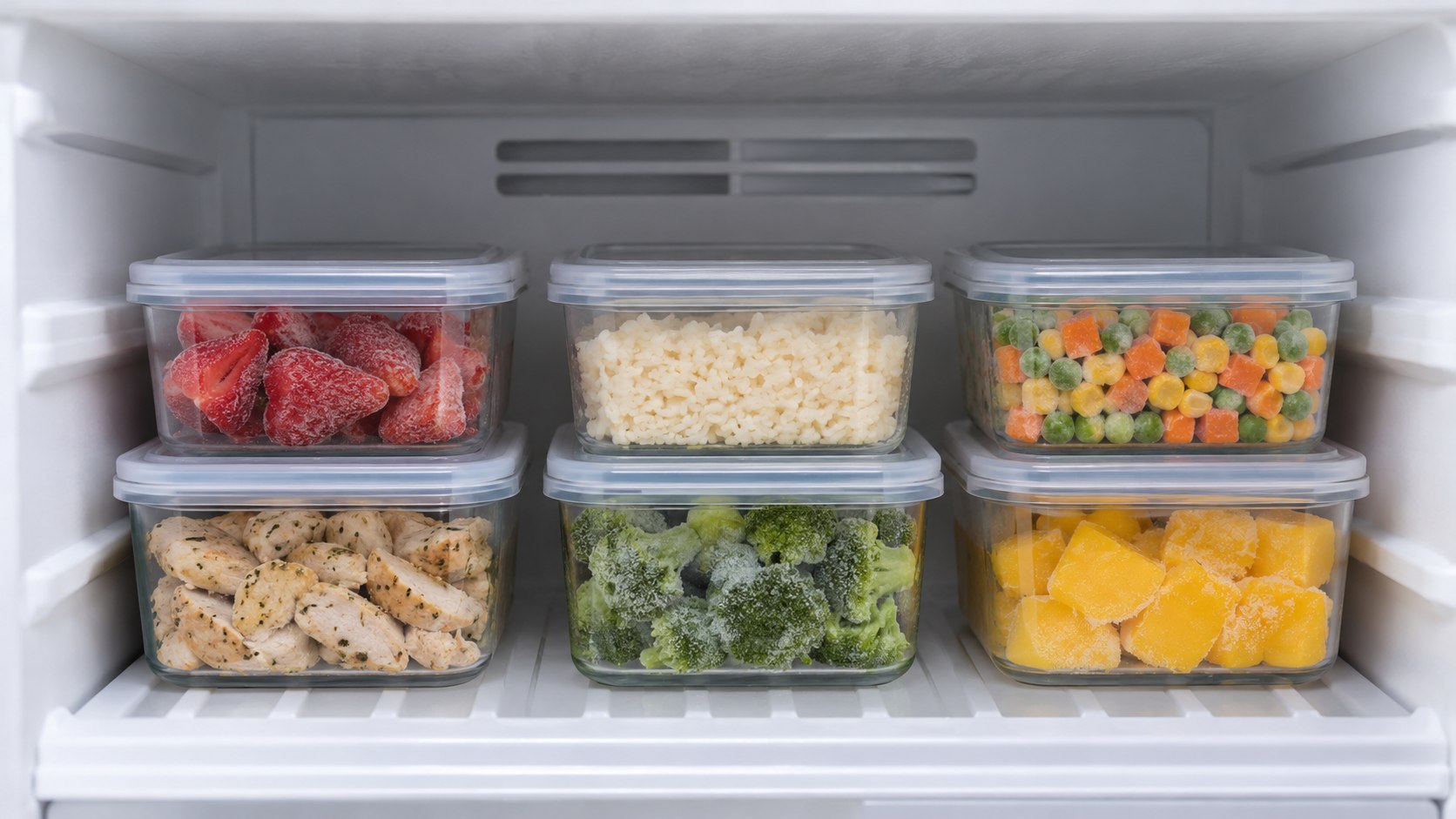
Freezer container headspace depends on what you’re freezing, how much the container holds, and the size of its opening. For fruit packed in liquid in a wide-top container, the National Center for Home Food Preservation specifies a half inch in a pint and one inch in a quart. Those figures aren’t universal soup or leftover fill lines. Check the directions for your particular pack, then choose a box that holds the portion you want below the fill line, or a freezer bag if a flexible shape works better.
Match freezer container headspace to the food
Headspace is the gap between the food and the closure. A container sold as a quart box doesn’t necessarily hold a usable quart of liquid for freezing. Expansion space is part of the package, just as much as the lid. Look for a marked freezer fill line or directions for that food and container. If dinner portions take the food above the line, choose the next size or split the batch.
Read the chart by pack type first, then by the opening and size of the container. The fruit example above refers to fruit packed in juice, sugar, syrup, or water. For juice alone in a narrow-top pint, the same chart specifies one and a half inches, quite different from fruit in a wide-top pint. These entries illustrate why you shouldn’t copy the fill line from one shape or food to another.
With flexible freezer bags, press out excess air before sealing, as the center advises. That does not mean stretching the bag tight around a liquid or filling right up to the zipper. Give the contents room to expand, keep the closure free of food, and follow the bag maker’s filling instructions. If holding a bag open while ladling soup feels awkward, choose a rigid box instead. It’s also easier to set down between ladlefuls.
Picture the portion on the way out
Imagine opening the freezer for dinner. If you need a single serving of chili, a large container that holds the whole pot is the wrong unit, even if it fits the shelf perfectly. Use your usual bowl or a measuring cup to figure out how much you’d want to thaw together. Look for a box that holds that amount with room left for expansion, rather than one whose brim capacity just equals the serving.
Other foods behave differently. For a handful of frozen rolls, the ability to take one and close the package matters more than forming a tidy brick. For a slice of lasagna, decide whether you mind a bag pressing against the top. A rigid container makes sense when you want distinct layers to stay intact. If most of what you freeze comes in its own suitable packaging, consider buying just for the foods that don’t, rather than replacing packaging for the sake of a matching shelf.
Find the rectangle your drawer will actually accept
Measure the flat floor of the basket, not just the outside of the drawer. Look for sloping sides, a hump at the back, and a shallower section beneath another basket. For a shelf freezer, measure the opening as well as the depth: a door shelf can block a box that fits inside the compartment. Compare those measurements to the widest part of the container with its lid and clips in place.
Place a paper template of the closed box on the bottom of the drawer. Can another sit beside it, or would a narrower rectangular container make better use of the remaining strip? Now lift the template straight out as if it were full. If you’ll need to turn a real box on edge to get it through the opening, count that spot as unavailable for liquid foods. Leave room for fingers and for air circulation rather than trying to tile every last inch.
| Pack | Good match | Space to reserve | Check before buying |
|---|---|---|---|
| Shallow square box | Sauce, stew, or a fragile portion | Flat base and room above for a second closed box | All clips close and the upper box sits level |
| Narrow rectangular box | A single portion in a long drawer | Width at the rim, not just the base | Enough room to lift it out without tipping |
| Flat freezer bag | A thin meal portion or irregular pieces | A level place to freeze it before filing upright | Freezer designation, dependable seal, readable label |
| Wide-mouth freezer-rated jar | Liquid you prefer to keep in glass | Upright space, including expansion room inside | Manufacturer approves freezing in that jar |
Set a higher bar than “it came with food in it”
When comparing freezer food storage containers, look for a freezer-use designation for both the base and its lid. The center recommends packaging that resists moisture loss, seals well, and won’t turn brittle and crack in the cold. A takeout tub that has carried dinner home hasn’t necessarily met those conditions. Likewise, an ordinary glass food jar is not interchangeable with a jar designed for freezing. If you want glass, look for a wide-mouth product explicitly approved for that use and follow the fill instructions.
Try a lid before committing to a whole set, if you can. Does the rim close evenly with ordinary hand pressure? Can you tell when a corner is still up? Check whether different depths share the same lid and whether a replacement can be bought separately. A stack of empty bases isn’t much use if the only matching cover is already in the freezer. For a bag, check that the package specifies freezer use; “resealable” describes the closure, not the material’s suitability for freezing.
Stack the frozen portions, then plan for the empty ones
Decide where an unfrozen bag will lie level without curling around a wire shelf or slipping between boxes. A small rimmed tray can provide support if there’s room for both tray and bag. Once solid, flat packs can stand like folders. Write the contents and date where they’ll still be visible in that position. For boxes, a label on the end often beats one on top when the second box hides the first lid.
Give the oldest portions a reachable lane rather than burying them beneath every new batch. The pantry and freezer reset for weeknight meals shows how to reserve a use-first spot. FDA recommends keeping a freezer at 0°F and avoiding crowding that prevents air circulation. Keep the thermometer readable as the drawer fills; the refrigerator thermometer placement guide also discusses monitoring freezer conditions. Packaging and temperature answer different questions: a tight lid can protect quality, but it can’t make a warm freezer colder.
Finally, take an empty box back to the cabinet. Can the bases nest? Do the loose lids stand together without springing out? If a set works only when all its pieces are full, it solves a freezer problem by creating a cabinet problem. Favor the size you reach for most, then add a different format only for a food or shelf that the first one cannot handle.
FAQ
Can I use a sandwich bag if it closes tightly?
Choose a bag marked for freezer use. A tight zipper alone doesn’t tell you whether the material is suitable for longer exposure to dry freezer air.
Does freezer burn mean the container made the food unsafe?
FDA identifies freezer burn as a quality issue. Dry spots alone don’t establish that the food was unsafe, but they don’t establish that it stayed at a safe temperature either. Check the storage history separately.
Can a freezer-safe glass box go straight into the oven?
Don’t assume so. Freezer approval isn’t approval for oven heat or a sudden temperature change. Check the directions for the exact dish and lid before planning to thaw, reheat, or bake in it.
Do round containers ever make sense in a square drawer?
Yes. A round container you already own may fit a narrow end space and hold the right portion. If it is freezer-rated, closes properly, and comes out easily, there’s no reason to replace it just to square off the corners.
Sources and fact-checking
Sources checked November 19, 2026. This is a research-based guide, not a hands-on product test.
FDA’s household food storage guidance covers freezer temperature, airflow, and freezer burn. The National Center for Home Food Preservation explains how to choose freezer packaging and provides a headspace chart for specific produce packs. Shelf layouts and portion comparisons are buying considerations, not manufacturer load ratings.



댓글 0
첫 댓글을 남겨보세요.