How to Build a Cleaning Schedule When You Share a Small Apartment
Sharing a small apartment makes cleaning one of the common friction points: who does what and when often depends on memory, vague promises, or the loudest person. That usually means tasks slip through the cracks until resentment builds.
This article gives a practical, low-overhead way to stop relying on memory: assign chores by how often they need doing and who owns them, then use simple decision signals so everyone knows when a task is due. The goal is a predictable, maintainable system rather than perfection.
Start with the real constraint
Space, time, and interest are the real constraints in a small apartment. You have limited storage for cleaning tools, limited free minutes, and different thresholds for what a “clean” living room looks like. A successful plan accepts those limits and focuses on consistency, not spotless results every hour.
Because people move, schedules change, and guests show up, the system should be flexible: it must tolerate missed turns and make it easy to catch up. One practical option is to separate tasks by frequency (daily, weekly, monthly) and attach clear ownership so nobody has to guess who will do what.
Also verify how and when to use cleaners: the U.S. Centers for Disease Control and Prevention distinguishes cleaning with soap and water from disinfecting, and says cleaning alone is sufficient in most situations unless illness-related circumstances make disinfection appropriate. Always follow product labels, manufacturer instructions, and any rules in your lease or local authority guidance when using cleaning chemicals or disposing of waste.
At-a-glance plan
| Frequency | Typical tasks | Owner model | Decision signal |
|---|---|---|---|
| Daily | Wash dishes, wipe counters, take out trash if full, quick tidy | Rotate daily or assign by area (kitchen, living space) | Visible: sink free of dishes or trash bag over half full |
| Weekly | Vacuum/sweep, mop high-traffic floors, bathroom wipe-down, change towels | One person owns week-long rotation or two people split duties | Calendar day or a simple shared checklist checkbox |
| Every 2–4 weeks | Dust higher surfaces, clean inside microwave/oven, wipe baseboards, wash bedding | Assign by task type (appliances, linens) as a practical option | Check marks on a visible chart or a digital reminder |
| Quarterly or as-needed | Declutter closets, deep-clean fridge, clean windows, donate items | Shared project day or trade tasks for other chores | When clutter reaches a set bin level or a quarterly calendar prompt |
Build the system step by step
- List every recurring task you notice for one week. Practical option: track items on your phone or a sticky note so nothing depends on memory.
- Sort tasks by frequency: daily, weekly, biweekly, monthly, quarterly. Personal planning approach: be realistic—don’t move a task to weekly if it visibly needs daily attention.
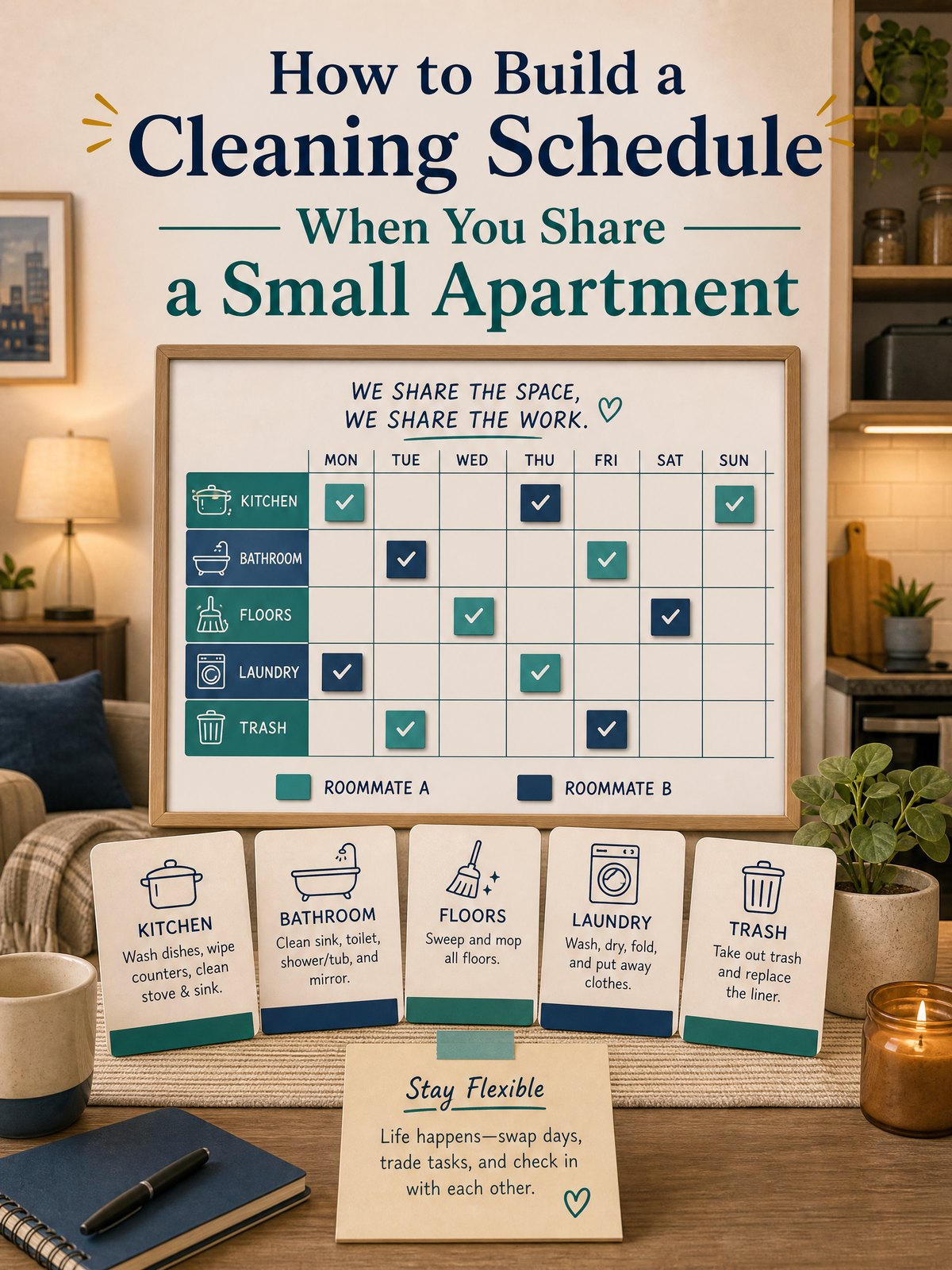
- Choose an ownership model: fixed owners for specific tasks, a rotating schedule, or split by area (one person handles kitchen, another handles bathroom). Each is a practical option—pick the one the group agrees to.
- Set simple decision signals to trigger action: a checked box on a paper chart, a shared calendar event, or a short message in a group chat. Practical option: use whatever signal everyone will notice.
- Create a short catch-up policy: if someone misses a turn, trade tasks, swap future turns, or cover with a small agreed-upon penalty (like making coffee). Personal planning approach: pick a low-friction consequence before it becomes an argument.
After these steps, try the plan for one month and treat that trial as data. If daily tasks are still getting ignored, consider changing owners or simplifying the task (for example, “clear the sink” instead of “wash every cup immediately”). If a task feels excessive, discuss reducing its frequency as a practical option rather than letting it be skipped silently.
Trade-offs to consider
No system is perfect; pick trade-offs you can live with.
- Fairness vs. convenience: strict rotation is fair but less convenient than fixed ownership, which may feel unequal over time.
- Detail vs. simplicity: a long checklist covers more but is harder to maintain; a short list is easier but might miss niche tasks.
- Digital vs. physical signals: apps send reminders but require everyone to use them; a wall chart is visible but needs apartment space.
Keep it workable
Maintenance is the ongoing task: once a week, spend five minutes reviewing the chart or calendar together to confirm upcoming duties and swap if needed. Practical option: combine this check-in with an existing routine—after grocery runs, before weekend plans, or during a short weekly house meeting—so it doesn’t feel like extra work.
FAQ
What if a roommate refuses to participate?
Practical options include negotiating a different contribution (paying extra utilities or buying supplies) or documenting agreed expectations in writing. If your living situation involves a lease or house rules, verify obligations with your lease terms or discuss options with the landlord as appropriate.
How do we handle supplies and shared costs?
Agree on a transparent approach: one person buys basic supplies on rotation, or everyone contributes to a shared fund. A personal planning approach is to keep receipts for a month and reconcile them in a simple shared note app.
Do we have to disinfect as well as clean?
The U.S. Centers for Disease Control and Prevention distinguishes cleaning with soap and water from disinfecting, and says cleaning alone is sufficient in most situations unless illness-related circumstances make disinfection appropriate. Follow product labels and manufacturer instructions when you use disinfectants and check local guidance if someone in the home is ill.
Next step: pick one ownership model from the options above and try it for one month. After the trial month, hold a short check-in to tweak frequencies, swap tasks, or simplify the plan.
Sources and fact-checking
This guide provides practical editorial guidance. Requirements and safe choices can depend on the product, lease, local rules, and individual situation.
- U.S. Centers for Disease Control and Prevention — Cleaning and Disinfecting — CDC distinguishes cleaning with soap and water from disinfecting, and says cleaning alone is sufficient in most situations unless illness-related circumstances make disinfection appropriate.
Fact-checked against the linked official resources on August 27, 2026.