
Fire Escape Ladder Window Sill Thickness: Verify the Exact Window and Model
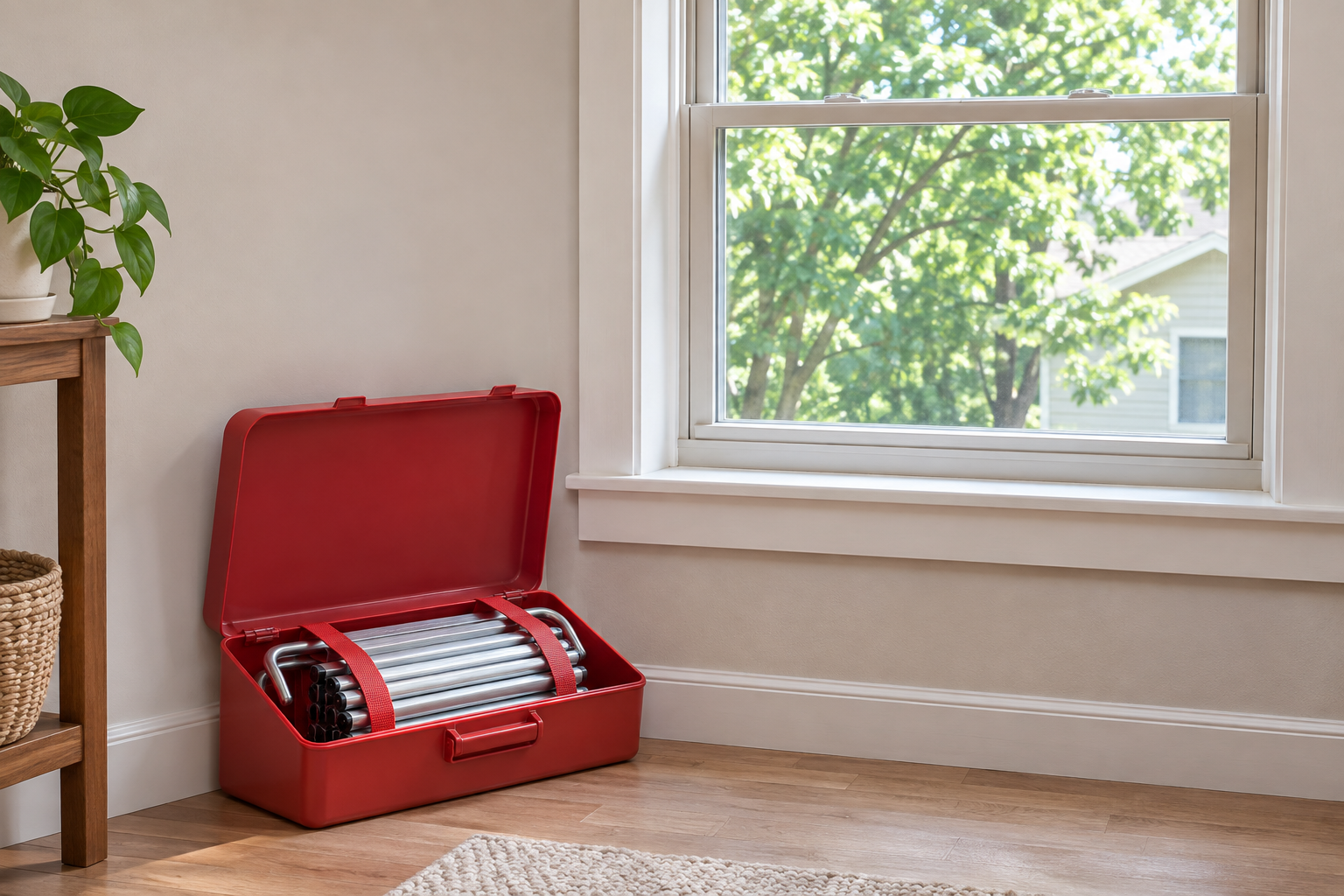
Fire escape ladder window sill thickness is only one model-specific part of fit; no escape ladder is universal. Check the exact ladder’s documented fit at the specific intended window, and do not treat any ladder as a guarantee of a safe escape. This is a model-specific decision, not a substitute for a manufacturer’s instructions, local requirements, or qualified help. Keep the product label and its current US documentation together while you decide.
For the Kidde KL-2S example, check the manufacturer’s 5½-to-11-inch windowsill range, a clear window opening at least 16 inches wide, and the 14-foot maximum use height. These are model-specific conditions, not limits for every escape ladder.
Match the ladder model to the building height first
Identify the exact ladder model and read its US user guide before choosing a window. A two-story model and a three-story model can have different height, length, storage, deployment, and single-use rules. Do not buy or store a ladder based on a broad “fits most windows” claim.
For the Kidde KL-2S, the user guide describes an approximately 13-foot ladder and a maximum use height of 14 feet. Those are different measurements: the nominal ladder length does not set the approved window height. Confirm the exact model and its guide before choosing an upper-floor window.
| Fit item | Why it matters | Decision boundary |
|---|---|---|
| Exact model and story rating | Ladder length and approved height vary | Use the model’s own manual only |
| Window opening | A person must be able to exit through the opening | Measure only against the manual’s requirement |
| Sill and hook contact | The hooks need the approved surface and dimensions | Do not use a sill outside the stated range |
| Exterior path below | Obstructions can make deployment unsafe | Choose another approved escape option if blocked |
| Reuse status | Some designs are explicitly single use | Follow the manual; do not assume it can be repacked |
Check the window, sill, and outside path together
For the Kidde KL-2S, the stated windowsill range is 5½–11 inches and the guide requires an opening at least 16 inches wide. Check the sill and frame against the manufacturer’s diagram. An opening that meets the width requirement is not, by itself, approval of the entire window or attachment path.
Do not choose a window blocked by furniture, security devices, air-conditioning equipment, or a window treatment that cannot be cleared as intended. Do not assume a balcony, railing, or a neighboring window is an approved attachment point. Remove no security feature or building component without the required authority and an approved safety plan.
Plan, practice, and storage have limits
Family escape planning is important, but avoid unsafe demonstrations. Kidde strongly recommends practicing only the mounting steps 1 through 3. Do not pull the release strap to deploy the ladder during practice, do not have anyone climb a deployed ladder as a casual exercise, and do not deploy, repack, or reuse it contrary to the manual. A manufacturer may call the ladder single-use, and a person’s mobility, age, or medical needs may make an escape plan unsuitable. Discuss those limits with local fire-safety professionals where appropriate.
Keep the ladder where the manual says it can be reached without blocking the exit or turning the room into a storage hazard. Establish more than one way out of rooms when possible and follow local fire department guidance. A window treatment choice can also affect access; the window security film guide explains that window modifications have limits and should not be treated as a universal safety solution.
Do not promise a universal escape outcome
A correctly stored ladder does not guarantee a safe exit in a fire. Conditions can change quickly, and the safest action is to follow emergency instructions and local guidance. Keep emergency contacts and critical household information accessible, including in a renter emergency documents folder. This article does not replace a fire-escape plan reviewed for the people and building involved.
Make the storage location part of the fit check
A ladder can be correct for a window but still unusable if it is buried behind furniture, a locked closet, or heavy storage. Store it exactly as the manual directs, in a location that can be reached without climbing over obstacles. Do not place furniture in front of the selected escape window merely because it can be moved in ordinary circumstances. A planned route needs to be evaluated as the room changes.
Check the window’s normal operation as part of routine maintenance, but do not alter latches, guards, security bars, or building components without authorized guidance. A window that is painted shut, damaged, or blocked is a building safety issue to report, especially in a rental. The ladder’s hooks cannot correct a window that does not open or a route that cannot be used.
Account for the people who may need to escape
Children, older adults, guests, and people with mobility, sensory, or medical needs may require a different plan. Do not assume that a person can use an emergency ladder because the product has a stated load figure or because another household member can. Make a practical plan with local fire-safety professionals if there are special needs, and designate an outside meeting place according to local guidance.
Review after changes to windows or rooms
Recheck the exact model manual if you move, replace a window, add a security device, change floors, or buy a different ladder. Window dimensions and sill construction can change even in similar rooms. A past fit check is not permanent approval. If you cannot verify fit and a clear exterior path, do not store the ladder as a relied-upon escape method.
FAQ
Will any escape ladder fit my window?
No. Confirm the exact ladder’s opening, sill, height, and attachment requirements in its manual.
Can I use a two-story ladder from a third story?
No. Use only within the model’s stated height and story limits.
Can I practice by climbing the ladder?
For the cited Kidde KL-2S, practice only mounting steps 1–3. Do not pull the release strap, deploy the ladder, or climb it for practice.
Can I reuse a deployed escape ladder?
Do not assume so. Kidde’s KL-2S product page describes it as single-use; follow the exact model documentation.
Check the exact model in safety notices
Check the escape ladder’s exact brand and model in CPSC notices and compare any serial, lot, or date range with the label. Follow a matching notice’s instructions rather than trying to repair, repack, or test-deploy the ladder. Resolve replacement and escape-plan questions with the manufacturer and local fire-safety authorities before relying on it. Use CPSC Recalls & Product Safety Warnings. No search result is a guarantee of safety.
Sources and fact-checking
Checked against the official sources below on November 27, 2026. This is research-based guidance, not a claim of hands-on product testing.


댓글 0
첫 댓글을 남겨보세요.