
Water Filter Pitcher Size: Will It Fit Your Fridge Door?
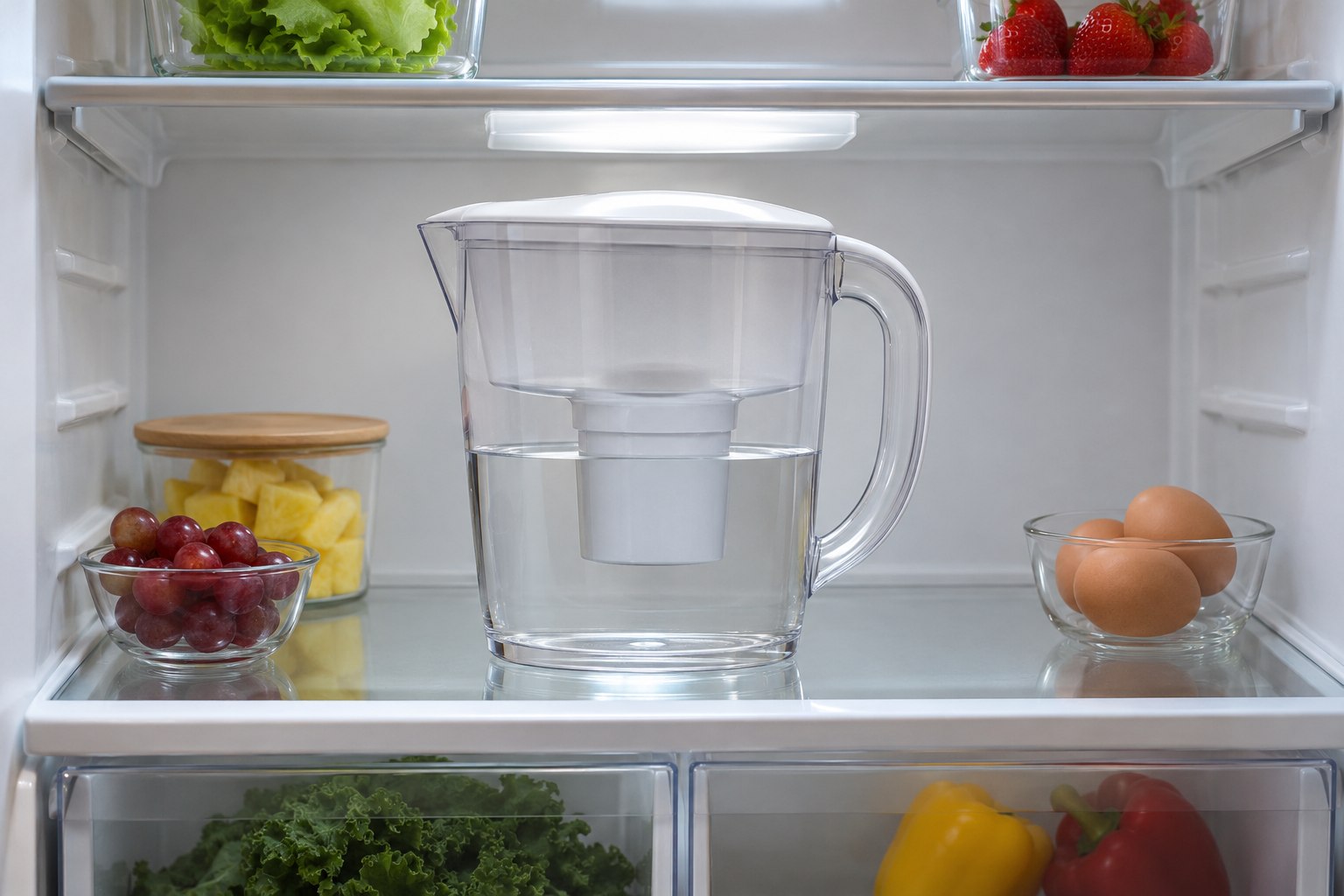
Choose a water filter pitcher size by measuring the place you’ll lift it out of, not just the place it will stand. A door bin works if the pitcher sits level, clears the bin above it, and comes out without tipping. Otherwise, try the front of a main shelf. Among the models that fit, choose the capacity you can comfortably pour when full. Then check the cartridge for the particular contaminant you want to reduce. The bigger pitcher isn’t necessarily the better filter.
Start with the breakfast rush, not the cup count
Line up what you actually fill before the next person can refill the pitcher: perhaps a travel bottle and a drinking glass. Use a measuring cup to find their combined volume. A household that fills bottles together may want more water ready at once than one that pours the same amount over an afternoon. Neither household needs to buy a pitcher that holds a full day’s supply unless that’s how they intend to use it.
Look at what the manufacturer means by capacity. You want to know how much filtered water is available to pour, not how much water fits into all the components laid out on the counter. The upper reservoir is where tap water goes before it passes through the filter. Check whether reaching the listed capacity takes more than one fill of that reservoir. If the page doesn’t say, don’t assume the pitcher delivers its entire capacity straight from a single trip to the faucet.
Measure the door bin at its narrowest point
Leave the refrigerator shelves in their usual positions. Measure the flat bottom of the door bin, then measure again at the retaining rail. A curved corner, a bottle divider, or a molded lip can take away usable width. Measure up from the bin floor to the obstruction above. The difference between that height and the pitcher’s height has to let you lift the base over the rail.
For a concrete comparison, Brita’s U.S. page for the Denali with Original Filter lists a six-cup capacity and dimensions of 9.7 inches high, 4.6 inches wide, and 9.1 inches long. Cut a paper rectangle to those last two dimensions, mark the handle end, and put it in the bin. This is a first check, not proof of fit: a rectangle won’t tell you whether your fingers can get behind the handle or whether the shoulder of the pitcher clears the rail.
To check height, fold a piece of cardboard upright on the paper footprint. Close the door slowly with the mock-up in place; stop rather than force it if it touches a shelf. Open the door as far as the kitchen wall normally allows and try the lifting motion. A bin that would work with the door wide open may not work beside a wall. Keep the milk carton or condiment bottle that usually lives next to the pitcher in place for this test.
| Location | What to measure | Reason to choose it | Reason to rule it out |
|---|---|---|---|
| Door bin | Inside floor, rail, lift clearance, and door swing | Leaves the main shelf open; handle is easy to reach | The pitcher rocks or has to tilt to get over the rail |
| Front of main shelf | Closed height, handle depth, and hand space beside it | Can slide forward before lifting | Spout or handle projects into the door bins |
| Deeper on a shelf | Reach past the front row with groceries in place | May suit an occasional second pitcher | A full pitcher has to come out over other food |
Choose a water filter pitcher size you can pour comfortably
If the water filter pitcher size you want rules out the door, turn the paper footprint on a main shelf so the handle points toward you. Leave enough room to wrap your hand around it without sliding neighboring food out of the way. Verify that the whole base stays on the shelf and that the pitcher won’t hide a vent or prevent a drawer from opening. If you’re measuring a refrigerator just emptied for shopping, use this small-fridge reset before grocery day to distinguish a permanent space from one that disappears when groceries come home.
Consider the distance from that shelf to the glass. A large pitcher might be easy to carry with both hands but hard to tip from a high shelf into a bottle with a narrow mouth. Try a familiar jug filled with the amount of water you measured, carrying it from fridge to counter and pouring over the sink. That gives you a feel for the water alone; the pitcher, reservoir, and cartridge add weight, and handle shape changes the balance. If the load feels awkward, a smaller pitcher and a second refill are a reasonable trade.
Open the lid where you’ll actually fill it
You don’t need to open the lid inside the refrigerator if you always refill at the sink. You do need room under the faucet for the lid in its filling position. Check where the water stream lands with the pitcher standing upright. If your sink has an over-the-sink dish rack, do that check with the rack loaded: a hanging mug can occupy exactly the space where a flip lid needs to open.
Changing a filter is a different motion from flipping a fill door. Find a dry counter spot where the entire lid can come off and the reservoir and cartridge can lift out. Look at the care instructions before deciding which parts can join your normal dishwashing routine. For the Denali example, Brita says to remove the filter and hand-wash the other components with mild soap, not put them through the dishwasher. A pitcher that fits the refrigerator but not your sink is a poor match for a tiny kitchen.
Buy the filter claim separately from the plastic shell
Record the cartridge name alongside the pitcher model when you compare prices. A package photo or cup count isn’t a performance data sheet. If lead is the concern, EPA’s consumer tool identifies pitcher and other point-of-use filters evaluated by an accredited third party for lead reduction and Class I particulate reduction. Check the exact system and claim. A claim about chlorine taste or odor isn’t evidence of a lead reduction claim, and neither tells you that the unit treats every contaminant.
Use the same model-specific approach to replacement cartridges. Brita lists 40 gallons, or about two months for most households, for the Original filter in the Denali example; it notes that hard water can mean more frequent replacement. Don’t transfer that schedule to another cartridge. Compare current refill-pack prices for the cartridge you intend to buy, and check that you can obtain it without buying another pitcher. Between two equally comfortable sizes, availability of the correct refill is a good tiebreaker.
FAQ
Can I store a pitcher sideways if it’s too tall?
Don’t count on a pouring lid to hold water on its side. Choose upright storage unless the maker explicitly approves another position for the filled pitcher. Turning the handle sideways while keeping the base level is a different option worth measuring.
Can I just fill a large pitcher halfway?
Yes, if you follow its filling directions. That can make the pour more manageable, but the handle, lid, and base still take up the same refrigerator space. Compare its footprint with a smaller model before buying.
Is a pitcher’s listed weight its weight when full?
Not unless the specification says so. Look for a clearly identified filled weight; otherwise, use a water-filled jug as a rough handling check rather than treating the product or shipping weight as your lifting load.
What if the product page doesn’t show the lid open?
Ask for the open-lid height or check a display model. If the faucet is the only tight spot, a removable lid might work where a tall hinged one won’t. You still need room to install the cartridge.
Sources and fact-checking
Sources checked November 19, 2026. This is a research-based guide, not a hands-on product test.
Brita’s U.S. Denali with Original Filter specifications supply the model dimensions, capacity, care directions, and replacement example. EPA’s guide to filters certified to reduce lead addresses certification, not household fit or the performance of the example pitcher.



댓글 0
첫 댓글을 남겨보세요.