
Portable Air Conditioner for Apartment: Vent, SACC, and Fit
A portable air conditioner for apartment use must fit the window and exhaust route before its cooling number, app, or wheel design matters. Compare DOE SACC capacity, room heat load, single- versus dual-hose layout, window-panel range, electrical circuit, condensate plan, noise, lease rules, and security.
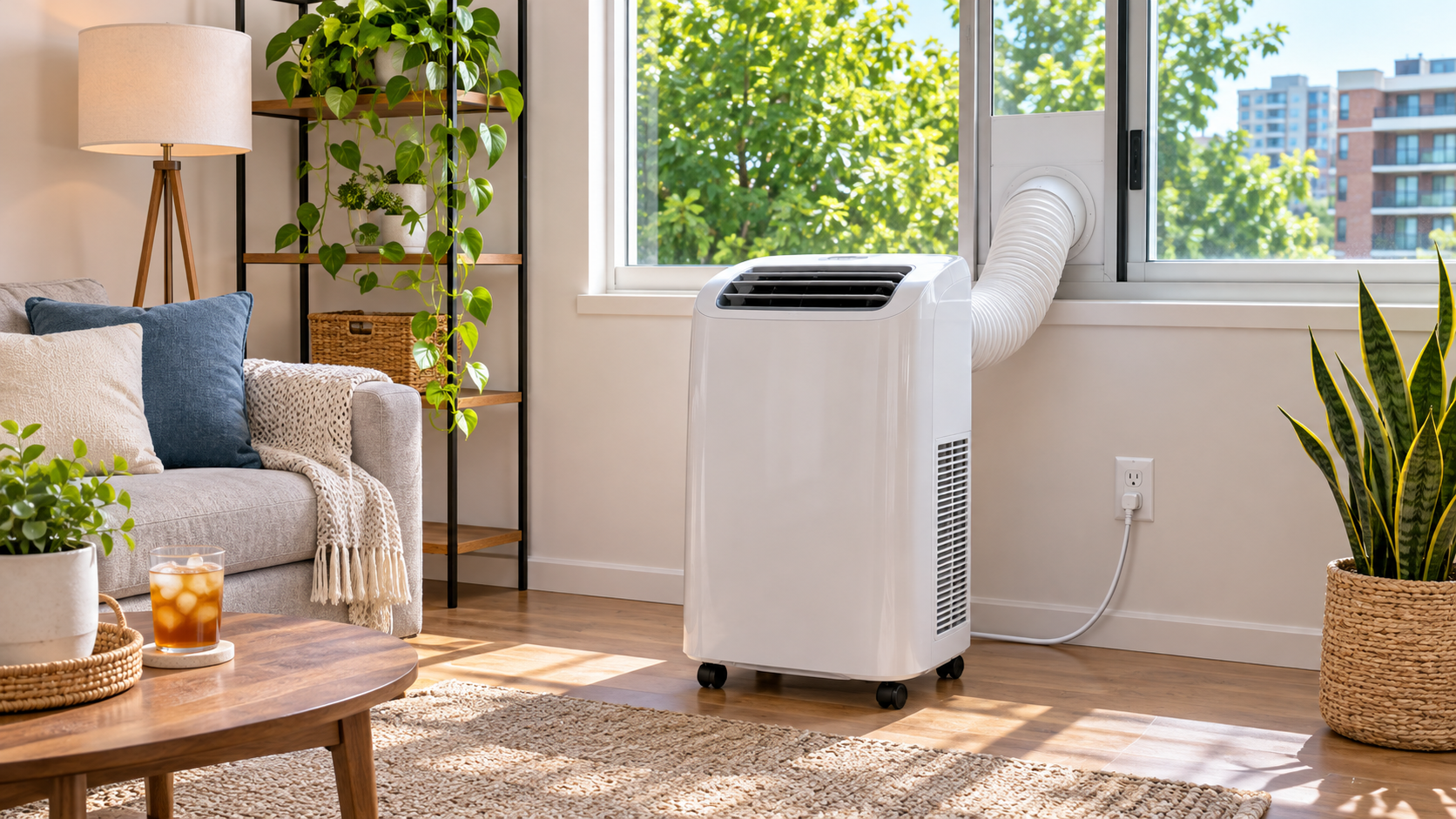
Portable air conditioners are not vent-free. Cooling mode moves heat from the room and the exhaust hose must discharge outdoors through an approved window or opening. Evaporative air coolers are a different product and do not provide refrigerated air conditioning in humid climates.
Start with the window, room, and rating label
Measure the window opening, panel orientation, sill, screen, lock, curtains, blinds, and distance to the planned floor position. Confirm that the kit supports a vertical or horizontal opening as needed and can be sealed without prohibited lease modifications. A long, sharply bent hose reduces practical placement options.
Portable units can display both an older ASHRAE capacity and the DOE Seasonally Adjusted Cooling Capacity, or SACC. Compare the DOE-rated capacity or the standardized rating shown on the EnergyGuide label when possible. FTC labeling rules require portable air-conditioner labels to provide capacity, estimated annual energy use, efficiency information, and operating-cost context.
| Decision | What to compare | Apartment constraint | Avoid |
|---|---|---|---|
| Cooling capacity | DOE SACC or current standardized rating | Room area, sun, ceiling, people, and heat-producing devices | Comparing only the larger ASHRAE number |
| Hose design | Single or dual hose, diameter, length, and bend limit | Window distance and floor path | Extending or crushing the hose without approval |
| Window kit | Panel range, orientation, seal, lock, and weather resistance | Lease rules, screens, blinds, and security | Cardboard or loose fabric exhaust setups |
| Condensate | Self-evaporation limits, drain ports, bucket or hose | Humidity, floor protection, and drain access | Assuming “no drain” applies in every condition |
Nine buying checks for a portable apartment air conditioner
1. Use the standardized cooling rating
Find DOE SACC or the current standardized capacity on the EnergyGuide label or manufacturer documentation. Do not compare one product’s ASHRAE number with another product’s SACC. The adjusted rating reflects portable-unit operating conditions more realistically. Match capacity to the room and heat load rather than choosing the largest number that fits the budget.
2. Measure the real room load
Record floor area, ceiling height, afternoon sun, window size, kitchen connection, occupancy, computer equipment, and whether doors remain open. A south- or west-facing studio with cooking heat is a harder job than a shaded closed bedroom of the same size. Oversizing can also increase cost, noise, and cycling.
3. Verify the window-kit range
Measure the clear opening and check the kit’s minimum and maximum panel length, orientation, and panel thickness. Confirm how the hose adapter attaches and whether the window can be secured after installation. Renters should review lease and building rules before drilling, removing screens, or altering a fire-escape window.
4. Plan the shortest approved hose route
Follow the manual’s hose length, bend, and elevation limits. Keep the unit near the window with smooth, gradual routing and enough space behind it. Do not add an unapproved extension, crush the hose behind furniture, or wrap it in combustible material. The hose becomes hot because it carries room heat outdoors.
5. Compare single- and dual-hose designs
A single-hose unit exhausts indoor air and can draw replacement air into the room through gaps. A dual-hose design separates intake and exhaust paths and may improve practical performance in some conditions, but it adds another hose and a larger window connection. Compare standardized ratings, physical fit, and price rather than assuming hose count alone decides efficiency.
6. Check the circuit and plug reach
Read rated voltage, amps, and watts. Identify a grounded wall outlet within the supplied cord’s reach and determine what else shares the circuit. Do not use an extension cord unless the manufacturer specifically permits it. A portable AC can run for many hours, so inspect the plug and outlet for looseness, heat, or damage.
7. Understand condensate behavior
“Self-evaporating” does not mean no water under every temperature and humidity condition. Find all drain ports, bucket or internal-pan alerts, continuous-drain instructions, hose diameter, and floor-protection advice. If a drain hose is needed, ensure it slopes correctly or uses an approved pump. Test the plan while supervising the unit.
8. Price noise, maintenance, and movement
Compare sound ratings and compressor cycling at the mode you will use at night. Check filter access, caster clearance, carrying handles, unit weight, and seasonal storage dimensions. A wheeled machine still has to cross thresholds and may need two people on stairs. Clean filters and drain the unit before storage as directed.
9. Verify identity, security, and recalls
Record the exact model, EnergyGuide data, serial or date code, manual, warranty, and seller. Search CPSC recalls. Inspect whether the window panel creates a security gap or prevents the window lock from engaging. Use an approved secondary window lock if needed without blocking emergency egress.
Apartment portable AC worksheet
- Room: area, ceiling, sun, windows, occupants, kitchen, electronics, doors, and target sleeping zone.
- Rating: DOE SACC, EnergyGuide efficiency and estimated energy use, voltage, watts, and amps.
- Window: opening direction, clear range, sill, screen, blind, lock, panel, seal, and lease rules.
- Hose: count, diameter, supplied length, bends, heat, adapter, and shortest approved route.
- Water: drain ports, alerts, high-humidity behavior, hose slope, pump, and floor protection.
- Operation: noise, filters, outlet, caster route, storage, model identity, and recall result.
These TrendIssue guides help the cooling unit fit the apartment and seasonal storage plan.
- How to Prepare a Small Apartment for Winter — use the same measure-first approach for seasonal equipment
- How to Rotate a Small Apartment Closet for Summer — make space for seasonal cooling gear and window parts
- A Small Home Safety Reset — review outlets, cords, paths, and emergency access
Test cooling, drainage, and security immediately
A short power-on test is not enough. Use several operating conditions while the return window and installation materials are available.
- 1. Document: Photograph the model label and EnergyGuide information, save the manual, and verify recall status.
- 2. Install: Fit the window panel and hose exactly as directed, seal gaps, and confirm the window remains secure and emergency egress is preserved.
- 3. Run closed-room test: Use the planned mode and fan setting with doors and windows in normal positions; observe cooling and noise over several hours.
- 4. Check water: Inspect drain ports, floor, hose, and alerts during a humid period or after extended operation.
- 5. Maintain and store: Practice filter removal, safe movement, draining, hose disconnection, and dry seasonal storage before the return period ends.
Common mistakes and tradeoffs
Comparing only ASHRAE BTU: Use DOE SACC or comparable standardized capacity to avoid inflated cross-model comparisons.
Buying before measuring the window: A mismatched panel or blocked lock can make the entire appliance unusable.
Extending the exhaust hose casually: Extra length and sharp bends can conflict with the tested installation and reduce practical performance.
Assuming no drainage is ever needed: Humidity and operating conditions can still require draining.
Ignoring the shared circuit: Long runtime and high electrical load require the correct wall outlet and an undamaged connection.
Frequently asked questions
What BTU should I compare on a portable air conditioner?
Use DOE SACC or the current standardized rating shown in official documentation. Do not compare an ASHRAE value from one model with SACC from another.
Do portable air conditioners need a window?
They need an approved path to exhaust heat outdoors, usually through a window kit. A product with no exhaust hose is generally an evaporative cooler, not the same type of air conditioner.
Do I have to drain a portable AC?
It depends on the model, mode, temperature, and humidity. Check every drain port and the manual; self-evaporation may reduce water handling but does not eliminate it in all conditions.
Can I use an extension cord?
Use the outlet and cord arrangement required by the manufacturer. Portable air conditioners are high-load appliances, and many manuals prohibit ordinary extension cords.
Sources and fact-checking
- U.S. Department of Energy: Portable Air Conditioners
- Electronic Code of Federal Regulations: EnergyGuide Label Content for Portable Air Conditioners
- U.S. Consumer Product Safety Commission: Recalls & Product Safety Warnings
Fact-check completed November 16, 2026. Product specifications, prices, manuals, and recall status can change, so verify the exact model before purchase.




댓글 0
첫 댓글을 남겨보세요.