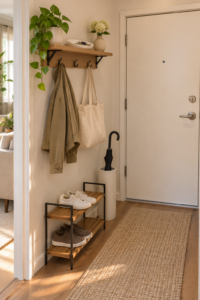
Wall Mounted Coat Rack vs. Freestanding: Best for Small Spaces?
A wall mounted coat rack keeps the floor open and can make a narrow entryway easier to use, but it requires a suitable wall and correct installation. A freestanding coat rack needs no wall holes and moves easily, but its base takes floor space and it can become unstable when weight is uneven. The best choice is not simply the one with more hooks. It is the one your space, wall, lease, and daily load can support safely.
This guide compares the two formats without naming a “best” product. If you need a broader plan for shoes, keys, bags, and mail, see our entryway storage guide. If you are choosing only a place for coats and bags, start with the decision below.
Quick answer: which coat rack fits your situation?
- Choose a wall mounted coat rack when the hallway is narrow, floor clearance matters, the wall can support the installation, and drilling is allowed.
- Choose a freestanding coat rack when you cannot alter the wall, expect to move the rack, or have a stable corner with enough floor clearance.
- Choose neither yet if the doorway is already crowded, the wall material is unknown, or your household routinely overloads hooks with heavy bags.
Renters should read the lease and obtain any required permission before drilling. Regardless of format, follow the product’s installation, assembly, and load instructions rather than relying on generic hardware advice.
Wall-mounted vs. freestanding coat rack
| Decision factor | Wall-mounted rack | Freestanding rack | What to verify |
|---|---|---|---|
| Floor space | Keeps floor clear | Needs a base footprint plus room for hanging coats | Door swing and walking path |
| Installation | Requires compatible fasteners, wall, and placement | Usually requires only correct assembly | Manual, wall type, lease, tools |
| Mobility | Fixed after installation | Easy to relocate when unloaded | How often the layout changes |
| Stability | Depends on correct attachment and load | Depends on base, assembly, placement, and balanced loading | Wobble, loose hardware, uneven loads |
| Cleaning | Floor below stays accessible | Must be moved or cleaned around | Can it move safely when empty? |
| Rental fit | May require written permission and wall repair later | Avoids wall modification | Lease and landlord instructions |
Measure the real footprint before shopping
Product width is only one measurement. Hanging coats project beyond the rack, a freestanding base can be wider than its hooks, and a wall unit needs clearance for sleeves and bags. Use painter’s tape to outline the expected area on the wall or floor, then open the door and walk through with a grocery bag or backpack.
For a wall mounted coat rack, measure:
- Available wall width without covering a switch, intercom, panel, or door trim.
- Projection from the wall, including the depth of hanging coats.
- Installation height for the shortest and tallest users.
- Distance from the door so a coat or bag cannot catch the handle.
- Wall construction and any location restrictions in the product manual.
For a freestanding coat rack, measure:
- The full base width or diameter, not just the central pole.
- The sweep of coats and bags hanging from the outer hooks.
- Clearance from the door, bench, shoe rack, and walking lane.
- Ceiling height and nearby light fixtures or sprinklers.
- The space needed to clean around it or move it while unloaded.
A cardboard floor template is useful for a freestanding model. Leave it in place for a day and see whether people step around it, bump it, or use it as an unintended bag drop.
When a wall mounted coat rack is the better choice
Wall-mounted storage is usually the more space-efficient format for a very narrow hallway because it does not claim a permanent floor footprint. It also lets you choose a height that works for the household and keeps shoes easier to reach or clean around.
It is a strong candidate when:
- The entryway has usable wall space but very little floor space.
- You want hooks at different heights for adults and children.
- You can install the rack exactly as the manufacturer specifies.
- The lease or landlord permits the required holes and hardware.
- The daily load is predictable and within the stated limits.
Do not assume that any screw or adhesive hook is interchangeable with the supplied hardware. Wall materials differ, and a fastener appropriate for one surface may be wrong for another. Read the rack instructions, identify the wall construction, and use a qualified installer if the support or hidden utilities are uncertain.
When a freestanding coat rack is the better choice
A freestanding coat rack can be a practical rental solution because it requires no permanent wall modification and can move to a new home. It also works where the wall is occupied by a closet door, mirror, electrical panel, or material that the renter should not drill.
It is a strong candidate when:
- Drilling is prohibited or the wall type is unsuitable.
- You have a stable corner outside the main walking path.
- You expect to rearrange the room or move within a short period.
- The base is wide and stable enough for the intended load.
- Household members can load both sides evenly.
The ability to move a rack is useful only when it is empty. Dragging a loaded stand can loosen joints, damage flooring, or shift the center of gravity. Place the heaviest permitted items lower when the design provides lower hooks, distribute coats around the pole, and do not hang a heavy bag on one outer hook unless the manufacturer specifically allows it.
Stability and tip-over questions
The CPSC’s Anchor It! campaign focuses on preventing furniture and TV tip-overs, especially around children. Coat racks are not the same product category as dressers, but the broader safety habits are still relevant: use stable products, follow manufacturer instructions, keep heavier loads low when possible, and respond to wobbling or leaning instead of treating it as normal.
If a freestanding rack rocks on a flat floor, check assembly and fasteners with the load removed. If it remains unstable, stop using it and contact the manufacturer or retailer. Do not improvise a wall attachment unless the product is designed for one.
For a wall mounted coat rack, inspect the mounting points periodically. A widening gap, crumbling wall surface, bent hook, loose screw, or new movement under normal load is a reason to unload the rack. Correct repair depends on the wall, hardware, and product instructions.
If children live in or regularly visit the home, avoid turning hooks into climbing points and keep straps or dangling loops from inviting pulling. Follow any child-safety warnings supplied with the product.
What specifications matter most?
Marketing photos rarely show winter coats, backpacks, or uneven use. Compare products by the information you can verify.
- Overall dimensions: include the full base, shelf, and hook projection.
- Load information: look for a stated limit and whether it applies per hook or to the entire rack.
- Required hardware: confirm what is included and what wall conditions the instructions cover.
- Base design: a broad, level contact area is easier to assess than a decorative base with uncertain footing.
- Hook spacing: closely spaced hooks may hold fewer bulky coats than the hook count suggests.
- Assembly method: joints and fasteners should be accessible for retightening if the manual calls for it.
- Return policy: useful when the actual footprint or stability differs from expectations.
Count daily items before counting hooks. Two adults may need four useful positions for coats and bags, not a twelve-hook rack that becomes a permanent storage tower.
A renter decision scorecard
Use this simple sequence before buying:
- Protect the path: eliminate any option that interferes with the door or planned exit route.
- Check permission: if drilling is required, review the lease and ask the landlord in writing when necessary.
- Verify the surface: compare the wall or floor conditions with the manufacturer’s instructions.
- Test the footprint: use tape or cardboard for at least one normal day.
- Count the load: list the actual coats and bags used daily.
- Plan overflow: decide where seasonal and occasional outerwear will live.
If both formats fit, choose based on the tradeoff you feel every day. In a very narrow hall, preserving floor space may justify proper wall installation. In a temporary rental with an open corner, the flexibility of a freestanding coat rack may be more valuable.
Keep the entryway usable after installation
A rack does not solve excess volume. Set a practical limit, such as one daily coat and one everyday bag per person, and move off-season items to another location. Pair the rack with a defined shoe area rather than letting footwear spread into the walking path. Our shoe storage guide for small spaces can help you choose that boundary.
The U.S. Fire Administration advises households to make sure doors and windows in an escape plan are not blocked. Review its home fire escape plan guidance, then confirm that coats, bags, and the rack itself stay outside the route.
If you are installing a separate tall storage unit nearby, our anti-tip furniture straps guide for renters explains what to check before anchoring furniture. Do not use a coat rack as a substitute for a properly installed storage cabinet, and do not attach unrelated furniture to the coat rack.
Frequently asked questions
Is a wall mounted coat rack better for a small entryway?
It often preserves more floor space, which is valuable in a narrow entryway. It is the better choice only when the wall is suitable, the rack can be installed according to its instructions, drilling is allowed, and hanging items will not interfere with the door or walkway.
Are freestanding coat racks safe?
A properly assembled rack on a level floor may be suitable for its intended load, but stability varies by design and use. Follow the manual, distribute weight evenly, keep within stated limits, and stop using a rack that wobbles, leans, loosens, or shows damage.
Can renters install a wall mounted coat rack?
That depends on the lease, landlord requirements, wall construction, and local rules. Review the lease and obtain permission when required before drilling. Also ask who is responsible for installation and wall repair at move-out.
How many hooks should a coat rack have?
Count the daily coats and bags you intend to hang, then choose spacing and capacity that can handle that real load. More hooks are not automatically better because bulky items can overlap, invite overloading, and extend into the walking path.
Sources