
Plug-In Carbon Monoxide Alarm Outlet Placement: Start With the Manual
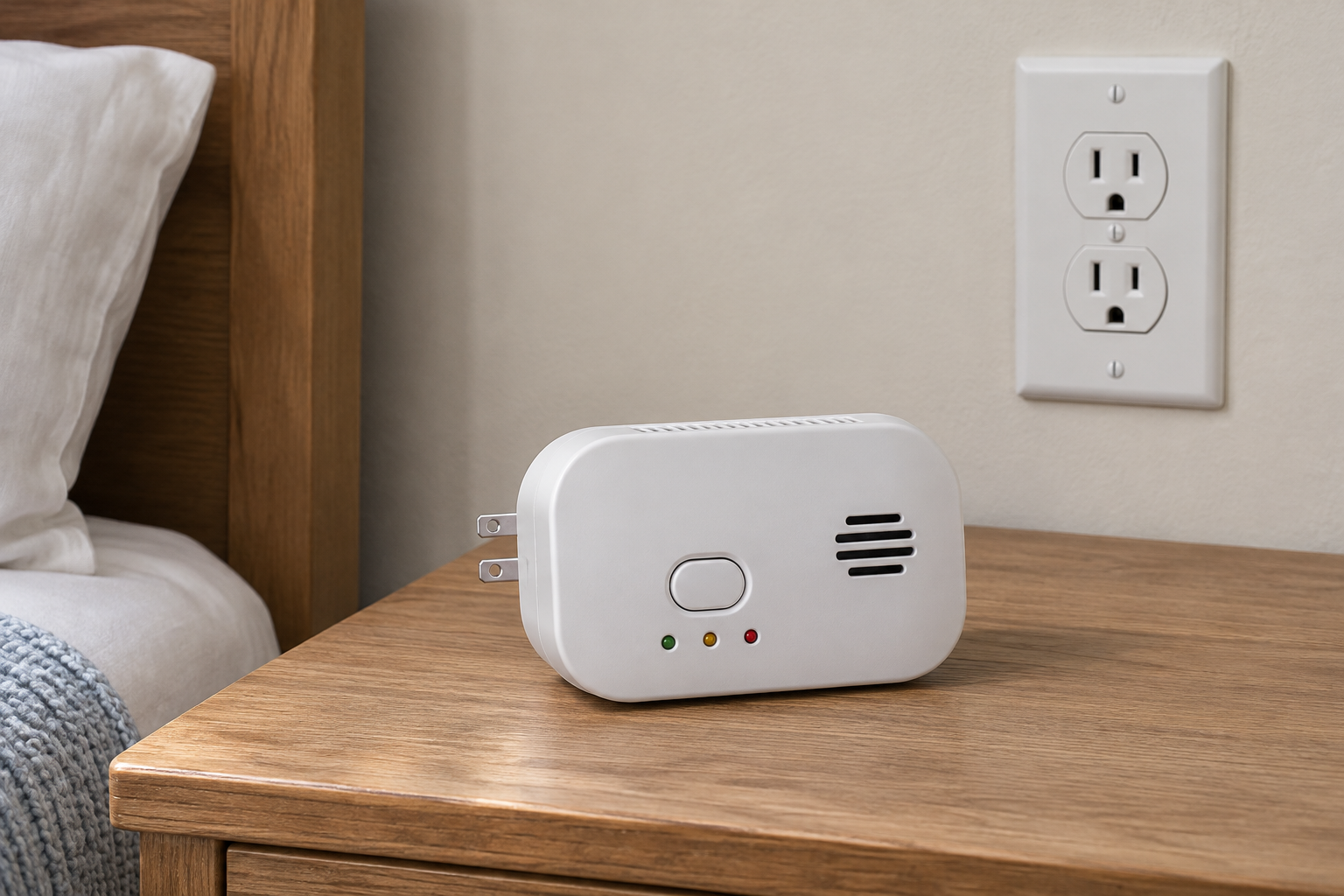
Plug in carbon monoxide alarm outlet placement starts with the exact alarm manual, not a universal “best outlet.” Choose a permitted outlet location that supports coverage near sleeping areas, stays unobstructed, and meets local rules. This is a model-specific decision, not a substitute for a manufacturer’s instructions, local requirements, or qualified help. Keep the product label and its current US documentation together while you decide.
Choose the alarm model before choosing the outlet
Confirm whether the product is plug-in only, plug-in with battery backup, battery-operated, or hardwired. The alarm’s instructions determine its allowed orientation, height, room conditions, power requirements, and prohibited locations. A plug-in alarm needs a continuously usable receptacle; it should not be placed where furniture, drapery, or stored items cover it.
| Outlet-location question | What to check | If unclear |
|---|---|---|
| Sleeping-area coverage | Whether the location serves the stated coverage purpose | Read the manual and local requirements |
| Outlet obstruction | Furniture, curtains, or stored items will not cover the alarm | Select another permitted location |
| Windows, doors, vents, dead-air spaces | Exact manual limits and airflow conditions | Do not guess from a room diagram |
| Power outage | CPSC recommends battery backup for plug-in and hardwired CO alarms | Choose a model with battery backup and maintain it as directed |
| Rental property | Building-provided alarm system and manager responsibility | Ask the manager; do not replace required equipment casually |
Do not use an outlet just because it is convenient
An outlet behind a sofa, under a curtain, next to an open window or door, or in another location the manual excludes may be a poor choice even when it is physically available. Kidde says alarms should be free of obstructions and not placed in dead-air spaces or next to a window or door. Its placement page discusses additional placement considerations near CO sources; use the exact product manual to resolve conflicts.
Do not place a plug-in alarm in a kitchen or above a fuel-burning appliance merely to be close to a possible source. CPSC specifically says it does not recommend those locations. Do not use an extension cord, power strip, or adapter unless the manufacturer explicitly permits that configuration.
Plan for sleeping areas and power loss
CPSC recommends battery backup for plug-in and hardwired CO alarms. Verify the exact model includes it and maintain it as the manual directs. Test and maintain the alarm only as its manual directs. An alarm is not a repair for a suspected combustion, venting, appliance, or health emergency. If an alarm sounds or anyone may have symptoms, immediately move outside, call 911 from there, and do not re-enter until emergency responders say it is safe.
For renters, do not remove a building-provided alarm to make room for a personal product. Record model information and report missing or malfunctioning equipment. Keep the manager’s response and alarm information with the materials in this renter emergency documents folder; use the maintenance request guide to document unresolved building equipment.
Check local requirements separately
State and local CO-alarm laws can set requirements that a general product page does not capture. Confirm the authority having jurisdiction, fire department, or building manager’s current requirements for the address. This article does not determine code compliance or establish an adequate number of alarms for a home.
Use the product’s placement diagram as the tie-breaker
General advice cannot resolve a conflict between two nearby outlets. The manual may specify an orientation, a distance from a corner or source, temperature and humidity limits, or locations to avoid. Read that document before purchase and again before plugging it in. Do not turn the alarm face toward a wall, cover its openings, or use a receptacle that requires the device to be bent, squeezed, or hidden.
If the only available outlet is not allowed by the manual, the solution is not to adapt the alarm. Consider another alarm type only after confirming the manufacturer instructions and local requirements. Do not alter an outlet or building wiring yourself to create a location for an alarm.
Keep alarms ready for an emergency
Follow the manual’s test, battery, cleaning, and replacement instructions. Do not spray cleaners into it or assume a test button proves every possible condition. If it signals, do not spend time relocating it or searching the app first. If the CO alarm sounds, get everyone outside to fresh air immediately. Call 911 from outside and do not re-enter until emergency responders say it is safe. CO is odorless and cannot be confirmed by smell.
FAQ
Can I put a plug-in CO alarm behind furniture?
No. Do not obstruct it; choose a location allowed by the exact manual.
Does a plug-in CO alarm need battery backup?
CPSC says plug-in or hardwired CO alarms should have battery backup. Check the exact product.
Can I use an extension cord for a CO alarm?
Do not assume that is permitted. Follow the alarm manufacturer’s power instructions.
Do local rules matter if I follow the manual?
Yes. Local requirements and rental building rules may add obligations.
A personal plug-in alarm does not replace required building equipment. Plan the home’s alarm coverage with the exact model instructions and, in a rental, building management.
Check the exact model in safety notices
Search CPSC notices for the CO alarm’s exact brand and model, then compare any serial, lot, or date range with its label. Follow a matching notice’s stop-use, replacement, repair, or disposal instructions and promptly arrange working replacement coverage. In a rental, contact building management; do not treat recall research as a reason to delay evacuating when an alarm sounds. Use CPSC Recalls & Product Safety Warnings. No search result is a guarantee of safety.
Sources and fact-checking
Checked against the official sources below on November 27, 2026. This is research-based guidance, not a claim of hands-on product testing.



댓글 0
첫 댓글을 남겨보세요.