
Meat Thermometer Probe Cleaning and Waterproof Ratings
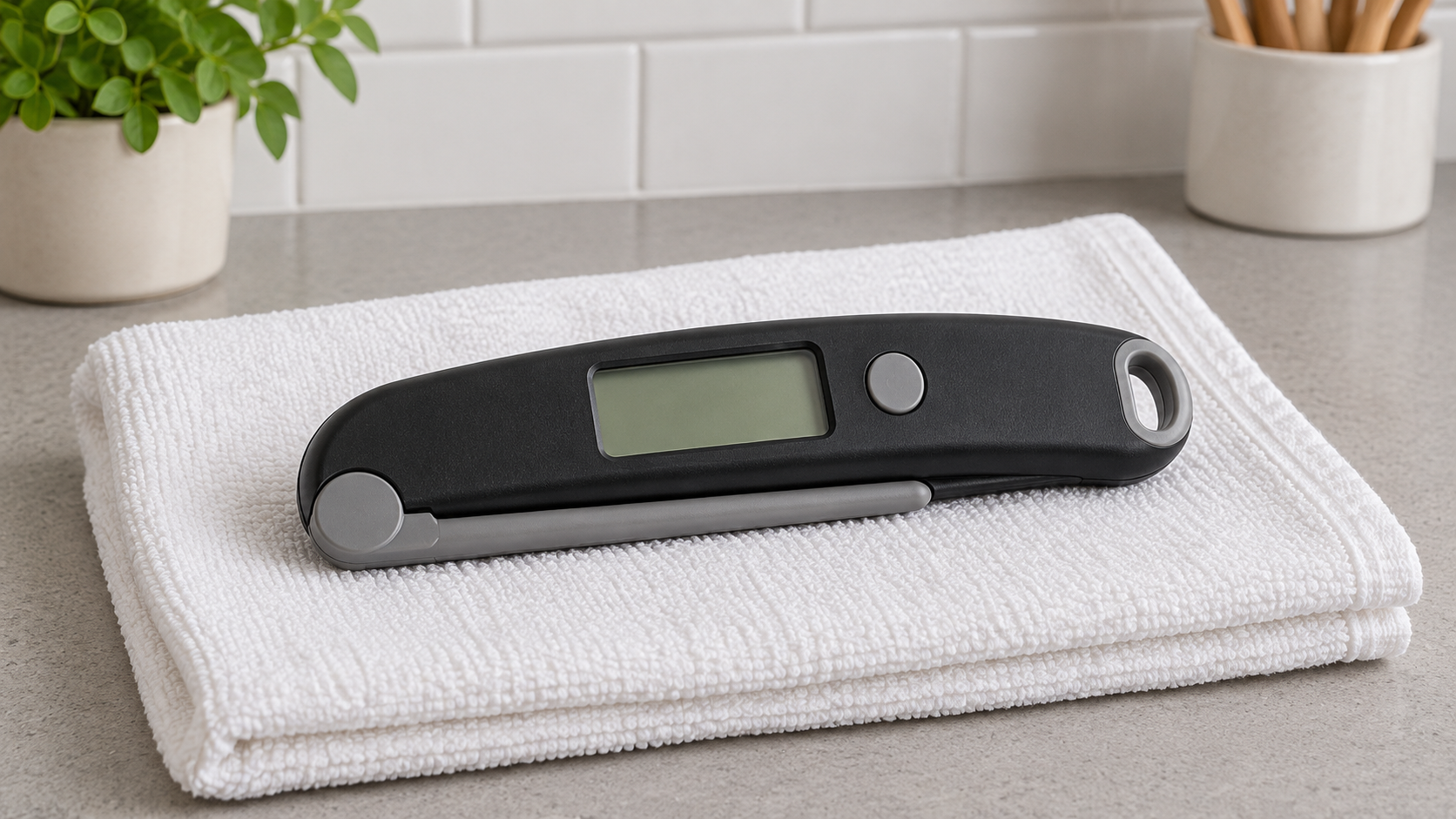
For meat thermometer probe cleaning, wash the food-contact stem as directed before and after use. A waterproof rating does not make the whole thermometer dishwasher-safe. A food probe is different from a refrigerator thermometer: you insert its probe into food for a spot reading, then clean it before and after use. A refrigerator thermometer stays in an appliance to monitor air temperature over time. Choose and care for each tool by its documented purpose.
Meat thermometer probe cleaning and waterproof ratings are separate checks
First identify the product type. An instant-read or handheld food thermometer has a probe intended for food. USDA says food thermometers should be washed with hot, soapy water or according to the manufacturer’s instructions, and that most should not be immersed in water. That is the baseline for a handheld food probe, even when its marketing uses words such as water resistant or waterproof.
Then read the exact ingress-protection rating and manual. For example, ThermoWorks lists the ThermoPop 2 at IP67 and describes that model as suitable for rinsing or wiping after splashes. That is evidence about that named model, not a rating for every meat thermometer or an instruction to use a dishwasher. The manufacturer’s directions remain the controlling source for the exact item in your hand.
| Tool or claim | What it is for | Cleaning decision |
|---|---|---|
| Handheld instant-read food probe | Checking food’s internal temperature at a point in time | Wash the probe/body as the exact maker directs; USDA says most thermometers should not be immersed |
| Product specifically rated IP67 | A rating for that named product’s enclosure | Check the maker’s instructions before rinsing, soaking, or using any appliance |
| “Water resistant” with no clear rating | An imprecise product claim | Do not infer immersion capability; use the manual |
| Refrigerator thermometer | Monitoring refrigerator or freezer air over time | Do not substitute its placement guidance for food-probe cleaning or insertion |
| Probe sheath | Storage protection for a sharp probe | Clean and dry as directed before storing the probe in it |
Clean before the next food touches the probe
Wash the thermometer after it contacts food and before it goes into another food, following the maker’s instructions. USDA specifically says to wash food thermometers with hot, soapy water or according to manufacturer directions. Avoid contaminating the clean probe by setting it on a used cutting board or returning it to a dirty sheath.
For a model whose maker permits rinsing, keep the action brief and controlled rather than turning it into a blanket soaking rule. Do not put an electronic thermometer in a dishwasher unless the manufacturer expressly says to do so. Dry it according to the manual and inspect the probe, seal area, and display for damage before using it again.
Use the food probe in the right place
Cleaning alone cannot make a reading meaningful. USDA says to place a food thermometer in the thickest part of food, away from bone, fat, or gristle; for thin foods, insert it through the side until it reaches the center. Check multiple locations for large or irregular foods. Those are food-probe decisions, not refrigerator-thermometer placement instructions.
For the separate task of monitoring chilled storage, see our refrigerator thermometer placement guide. For a food-safety decision after an interruption, use the process in our food safety check after a power outage. Neither article replaces the cleaning directions for a handheld probe.
Read the IP code with the model name attached
An IP rating describes the tested enclosure protection of a specific product. It is not a general category label. Keep the box, manual, or saved product page so you can verify the rating later. If you cannot find a clear rating or care instruction, choose cautious hand cleaning rather than assuming the display and battery compartment can be submerged.
Also separate cleaning from calibration and battery service. A thermometer may be water-protected yet still have model-specific rules for seals, covers, calibration, or damaged probes. Stop using a thermometer that has a cracked housing, loose battery cover, bent probe, or behavior inconsistent with its instructions until you can follow the manufacturer’s troubleshooting guidance.
Create a clean-probe routine
Before cooking, begin with a clean thermometer and a clean sheath. After the probe touches raw food, clean it as the manufacturer directs before using it in another food. Keep the device off a wet counter edge and away from a sink basin unless the exact model instructions say that exposure is allowed. The goal is to avoid transferring residue while protecting the electronics.
After cleaning, let the tool dry before returning it to storage. If the sheath has residue, clean it too according to the product directions; a clean probe placed into a dirty sheath does not stay clean. Store the sharp probe protected, as USDA advises, and keep the manual available for battery replacement, calibration, and care details.
Choose a food probe for the job you actually do
For a thin cut, probe placement matters as much as the display. USDA says to insert through the side until the tip reaches the center of thin food. For a roast or an irregular item, check more than one place. A fast display does not eliminate the need to place the probe correctly, and a waterproof enclosure does not turn a food probe into a refrigerator monitor.
When shopping, compare the stated probe length, range, response information, and the exact IP rating only within the specific manufacturer page or manual. “Waterproof” is not a universal level of protection. If a product lists no rating, make no assumption from its appearance or from another product in the brand’s lineup.
Know when to replace or pause use
Pause and consult the maker if the device has a cracked screen, loose seam, compromised battery cover, corrosion, unreliable readings, or a damaged probe. Do not try to seal a food thermometer with tape or use a damaged device around food. The safest decision is to follow the maker’s service or replacement guidance.
Keep the probe-care directions with the handheld tool so cleaning and storage instructions are available when the thermometer is used again.
Match care instructions to the model
Before rinsing or cleaning any electronic thermometer, read the exact model’s instructions rather than using another product’s rating as a shortcut. A clear model name, intact housing, and documented cleaning method are the three facts worth confirming. That approach protects both the food-contact tool and the accuracy decisions you make with it.
When in doubt, a cautious hand-cleaning approach and the product manual are better than an assumption based on a label word alone.
FAQ
Can I immerse a waterproof meat thermometer?
Only if the exact manufacturer instructions allow it. USDA says most food thermometers should not be immersed.
Is IP67 the same as dishwasher safe?
No. An IP rating is not a dishwasher-safe claim. Follow the maker’s cleaning instructions.
Do I clean the whole thermometer or only the probe?
Follow the product manual. Clean food-contact areas carefully and do not assume the electronic body can be submerged.
Can I use a refrigerator thermometer to check a steak?
No. A refrigerator thermometer monitors appliance air; use a handheld food probe for internal food temperature checks.
Sources and fact-checking
Checked against the official sources below on November 27, 2026. This is research-based guidance, not a claim of hands-on product testing.


댓글 0
첫 댓글을 남겨보세요.