
Ironing Board Folded Dimensions: Storage, Carrying, and Steamer Differences
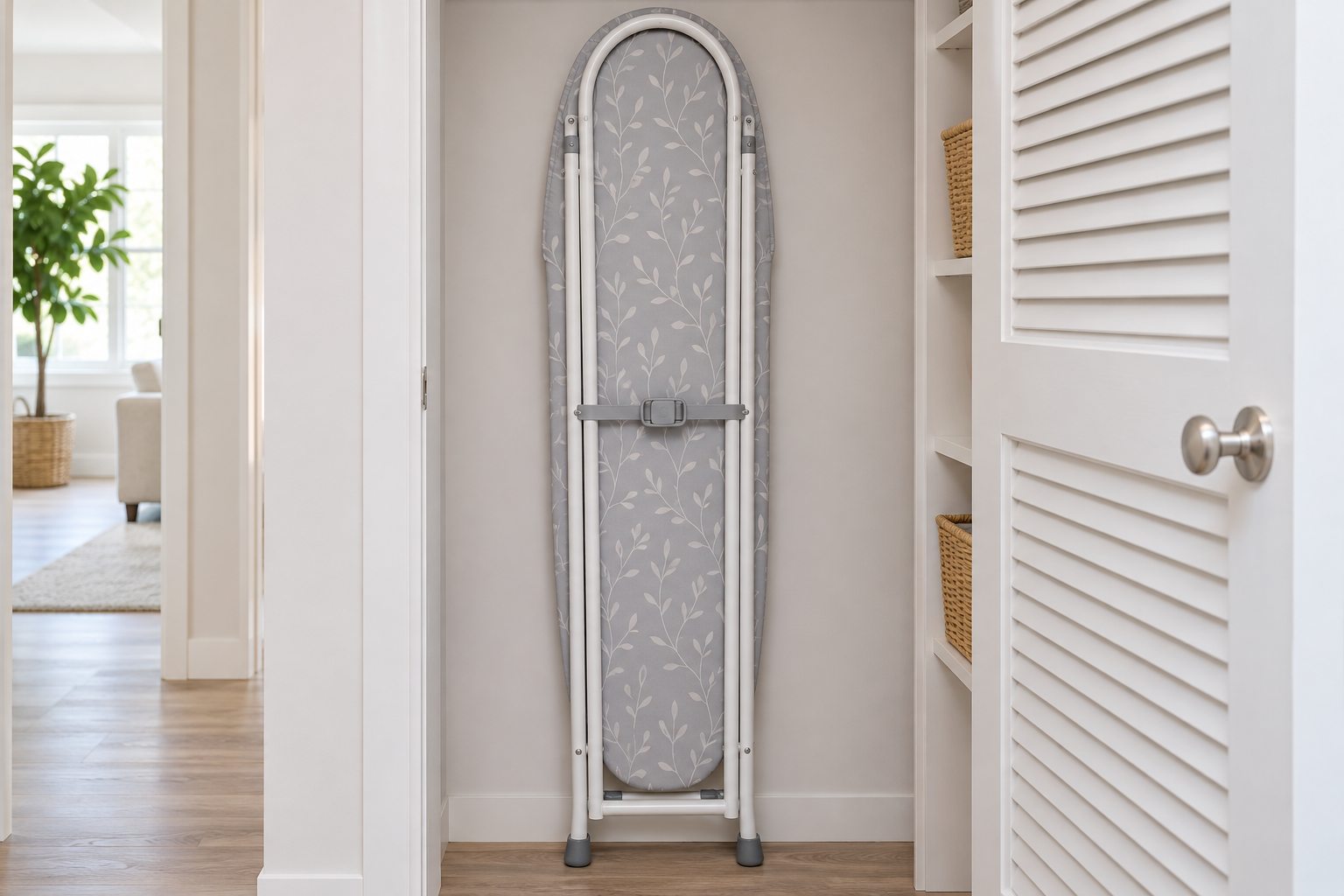
Ironing board folded dimensions tell you whether a board is worth bringing home only when you treat them as a stored object, not a vague promise to “fold flat.” Compare the folded length, width, thickness, weight, lock, and the route from the laundry spot to the closet. Then keep this decision separate from buying a clothes steamer: an ironing board supports pressing on a stable surface; a steamer needs a hanging setup, steam clearance, and its own cooling routine.
A manufacturer’s open-board dimensions do not reliably predict its folded shape. Joseph Joseph’s current US Pocket page, for example, lists the closed size as H18 by W13 by D6 inches. It separately lists an ironing surface of H35 by W13 inches and says that surface stands 4 inches above the tabletop when open. The ironing-surface dimensions are not the board’s complete open footprint. That is useful as an example of why the folded listing must be read directly, not extrapolated from the pressing surface. Full-size boards can be much longer when folded, and an iron rest, hanger, or leg assembly can be the widest point.
Measure Ironing Board Folded Dimensions and the Carrying Route
Start with the place where the board will rest. Measure height, width, and depth inside a closet, behind a door, beside a washer, or under a bed. Leave room for the lock, cover, and a hand to grasp the board. Next, measure the narrowest part of the travel path: doorways, a hallway turn, the gap beside furniture, and the clearance above a stair landing if relevant. A board can fit a closet in theory but be irritating to carry there every laundry day.
Record the folded dimensions in the orientation you will store it. A vertical closet slot uses height and thickness differently from an under-bed location. Do not assume a board marketed as “slim” will fit under your particular bed; check the clearance from floor to the lowest obstruction, including any center support or storage bin. If you will hang it, use only a hook or holder rated and installed for that purpose, and keep the board from becoming a door-swing or trip hazard.
| Option | What you measure | Best storage question | Different from a steamer because… |
|---|---|---|---|
| Tabletop board | Folded length, width, thickness, and bag or hook | Can it fit a drawer, cabinet, or closet shelf? | It still needs a stable table at use time |
| Freestanding board | Folded overall length, widest rest, thickness, weight | Can one person carry and park it without blocking a path? | It supports pressing, not hanging garments for steam |
| Wall or door holder | Closed projection and door-swing clearance | Is mounting allowed and is the route clear? | It stores a board, not a hot steamer |
| Clothes steamer | Appliance, cord, tank, and cooling location | Can garments hang safely while you use it? | It does not replace a board for every pressing task |
Decide whether a tabletop or freestanding board is the better carry
A tabletop board can have a short folded length, but it requires a separate sturdy surface each time. Verify that table before buying: it needs enough footprint, a stable level top, and a location away from water. Check the setup instructions for the board and iron before deciding that a particular table will work. Joseph Joseph describes Pocket’s folding legs, quick-release locking toggle, and adjustable non-slip feet; its product page does not certify your table or provide a universal setup procedure. Confirm the support surface and operating steps for the exact product.
A freestanding board eliminates the table decision but brings a larger folded object. Pay attention to the weight listed by the manufacturer, whether there is a transport lock, and where your hands will go when carrying it. Never use the cover as a handle. Before storing it, allow both the board and iron to cool. Joseph Joseph says an iron must cool to room temperature before it goes into Pocket’s storage compartment, and that the cover must be dry before the board is folded and stored. Check those requirements separately from the dimensions.
Give the locking and hanging details equal weight
A folded measurement is not a safety feature. Check how the legs lock open, how the board locks closed, and whether a child or pet could knock it loose in the chosen storage spot. Pocket’s US page describes a hanging hook and a wall-mount bracket with screws and wall plugs for a suitable surface. That is not permission to mount it on every rental wall or door. Check the product’s mounting instructions, the supporting surface, and your lease before installing a holder.
If the only proposed home is behind a frequently used door, test the door’s full swing and the board’s projection before purchasing. If it will live in a closet, make sure nothing can fall onto it and that a hot iron will not be stored with it. Keep the storage path clear rather than leaning the board temporarily in a hallway. “Temporary” is often where a folded board becomes a tripping obstacle.
Do not substitute a clothes steamer in this comparison
A compact steamer can be useful for wrinkle touch-ups, but it asks a different set of questions. You need a place to hang the garment, manage the cord as instructed, let the appliance cool, empty or handle its water system as directed, and store it upright or in the specified position. An ironing board decision is about the closed board’s volume, carrying route, setup stability, and a heat-safe iron rest.
Use a board when your routine includes pressing seams, collars, or flat fabric on a supported surface. Consider a steamer when your garments and storage routine suit the manufacturer’s steaming instructions, not simply because the board looks long in a closet. Read the related clothes steamer for small apartment living guide for its distinct fit and cooling checklist.
Know when a board is not worth storing
Skip or delay the purchase when you have no stable setup surface, no protected place for the hot iron to cool, no storage route that avoids a doorway or walkway, or no way to secure a hanging system within your lease and the product instructions. A smaller board is not always better if it forces you to press on an unstable table; a larger board is not better if you avoid putting it away.
A board also needs a return point in the laundry routine. Our small-apartment laundry routine can help you keep clothing and equipment from occupying the same temporary floor pile. It does not establish that a table or desk is an iron-safe surface.
FAQ
How do I find the true folded size of an ironing board?
Use the manufacturer’s specification or manual. Look for folded length, width, and thickness, then measure any iron rest or hook that projects beyond the frame.
Can I store an ironing board under a bed?
Only if the actual folded thickness and length fit the clear under-bed space and the board can slide in and out without snagging or damaging the cover.
Is a tabletop board easier to store than a freestanding one?
Often, but it needs a suitable table every time you use it. Compare the entire setup and carrying routine, not folded size alone.
Can a clothes steamer replace an ironing board?
They serve different routines. A steamer needs a hanging garment setup; a board provides a stable pressing surface. Choose based on the garments and space you actually have.
Sources and fact-checking
The numerical example and care details were checked November 25, 2026 on Joseph Joseph’s US Pocket product page. Its closed dimensions, ironing-surface dimensions, and tabletop height are different measurements. The page also gives cooling and dry-before-storage cautions. This is a researched storage-fit guide, not a pressing test or a certification of a table, wall, or holder.


댓글 0
첫 댓글을 남겨보세요.