
Portable Induction Cooktop: Power, Pan Fit, and Outlet Checks
A portable induction cooktop should match your cookware, counter, circuit, and cooking style before you compare temperature buttons or promotional wattage. Check the plug and breaker plan, test the pans you already own with a magnet, measure the flat cooking surface, and decide whether low-power cycling is acceptable for the foods you make most often.
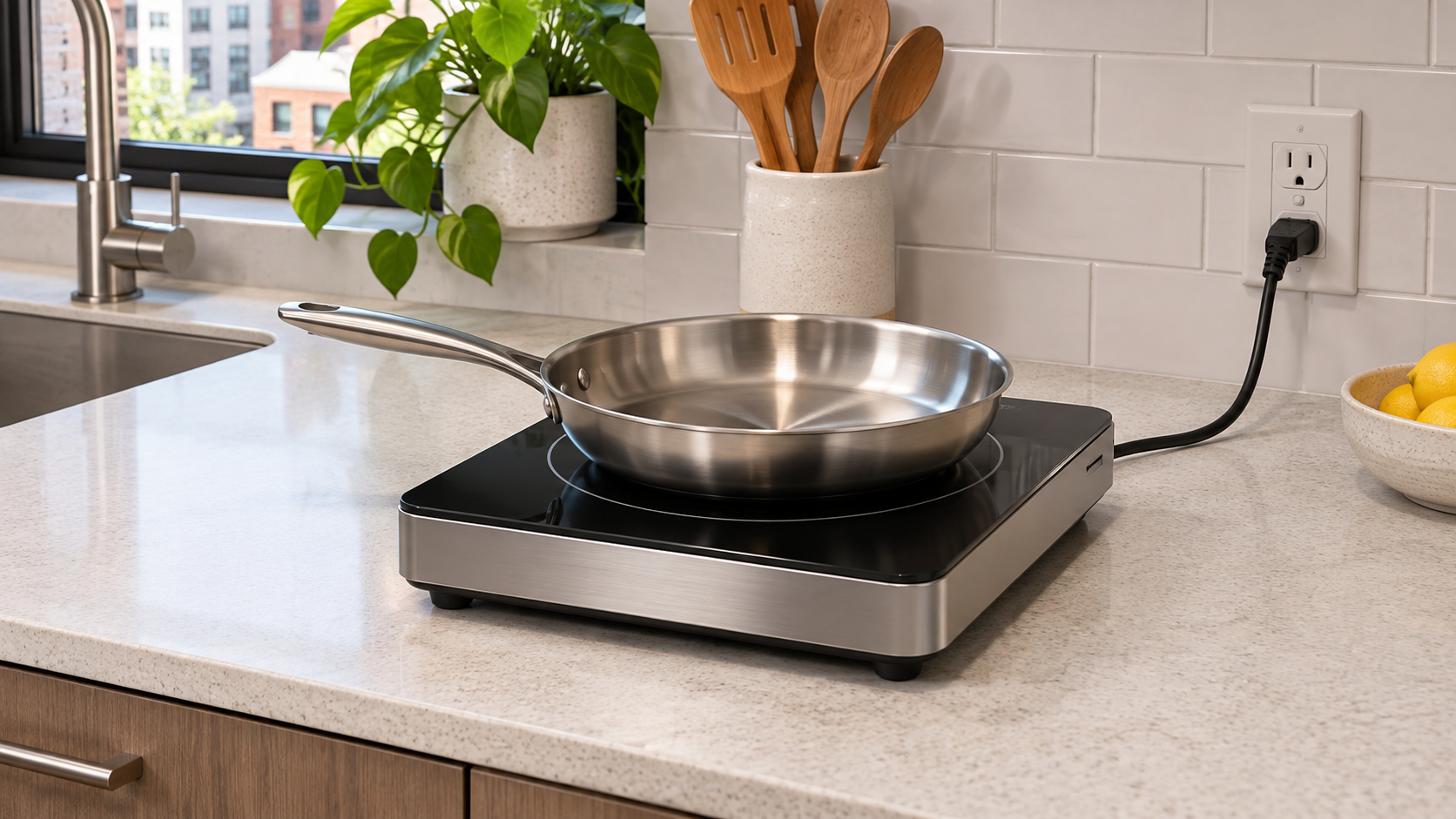
This guide focuses on single-burner portable units for apartments, temporary kitchens, dorm-style spaces where allowed, and backup cooking. Always follow building rules and the exact appliance manual; a countertop burner is still a high-power cooking appliance.
Confirm the circuit and cookware first
Induction uses an electromagnetic field to heat compatible cookware directly. The U.S. Department of Energy explains that a flat-bottom pan that a magnet sticks to will generally work. Aluminum, copper, glass, and some stainless cookware may not work unless they include a magnetic base. Test the actual bottom, not the handle or sidewall.
Many full-power portable units are rated around the upper limit of a standard household receptacle circuit. Check the nameplate watts and amps, use the outlet arrangement required by the manual, and avoid sharing the circuit with another high-draw appliance. The U.S. Fire Administration advises against extension cords for kitchen appliances.
| Decision | What to verify | Why it matters | Red flag |
|---|---|---|---|
| Electrical load | Rated watts, amps, plug, outlet, and shared appliances | Full power can use much of a household circuit | Need for an extension cord or repeated breaker trips |
| Cookware | Magnet attraction, flat base, diameter, and weight | Induction needs compatible material and good surface contact | Warped pan or tiny magnetic disk |
| Control range | Power steps, temperature steps, timer, and low-setting behavior | Fine control affects simmering and searing | Large jumps or undocumented cycling |
| Surface and storage | Unit width, depth, height, cord, fan clearance, and packed size | Portable must still fit during use and after cooling | Vent blocked by backsplash or soft surface |
Nine buying checks for a portable induction cooktop
1. Read the electrical nameplate
Record rated voltage, watts, and amps. Identify the planned wall outlet and what else is on that breaker. Do not assume a second outlet means a second circuit. High-power cooking beside a microwave, toaster oven, kettle, or air fryer can overload a shared branch circuit. Follow the manual and use a properly grounded outlet without an extension cord unless the manufacturer explicitly provides different instructions.
2. Test every pan you expect to use
Use a simple magnet on the flat bottom. Strong attraction is a useful compatibility screen, but also check minimum and maximum base diameter in the cooktop manual. A pan can be magnetic yet too small for detection or too wide for stable heating. Inspect for a flat base because warped cookware can rock, heat unevenly, and scratch the glass.
3. Measure the usable cooking zone
The outer housing dimensions do not tell you the supported pan area. Find the marked ring and the manufacturer’s pan-size limits. Include handle clearance, nearby wall space, and the path for lifting a hot pot. In a small kitchen, a large skillet handle can block a walkway even when the unit itself fits on the counter.
4. Compare power and temperature controls
Some units offer both wattage levels and temperature settings, but the numbers do not guarantee laboratory precision. Read the manual to understand whether temperature mode senses the glass or pan, the size of adjustment steps, and how the unit cycles at low settings. If you cook sauces or rice, low-end control may matter more than maximum wattage.
5. Check ventilation and fan noise
Portable induction units contain cooling fans and vents. Measure the clearance required around the underside, rear, and sides, and use the appliance only on the stable heat-resistant surface specified by the manufacturer. Do not operate it on a towel, bed, or other soft surface that can block airflow. Fan sound can continue briefly after cooking while electronics cool.
6. Look for cookware detection and shutoff behavior
Confirm how the unit reacts when a pan is removed, an incompatible pan is used, the timer ends, or overheating is detected. These features are useful, but they do not make unattended cooking safe. The U.S. Fire Administration says to stand by your pan and turn the burner off if you leave the kitchen.
7. Plan for spills and hot glass
Induction heats the pan directly, but the glass can become hot from contact with the cookware. Check residual-heat indicators, edge design, control placement, and cleaning instructions. A flat touch panel may be easy to wipe but can respond poorly to wet fingers. Keep pot handles turned away from counter edges and have a lid nearby for pan fires.
8. Check storage only after cooldown
Measure where the unit will go when fully cool, including the cord and any protective separator. Do not sharply wrap the cord around the housing or stack heavy pans on glass unless the manual permits it. A portable burner that must be moved after every meal needs a safe cooling zone that does not block the sink or food-prep area.
9. Verify exact model identity and recalls
Save the full model number, rating label, manual, warranty, and seller. Search the CPSC database for the exact unit. Avoid listings that mix several models under one review page without clear specifications, and do not assume a replacement power cord or accessory from a sibling model is interchangeable.
Portable induction pre-purchase worksheet
- Circuit: outlet location, breaker, shared appliances, nameplate watts and amps, and cord reach.
- Cookware: magnet result, flat base, minimum and maximum diameter, weight, and handle clearance.
- Cooking: power steps, temperature steps, timer, low-setting behavior, and pan detection.
- Counter: heat-resistant surface, vent clearance, splash exposure, walking path, and cooling zone.
- Storage: cooled dimensions, cord position, glass protection, and lifting weight.
- Identity: exact model, manual, warranty, certification, and CPSC recall search.
Use these TrendIssue guides to keep a new cooking appliance from consuming the entire small-kitchen workflow.
- How to Set Up a Small Rental Kitchen — choose a safe cooking and cooling zone
- A 15-Minute Weeknight Kitchen Reset — make cooldown and wipe-down part of the evening routine
- Pantry Inventory for Small Kitchens — match the appliance to meals you actually cook
Test the cooktop with your real cookware
Use the first few supervised meals to verify compatibility, circuit behavior, control range, and cleanup.
- 1. Label check: Photograph the nameplate and confirm voltage, wattage, plug, and manual instructions.
- 2. Cold fit: Place each intended pan on the marked cooking zone and check stability, diameter, and handle clearance.
- 3. Low-power test: Heat water or a simple sauce at low settings and observe cycling without leaving the pan unattended.
- 4. Circuit test: Run the cooktop on the planned outlet without another high-draw appliance and note any breaker or plug concerns.
- 5. Cleanup rehearsal: Allow full cooldown, wipe the glass as directed, clear the vents, and store the cord without pinching.
Common mistakes and tradeoffs
Buying before testing pans: Replacing an entire cookware set can erase the value of an inexpensive burner.
Sharing a circuit with another heater: Microwaves, kettles, air fryers, and portable induction units can all draw substantial power.
Assuming temperature numbers are exact: Control algorithms and sensing locations vary; compare steps and behavior, not only the display.
Blocking the cooling fan: Soft surfaces and tight backsplash placement can restrict required airflow.
Treating automatic shutoff as permission to leave: Cooking still requires attention and a clear fire-safety plan.
Frequently asked questions
Will my stainless-steel pan work on induction?
Some stainless cookware works and some does not. Test the flat bottom with a magnet and confirm the cooktop’s diameter limits.
Can I plug a portable induction cooktop into any kitchen outlet?
Use the grounded outlet and circuit arrangement required by the manual. Check the appliance’s rated load and avoid sharing the circuit with another high-power appliance.
Does the glass stay cool?
The pan is heated directly, but heat transfers back to the glass. Treat the cooking zone as hot until the residual-heat indication clears and the manual says it is safe to touch.
Is 1,800 watts always better?
Maximum power can speed heating, but low-setting control, cookware fit, circuit capacity, ventilation, and noise may matter more for everyday use.
Sources and fact-checking
- U.S. Department of Energy: Making the Switch to Induction Stoves or Cooktops
- U.S. Fire Administration: Cooking Fire Safety
- U.S. Consumer Product Safety Commission: Recalls & Product Safety Warnings
Fact-check completed November 16, 2026. Product specifications, prices, manuals, and recall status can change, so verify the exact model before purchase.



댓글 0
첫 댓글을 남겨보세요.