
Air Purifier for Small Room: 9 Checks Before You Buy
An air purifier for small room use should be sized by verified particle-cleaning performance, not by the smallest housing or the largest marketing coverage number. Measure the occupied space, compare smoke CADR, price the exact replacement filter, and make sure the unit can run at a tolerable sound level where you plan to sleep or work.
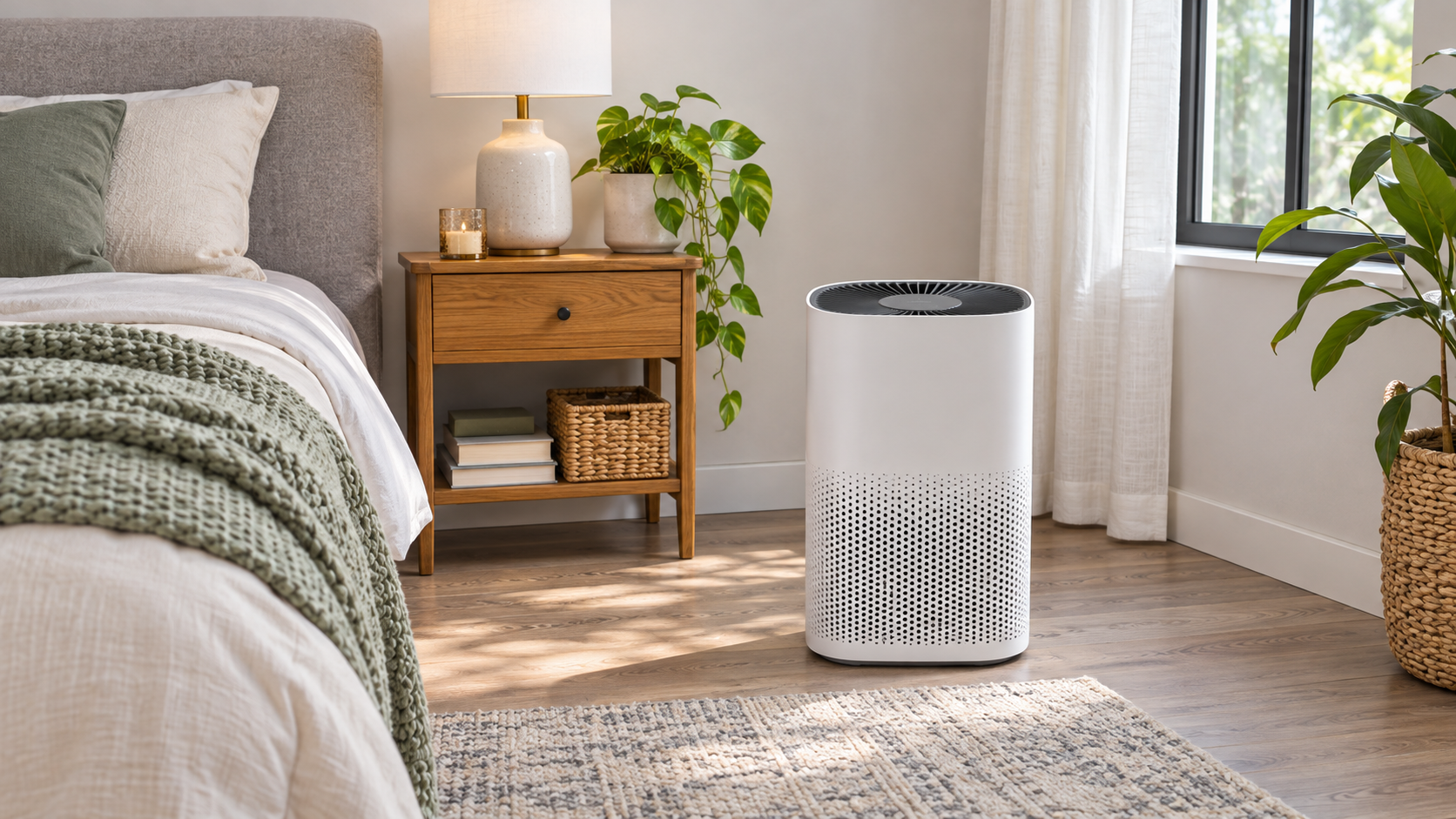
This buying guide is for apartment bedrooms, dorm-style rooms, and compact home offices. It does not rank individual models. It gives you a repeatable way to separate useful specifications from claims that cannot be compared across brands.
Start with room area and verified CADR
Measure length by width to get square feet, then note the ceiling height and whether the door normally stays open. A purifier placed in a closed 120-square-foot bedroom has a different job from one expected to serve an open studio. EPA guidance says the cleaner should have a CADR large enough for the room or area where it will operate.
ENERGY STAR presents a practical two-thirds rule for particle removal: look for a CADR that is at least two-thirds of the room area, assuming an eight-foot ceiling. Use smoke CADR when you want the most conservative particle comparison because smoke represents smaller particles than dust or pollen. Higher ceilings, open doors, and wildfire-smoke conditions can justify more capacity, but buying far beyond the need also raises purchase, power, and filter costs.
| Specification | What it tells you | Small-room decision | What it does not prove |
|---|---|---|---|
| Smoke CADR | Verified particle-cleaning rate in cubic feet per minute | Match it to measured room area and ceiling height | Odor or gas removal |
| HEPA designation | Filter is designed for high particle capture when used as specified | Useful when paired with adequate airflow and room sizing | That every marketplace replacement filter performs the same |
| Activated carbon | Adsorbent material intended for some gases and odors | Compare the amount of carbon and replacement cost | A universal gas-removal score; EPA notes no widely used rating system |
| ENERGY STAR certification | Model meets program energy-efficiency and reporting criteria | Helpful for units expected to run many hours | Silent operation or low filter prices |
Nine buying checks for a small room air purifier
1. Confirm the exact smoke CADR
Find the model-specific smoke CADR in an ENERGY STAR listing, AHAM data, package label, or manufacturer specification. Do not substitute the highest pollen CADR or a vague “covers up to” number. If the listing gives several coverage figures based on one, two, or five air changes per hour, make sure you understand which one is being advertised. For a bedroom, the more realistic number is the one tied to repeated cleaning, not a single pass through the room.
2. Measure the actual air zone
Use the room that will normally be closed around the purifier. If air flows freely into a hallway or living area, include that connected area or accept that one compact unit will not manage the whole zone. Record ceiling height as well as floor area. EPA and ENERGY STAR sizing tables assume an eight-foot ceiling, so a loft or high-ceiling studio needs more airflow than the floor area alone suggests.
3. Price filters before the machine
Search the exact replacement-filter model number and confirm it is available from a source you trust. Calculate at least one year of ownership using the manual’s replacement guidance, your expected runtime, and local air conditions. A low purchase price is not a bargain if genuine filters are frequently unavailable or cost nearly as much as the appliance. Treat washable prefilters and replaceable main filters as separate maintenance items.
4. Decide what happens at night
Check published sound levels at more than one speed, whether indicator lights can be fully switched off, and whether the unit remembers its setting after an outage. A sleep mode may reduce both noise and CADR, so compare comfort with the filtration you actually receive at that setting. If the purifier must sit beside the bed, measure the available floor or nightstand footprint without blocking the intake or outlet.
5. Avoid intentional ozone generation
EPA advises against using air cleaners that intentionally generate ozone in occupied spaces. Be cautious with ionizer, plasma, and similar feature names when the listing does not clearly explain operation. If a model includes an optional ionizing feature, verify whether it can be disabled and whether the exact model has appropriate ozone-emission certification. Do not treat a sharp smell as proof that the air is cleaner.
6. Separate particle and odor claims
CADR is a particle metric. Activated carbon or another sorbent is needed for some gases and odors, and EPA notes that gas-removal filters do not have a widely used consumer performance rating comparable to CADR. A thin carbon-coated sheet may not perform like a deep bed of carbon. If cooking odors or smoke gases are the main concern, compare carbon quantity, replacement interval, and ventilation options rather than relying on a HEPA label alone.
7. Plan placement and clearance
Read the manual for intake, outlet, wall, curtain, and heat-source clearance. A small unit pushed into a corner may be convenient but can restrict airflow and create a noisy recirculation path. Place it where air can move through the occupied part of the room, keep the cord out of walkways, and confirm the filter can be removed without moving heavy furniture.
8. Check controls without paying for unused extras
A reliable fan-speed control and filter indicator are more useful than an app you will not open. If you want automation, verify what the sensor measures, whether schedules work without a cloud account, and whether the appliance can still be operated manually. Sensor colors are not standardized across brands, so do not assume two products interpret “good” air the same way.
9. Verify model identity and recalls
Record the full brand, model number, filter number, seller, and warranty terms before checkout. Search the exact model in the CPSC recalls database, especially for used units and unfamiliar marketplace brands. A nearly identical photo or shared family name is not enough because electrical warnings and recalls may apply only to certain model, date-code, or production ranges.
A five-minute comparison worksheet
- Room: length × width, ceiling height, door position, and primary occupant zone.
- Performance: exact smoke CADR and the room-size assumption attached to it.
- Ownership: replacement-filter model, price, availability, and expected annual count.
- Sleep: sound at useful speed, display-off option, timer, and setting memory.
- Placement: footprint, intake and outlet clearance, cord route, and filter-removal space.
- Safety: ozone feature status, certification, exact model number, and CPSC recall result.
These related TrendIssue guides help you plan the room around the appliance instead of adding another object without a placement strategy.
- Small Room Humidifier: 8 Checks for Apartment Bedrooms — compare a different air-quality appliance with its own moisture risks
- Nightstand Organization for Small Bedrooms — clear a practical control and charging zone without blocking airflow
- A Small Home Safety Reset — review cords, outlets, and crowded pathways before adding an always-on device
Plan the first week before checkout
A purifier earns its floor space only if it can run, be maintained, and be evaluated in the actual room. Use the first week to confirm fit rather than assuming every marketing claim applies.
- 1. Day one: Photograph the model label and save the manual. Place the unit with required clearance and note the starting filter indicator.
- 2. First evening: Run the fan at the speed you can tolerate during sleep or focused work. Confirm that lights, beeps, and app requirements are acceptable.
- 3. First cleaning: Remove the prefilter and main filter exactly as the manual directs. If access is awkward in the planned location, move the unit before the return window closes.
- 4. Cost check: Save the exact replacement-filter listing and set a realistic reminder based on the manual and conditions, not a generic calendar date.
- 5. Performance review: Consider whether the unit can run long enough at a useful speed. EPA notes that higher fan speeds and longer run times generally increase filtration.
Common mistakes and tradeoffs
Buying by housing size: A mini enclosure can also contain a very low-airflow fan. Compare CADR and verified room assumptions before countertop convenience.
Trusting one huge coverage number: Some listings describe one air change per hour. That is not equivalent to repeatedly filtering bedroom air.
Treating HEPA as a complete answer: The filter label does not replace adequate airflow, sensible placement, or ongoing filter replacement.
Expecting one filter to solve every pollutant: Particle removal, gas adsorption, moisture control, and source control are different jobs.
Ignoring return and filter availability: A purifier that is noisy at useful speed or unsupported by replacement filters is difficult to fix after the return window.
Frequently asked questions
What CADR do I need for a small room?
ENERGY STAR suggests a CADR at least two-thirds of the room’s square footage for an eight-foot ceiling. Increase the target when ceilings are higher or the purifier must serve a connected area.
Is a tiny desktop air purifier enough for a bedroom?
Only if its verified CADR matches the bedroom area. Many desktop units are intended for a very small personal zone rather than an entire closed room.
Should I choose HEPA or activated carbon?
HEPA-type particle filtration and activated-carbon gas adsorption address different concerns. Many buyers need both, but compare the exact CADR for particles and the amount and replacement cost of carbon separately.
Can I leave an air purifier running overnight?
Follow the exact model manual and use a stable placement with clear airflow and an undamaged cord. The practical question is whether it can run at a useful speed without disrupting sleep.
Sources and fact-checking
- ENERGY STAR: How to Choose a Room Air Cleaner
- U.S. EPA: Guide to Air Cleaners in the Home
- U.S. Consumer Product Safety Commission: Recalls & Product Safety Warnings
Fact-check completed November 16, 2026. Product specifications, prices, manuals, and recall status can change, so verify the exact model before purchase.



댓글 0
첫 댓글을 남겨보세요.