
Safe Space Heater for Bedroom: 9 Checks Before You Buy
A safe space heater for bedroom use is not a heater you leave running while you sleep. Start with a model that has tip-over and overheat shutoff features, but also confirm that your room has a clear, stable location and a wall outlet. The safest purchase is the one that fits your room, outlet, routine, and lease instead of simply promising the most heat.
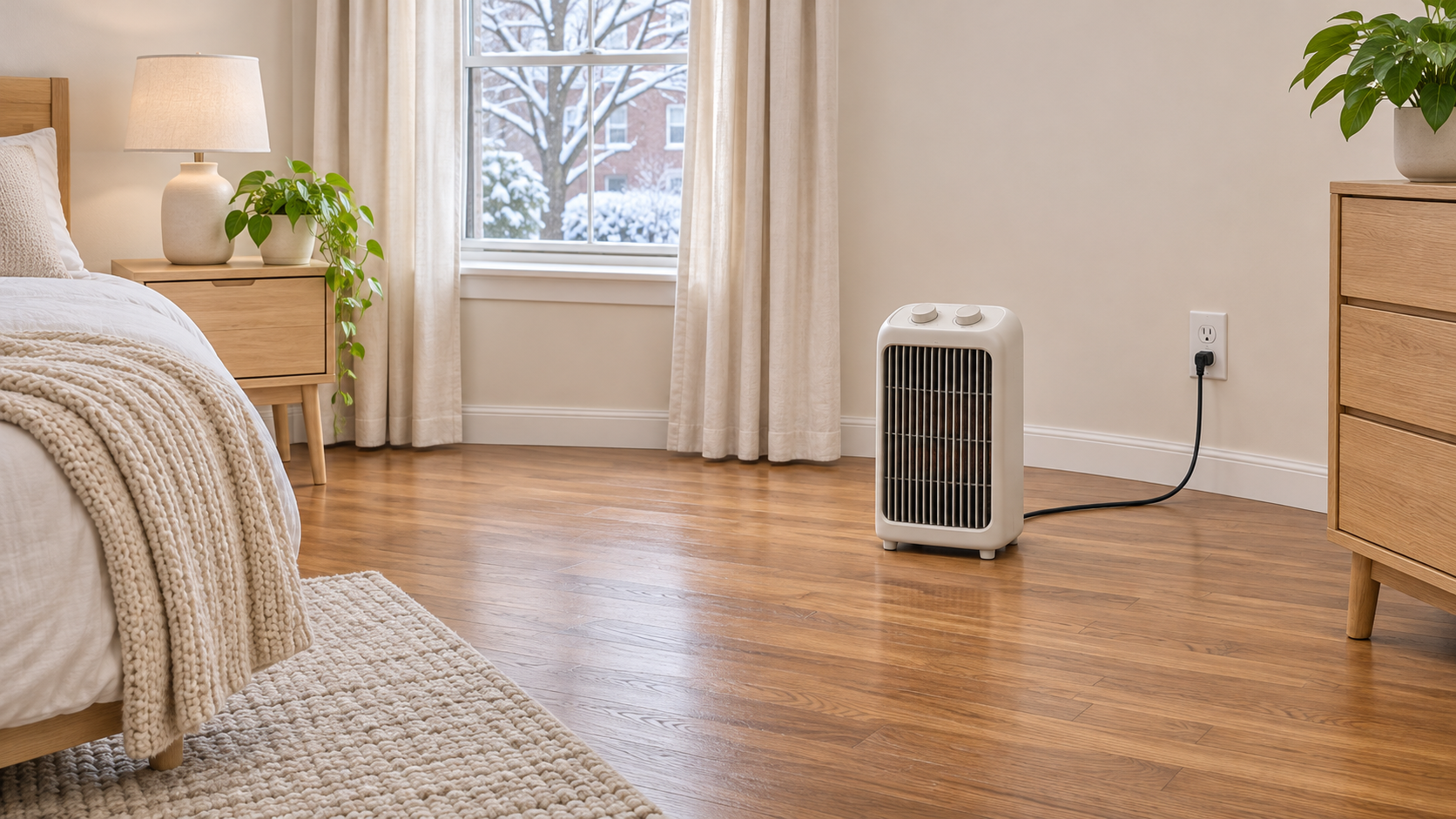
Before shopping, make one important decision: will the heater warm an occupied room for a limited period, or are you trying to solve an overnight heating problem? Portable heaters are not a substitute for a failed primary heating system, and federal fire-safety guidance says to turn them off when leaving the room or going to bed. If your bedroom cannot stay safely warm without overnight portable heat, contact the landlord, property manager, or a qualified heating professional rather than trying to solve the problem with a more powerful plug-in device.
Quick answer: what should a bedroom heater have?
- Tip-over shutoff and overheat protection listed in product specifications
- A thermostat or adjustable heat settings that reduce unnecessary runtime
- A cord that can reach a wall outlet without crossing a walking path
- A stable floor location with at least 3 feet of clearance from bedding, curtains, papers, clothes, and furniture
- An exact model number you can check in the CPSC recall database before checkout
- A manufacturer manual that clearly permits the room and placement you plan to use
Do not treat a timer, remote, app, child lock, or marketing phrase such as “bedroom safe” as permission to operate the heater while sleeping or unattended.
Why the room matters more than the product photo
The U.S. Consumer Product Safety Commission says portable heaters should stay at least 3 feet from drapes, furniture, bedding, and other combustible materials. The U.S. Fire Administration gives the same 3-foot rule for anything that can burn and says space heaters should be turned off when you leave the room or go to bed.
Mark the proposed placement before comparing prices. Open nearby doors and drawers, then walk the normal route to the hallway. If the spot is in a traffic path, beside hanging fabric, or where clothes routinely land, choose another location.
9 checks before you buy a safe space heater for bedroom use
1. Confirm the heater is for indoor residential use
Read the manufacturer’s specifications and manual, not only the retailer title. Confirm indoor use, required clearances, surface requirements, prohibited locations, and any instructions for children or pets. Do not bring outdoor, garage, workshop, or fuel-burning equipment into a bedroom simply because it is portable.
2. Check the exact wattage and plug requirements
Look at the nameplate or manual for the unit’s input, voltage, and plug instructions. A compact body does not necessarily mean a low electrical load. CPSC guidance says electric space heaters should be plugged directly into a wall outlet, never into an extension cord or power strip. If the only available outlet is loose, discolored, damaged, shared with other high-demand appliances, or located behind furniture, solve the outlet problem first.
3. Verify tip-over and overheat shutoff features
These features should appear in the manufacturer’s current documentation for the exact model. A product-family description or a seller’s generic feature list is not enough. Tip-over shutoff matters in a small bedroom where a pet, storage basket, or foot can contact the heater.
4. Map a reliable 3-foot clear zone
Check every side, not just the front grille. Bedding can shift overnight, curtains can move with airflow, and a laundry basket can be placed beside the heater after you set it up. The clear zone must remain clear during use. If maintaining that space requires daily perfection, choose another location or another heating solution.
5. Put it on a stable, level floor
A nightstand, dresser, folding stool, storage cube, or stack of books can increase the chance of a fall and may violate the manual. Use the surface specified by the manufacturer. Keep the cord visible, out from under rugs, and away from doorways or places where it can be pinched. The CPSC also advises placing portable heaters on a stable, level surface where they will not be knocked over.
6. Treat sleep as a hard stop
CPSC says to turn off portable heaters when sleeping, and USFA says to turn space heaters off when going to bed. A timer can help end a supervised warm-up period, but it does not replace that instruction. Use the heater while you are awake and in the room, turn it off before bed, and let the room’s primary heating system handle the night.
7. Compare controls by how they limit runtime
A thermostat, lower heat setting, and clear manual controls can be more useful than decorative displays or an app. Ask whether you can select a lower output, whether the unit cycles to maintain a setting, and whether the controls are understandable in low light. Avoid assuming that an “eco” label guarantees a particular operating cost. Your bill depends on the product’s actual power draw, runtime, local electricity rate, and how much of the room you are trying to heat.
8. Match the heat pattern to your routine
Small fan-forced ceramic heaters tend to feel warm quickly but add fan noise. Oil-filled electric radiators are usually heavier and slower to respond, but they may suit people who prefer quiet, steadier warmth during an awake evening routine. Radiant heaters focus warmth toward people and objects in their line of sight. None of these basic types removes the need for clearance, a direct wall connection, supervision, or recall checks.
9. Search the exact model for recalls
Copy the full model number from the manufacturer or retailer listing and search the CPSC Recalls and Product Safety Warnings database. Repeat the check when the heater arrives because product listings, model families, and third-party seller descriptions can change. If the model has been recalled, stop using it and follow the remedy listed by CPSC and the recalling company.
Bedroom heater comparison table
| Option | Useful when | Tradeoff to check | Manual detail to verify |
|---|---|---|---|
| Compact fan-forced ceramic | You want quick perceived warmth during a short, supervised period | Fan noise and concentrated airflow | Clearance, heat settings, tip-over shutoff, and surface rules |
| Oil-filled electric radiator | You prefer quiet heat during an occupied evening | Larger footprint, greater weight, and slower response | Surface temperature warnings, caster setup, clearance, and shutoff features |
| Radiant or infrared electric heater | You stay in one seated area and want directional warmth | Objects outside the direct path may not feel equally warm | Required front clearance, element guards, stability, and intended room use |
| Primary heating repair or service | The bedroom is unsafe or unlivable without heat through the night | May require landlord, property manager, or professional coordination | Lease procedure, maintenance request process, and local requirements |
A five-minute bedroom fit test
- Choose the outlet first. It should accept the heater directly without an extension cord, power strip, or cord under a rug.
- Mark the proposed footprint. Use the product dimensions, including feet or casters, not a visual guess from photos.
- Mark the clearance zone. Check bedding, curtains, clothes, papers, furniture, and the open door position.
- Walk the room. Test the nighttime path to the door and bathroom even though the heater must be off before sleep.
- Check the routine. Decide who turns it off, where it cools, and where it is stored when not in use.
If a small draft is making the room uncomfortable, a heating purchase may not be the only answer. Our door draft stopper guide for apartments explains how to measure the gap and avoid creating a door problem. For a broader seasonal plan, use the small-apartment winter preparation guide to review bedding, emergency supplies, maintenance, and storage without overbuying.
Common buying mistakes
- Buying by square-foot claim alone. Room shape, drafts, ceiling height, and placement change the result. Use the manufacturer’s sizing guidance.
- Assuming a small heater uses little power. Verify the nameplate and manual before deciding that an existing outlet or shared circuit is suitable.
- Letting convenience features replace safety habits. A remote, schedule, timer, or app cannot keep bedding 3 feet away or inspect a hot outlet.
- Using a power strip because the cord is short. CPSC specifically says to plug electric space heaters directly into a wall outlet.
- Planning to run it overnight. Federal guidance says to turn it off when sleeping or going to bed.
- Checking the brand but not the model. Recalls apply to specific products, date ranges, and model numbers.
FAQ
Is any portable space heater safe to use while sleeping?
CPSC says to turn off portable heaters when sleeping, and USFA says to turn space heaters off when going to bed. Safety features reduce certain risks but do not change that guidance. If the bedroom needs heat all night, address the primary heating system or contact the responsible property manager or professional.
Can I plug a bedroom space heater into a surge protector?
No. CPSC guidance says electric space heaters should be plugged directly into a wall outlet, not an extension cord or power strip. Follow the exact manufacturer instructions and stop using the setup if the plug, cord, or outlet shows damage or unusual heat.
Is an oil-filled radiator automatically safer than a ceramic heater?
No heater type is automatically safe in every bedroom. Compare the exact model’s shutoff features, listing, instructions, stability, cord, surface warnings, recall status, and required clearance. Your room layout and habits are as important as the heating technology.
What should renters check before buying a space heater?
Review the lease or building rules, confirm that the primary heat is working, identify a direct wall outlet, measure a stable clear zone, and document any heating problem through the property’s maintenance process. Do not make electrical changes or use equipment that the lease or manufacturer prohibits.
Sources and fact-checking
Checked November 15, 2026. The safety guidance in this article was verified against current U.S. official sources:
- U.S. Consumer Product Safety Commission: Keep Warm and Safe This Winter. CPSC reports that portable heaters, including electric space heaters, were involved in an estimated average of 1,600 fires, 70 deaths, and 150 injuries per year from 2020 through 2022. It advises 3 feet of clearance, direct wall-outlet use, and turning heaters off while sleeping.
- U.S. Fire Administration: Heating Fire Safety. USFA advises keeping anything that can burn at least 3 feet from heat sources and turning space heaters off when leaving the room or going to bed.
- CPSC Recalls and Product Safety Warnings. Search the exact brand and model before use and follow the listed remedy for any recalled product.
This guide provides general purchase and setup criteria. Follow the manufacturer manual and use qualified local help when the outlet, circuit, primary heat, or building rules are uncertain.



댓글 0
첫 댓글을 남겨보세요.