
Rolling Storage Cart for Small Spaces: What to Measure
A rolling storage cart saves space only when it can park, turn, and move without narrowing the room’s daily route. The outside width is not the only number. Handles, caster swivel, shelf lips, base trim, cabinet pulls, and the items placed on top can all make a slim cart behave wider than its listing.
Buy for one defined job and one defined parking location. A cart that becomes a mobile miscellaneous pile adds visual clutter and can roll into the walkway at the worst time.
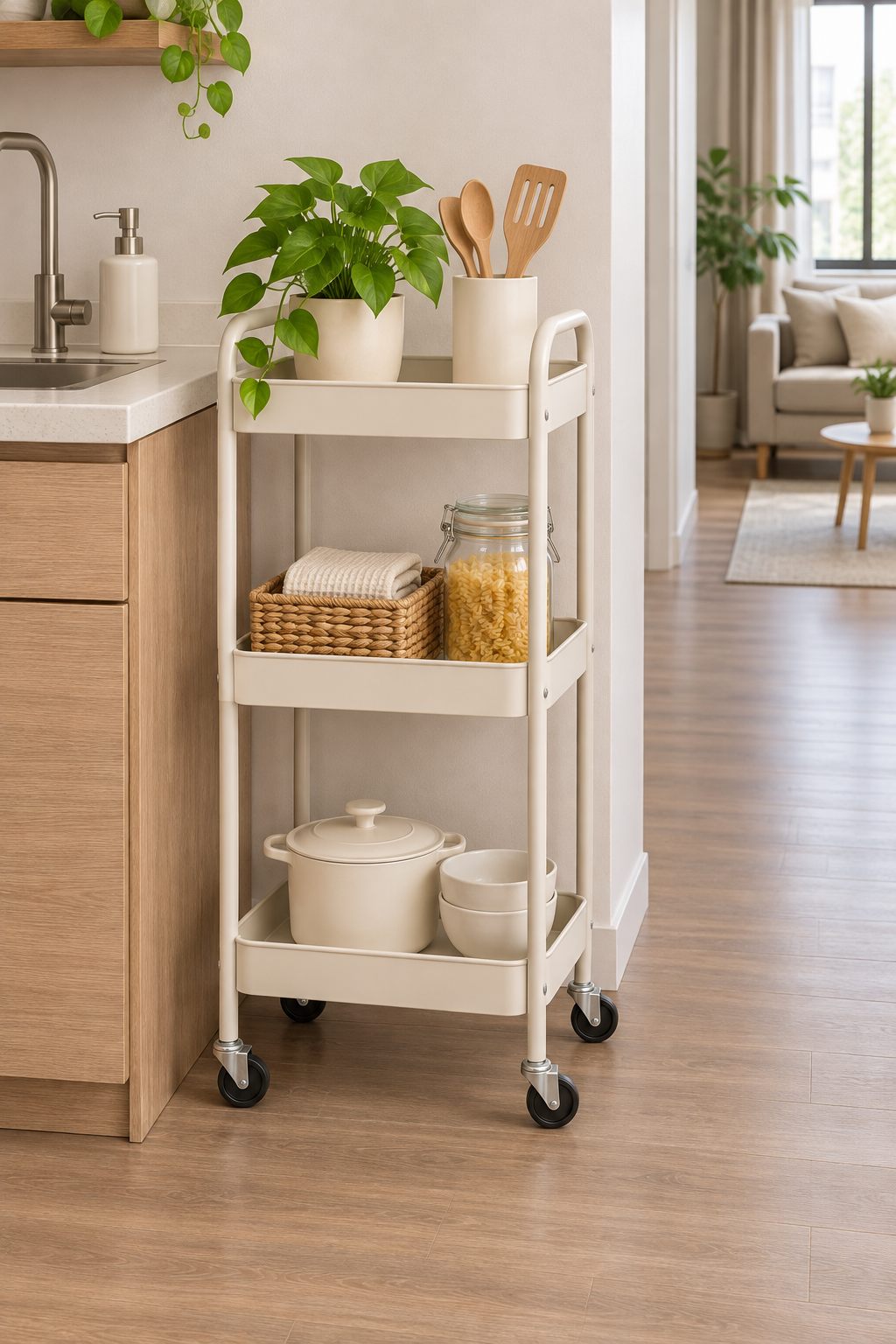
Define the cart’s job before comparing shelves
A rolling cart can serve as a pantry overflow station, cleaning caddy, craft cart, bathroom supply cart, or work-from-home station. Mixing unrelated categories usually makes every shelf harder to reset.
Write the five items that must live on the cart and the route it must travel. This determines shelf height, lip depth, wheel size, handle position, and whether locking casters matter.
- Open utility cart: fast access, but contents stay visible and can fall.
- Narrow enclosed cart: cleaner look, but door swing and ventilation matter.
- Mesh cart: lighter and ventilated, but small items need bins.
- Heavy-duty cart: higher capacity, but often wider, heavier, and less apartment-friendly.
Compare cart features by daily use
Specifications matter only when translated into the room and routine.
| Feature | Why it matters | Measure or test | Warning sign |
|---|---|---|---|
| Overall width | Determines parking and passing clearance | Include handles, wheel guards, and wall trim | Listing shows only shelf width |
| Shelf height and lip | Controls bottle, bin, and appliance fit | Measure tallest item and removal angle | Items must be tilted past the shelf above |
| Casters | Affect turning, thresholds, noise, and parking | Check wheel diameter, locks, and floor type | Tiny wheels on thick rugs or uneven transitions |
| Load rating | Supports safe distribution | Use per-shelf and total ratings | One vague maximum with no distribution guidance |
A wheel lock keeps a cart from ordinary rolling; it does not make an overloaded or top-heavy cart impossible to tip.
Map the parking spot and the route
Measure the parking width at floor level, counter height, and the widest point of nearby handles. Then measure the route: doorways, corners, rugs, transitions, appliance doors, and the space needed for another person to pass.
Mark the proposed footprint with painter’s tape and live with it for a day. If you step around the outline repeatedly, choose a different location or a smaller solution.
Plan each shelf from the bottom up
Keep heavier, dense items on the lowest shelf and lighter frequently used items at hand height. Tall bottles need enough space to lift out without hitting the shelf above. Small loose items need a contained bin rather than a shallow open shelf.
For kitchen use, compare the cart with the renter kitchen cabinet organization plan. A cart should solve a measured cabinet shortage, not duplicate half-empty storage inside the cabinets.
Check caster behavior on your floor
Small hard casters may roll easily on smooth flooring but catch on grout, threshold strips, or rug edges. Soft larger wheels can cross small transitions more easily but may increase total height and width. Check whether replacement casters are available.
Push the loaded cart slowly, turn it, and stop it on the actual route. Do not pull a tall cart around a blind corner by the top shelf. Use the frame or designated handle and keep hands clear of pinch points.
Keep the cart out of the escape route
USFA advises keeping doors and windows unblocked. A rolling cart beside an entry, bedroom window, or narrow hallway can drift or be left in the route after use. Give it a clear parking stop away from required openings.
The small rental living-room reset can help identify a stable parking zone. If every wall is already part of circulation, a cart may not be the right storage format.
Choose contents that belong together
A pantry cart can hold sealed overflow ingredients and meal-prep tools. A cleaning cart can hold daily supplies if children and pets cannot access them and every chemical remains in its original labeled container. Do not place food and household chemicals together.
For pantry use, apply the small-kitchen pantry inventory system so the cart has category limits and refill dates instead of becoming a second untracked pantry.
Plan cleaning and maintenance
Open shelves collect dust and spills. Look for removable trays or surfaces that can be cleaned according to the instructions. Check wheel axles for hair and debris and retighten assembly hardware when the maker directs it.
If a caster loosens, a shelf bends, or the cart no longer rolls straight, unload it before inspection. Do not continue adding weight to compensate for an unstable structure.
Test the cart footprint with a box
A cardboard mock-up reveals fit problems before assembly.
- Tape a box to the listed outside width, depth, and height.
- Place it in the parking spot and open every nearby door and drawer.
- Move it along the full route and through the tightest turn.
- Place weighted bags at the proposed shelf heights to visualize balance.
- Confirm the parked cart stays outside doors, windows, vents, and walking paths.
If the mock-up fits only when turned diagonally or when a cabinet stays closed, the cart is not a practical daily solution.
Common buying mistakes
- Buying from shelf width instead of overall dimensions.
- Ignoring handles, caster swivel, trim, and door clearances.
- Loading heavy items high or beyond per-shelf ratings.
- Mixing food, cleaning chemicals, paperwork, and tools on one cart.
- Parking the cart in a door, window, or hallway route.
Frequently asked questions
Are locking wheels necessary on a rolling storage cart?
They are helpful when the cart has a fixed parking spot, but locks do not correct overloading, poor weight distribution, or an uneven floor.
How narrow should a cart be for a small gap?
Leave clearance for trim, handles, wall irregularities, fingers, and caster movement. Do not buy a cart that matches the gap exactly.
Can I store a small appliance on the cart?
Only if the cart, shelf, ventilation, power setup, and appliance instructions support it. Move or operate appliances exactly as their manufacturers direct.
What should go on the top shelf?
Light frequently used items that cannot roll or fall. Keep dense liquids, glass, and bulk packages lower.
Sources and fact-checking
This guide was checked against the following current sources. Product dimensions, load limits, materials, mounting instructions, warranties, and return terms still need to be verified on the exact listing before purchase.
- U.S. Fire Administration — Home Fire Escape Plans — supports keeping doors, windows, and escape routes unblocked
- U.S. Consumer Product Safety Commission — Anchor It! — provides broader guidance on furniture stability and keeping heavier items lower



댓글 0
첫 댓글을 남겨보세요.