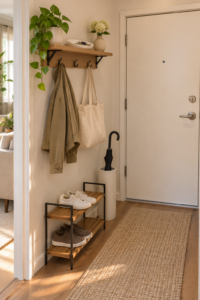
Magnetic Key Holder for Wall: What Renters Should Check
A magnetic key holder for wall use is worth buying only when its mounting method matches the exact surface beside your door. Some models attach to a steel door or metal panel with magnets, while others are wall-mounted racks that use magnets to hold the keys themselves. Before ordering, identify which design you are looking at, test the proposed location, and decide whether you need hooks, direct magnetic contact, or a small tray.
For a renter or small-home resident, the best option is usually the smallest holder that fits the daily key sets. It should be easy to reach without narrowing the route through the entry.
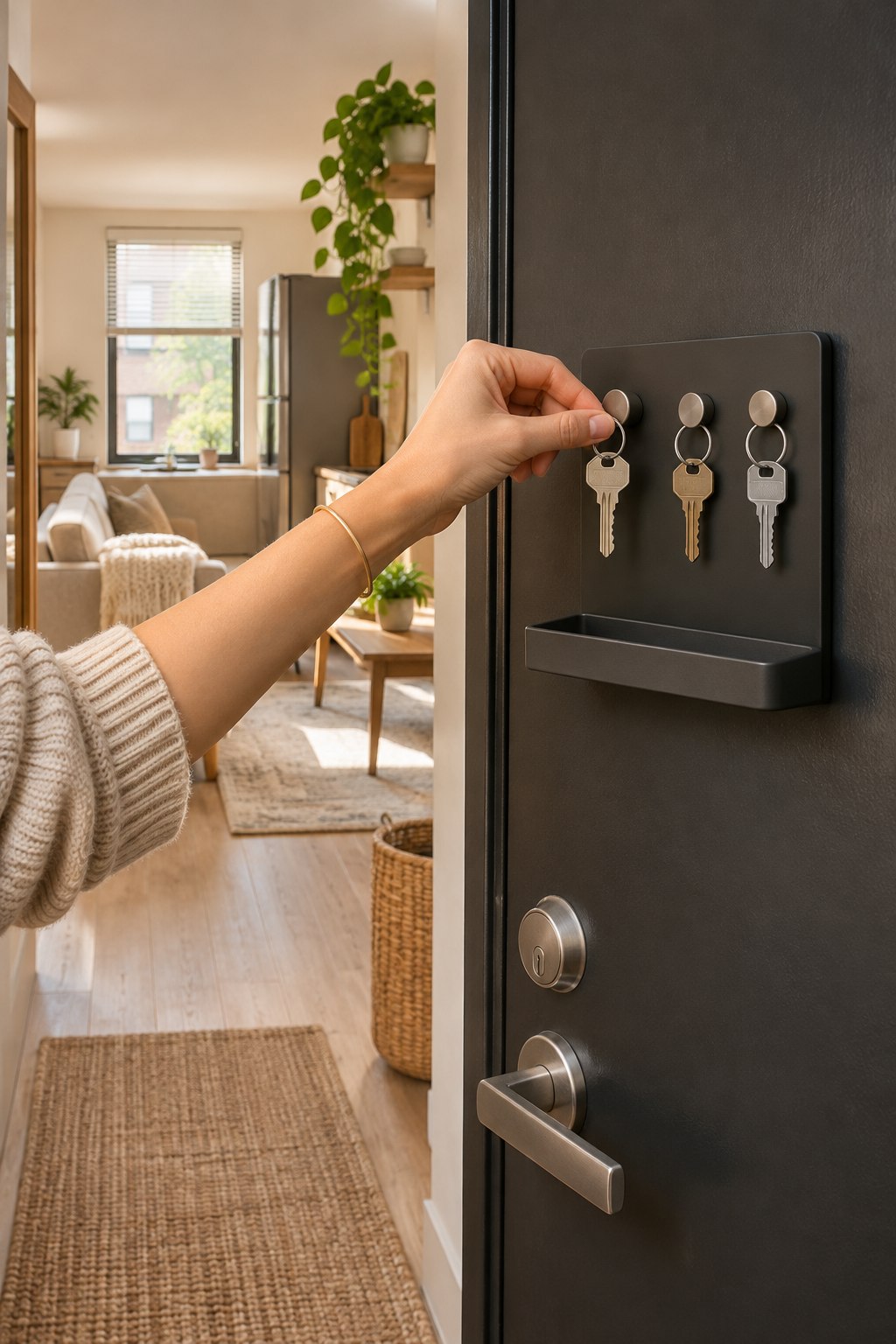
What does “magnetic key holder for wall” actually mean?
Product listings use the phrase for several different designs. That matters because the installation, surface compatibility, and daily experience are not the same.
- Magnetic-base organizer: The whole holder attaches to a ferrous metal surface, such as a compatible steel door or cabinet side. It may include hooks, a shelf, or a covered key compartment.
- Direct magnetic key rail: The rail is installed on a wall, but embedded magnets hold the metal keys or key rings. The rail itself may still require screws or adhesive.
- Hook rack with magnetic styling: Some listings use “magnetic” loosely even though ordinary hooks do most of the holding. Read the installation description rather than relying on the title.
- Magnetic cabinet or cover: The organizer has hooks inside a small enclosure, and a magnet keeps the door closed. This does not mean the organizer mounts magnetically.
Look for a diagram showing both how the organizer attaches to the surface and how the keys attach to the organizer. If the listing does not make both steps clear, do not assume it is a no-drill product.
Compare the main mounting choices before buying
| Mounting style | Best fit | Main tradeoff | Renter check |
|---|---|---|---|
| Magnetic base | Compatible steel door, cabinet, or metal panel | Fast to move, but not every metal-looking surface attracts a magnet | Test the exact spot and check whether movement could mark the finish |
| Adhesive backing | Smooth, approved surfaces with light daily items | No hole, but removal and holding performance depend on the product and surface | Follow the manufacturer’s preparation, curing, load, and removal directions |
| Screw mounted | Permanent location and a wall suitable for the specified hardware | Usually more fixed, but requires correct fasteners and wall knowledge | Check the lease and get permission before drilling when required |
| Freestanding tray or dish | No suitable wall or metal surface | Easy to place, but uses shelf or console space | Choose a stable surface away from the edge and walking path |
A no-drill label is not a guarantee that an organizer is appropriate for every rental. Paint type, finish, humidity, texture, key weight, and removal technique can all affect the result. Treat the product instructions as the controlling source for that specific item.
Start with the surface, not the organizer
Test whether the location is actually magnetic
Use a refrigerator magnet to test the exact installation area. Do not test another part of the door and assume the whole surface is the same. A metal-looking door can include nonmagnetic materials, decorative panels, or sections with different construction. If the magnet slides easily or attaches weakly, choose another location or another mounting method.
Also test the door in motion. Open and close it normally. A holder that seems stable while the door is still may shift when the door moves, especially after keys, a fob, or a small tray is added. The product instructions should say whether moving doors are an intended mounting surface.
Check paint, finish, and contact points
A magnetic organizer can still rub against a painted or coated surface. Inspect the back for exposed hardware, rough edges, or debris that could scratch the finish. Do not improvise a thick pad or add parts that change the magnet’s contact unless the manufacturer allows it. If preserving the finish is more important than using the door, a properly installed wall option or a tabletop key dish may be the better tradeoff.
Measure the door swing and walking path
Measure the organizer’s depth with keys hanging from it, not just the product body. Then open the door fully and check nearby walls, trim, switches, closet doors, and coat hooks. The U.S. Fire Administration advises making sure doors and windows in a home fire escape plan are not blocked. A key holder should not interfere with the lock, handle, door opening, or the clear route out of the home.
If the rest of the entrance also needs work, use the broader entryway storage ideas for small apartments guide to measure furniture and define zones before adding another accessory.
Count the keys you really carry
Do not buy by the advertised hook count alone. Put the actual daily sets on a table: apartment key, building fob, car key, bike key, mailbox key, work badge, and pet-access key if applicable. Bulky fobs may occupy the space of two ordinary keys, and wide key rings can collide when hooks are close together.
Use these checks:
- Can each key set be removed with one hand?
- Do neighboring rings tangle when one set is lifted?
- Is there a place for a car fob without forcing it against the door?
- Will every household member have a consistent position?
- Does the holder leave one open space for a temporary guest or service key?
A visible capacity limit is useful. When every position is full, the answer is usually to remove backup and rarely used keys, not to hang more weight from the organizer. Keep spare keys and keys that identify a specific address in a location that fits your household’s security needs rather than automatically displaying everything by the entrance.
Decide whether you need hooks, magnets, or a tray
Choose hooks for bulky rings
Hooks are often easier for car fobs, thick rings, lanyards, and mixed materials that may not attach directly to a magnet. Look at hook spacing and shape. A deep decorative hook may snag a bag or sleeve, while a very shallow hook may be awkward for a thick ring.
Choose direct magnets for a minimal routine
A direct magnetic rail can make the arrival motion simple: touch the metal key or ring to the rail and release it. The limitation is compatibility. Some key heads, covers, rings, and fobs contain little exposed magnetic material. Test your real key sets before committing to that style, and confirm the product’s intended use rather than relying on a general magnet-strength claim.
Add a tray only for a defined item
A shallow tray can hold one wallet, transit card, or pair of sunglasses, but it can also become a miniature junk drawer. Decide its job before purchase. If you need a larger system for mail, action papers, and household reminders, the small-apartment home command center guide covers that broader workflow. A key holder should not be forced to solve every entryway problem.
If the tray will briefly receive incoming mail, process it instead of letting it accumulate. The U.S. Postal Inspection Service recommends promptly picking up mail and following up on expected valuable mail that does not arrive. Bring mail inside, route it to action, filing, recycling, or secure disposal, and keep the key station available for daily carry items.
Use a five-minute fit test before installation
- Mark the outline. Use removable painter’s tape to show the organizer’s width and depth at the proposed location.
- Carry a normal load. Walk in holding groceries, a work bag, or the items you usually bring home.
- Place the keys with one hand. If you must turn sideways, reach behind the door, or set everything down first, move the outline.
- Open the door fully. Confirm that keys and organizer do not strike the wall, trim, lock, or nearby storage.
- Test every user’s reach. The position should be comfortable without encouraging anyone to pull on the holder.
This test often reveals that a wall spot is too close to the hinge, too high, or on the wrong side of the arrival path. For shared homes, the shared entryway organization system explains how to assign personal zones without crowding the door.
Common buying mistakes
- Assuming stainless-looking means magnetic: Test the exact location first.
- Confusing a magnetic closure with magnetic mounting: Read how the unit attaches.
- Buying for total household keys: Store only daily sets at the entry and route backups elsewhere.
- Ignoring door movement: Test the loaded holder while the door opens and closes.
- Choosing adhesive only to avoid permission: Adhesive can still affect a finish; follow instructions and lease rules.
- Adding a large mail shelf by default: Buy a combined organizer only if you already have a mail-processing routine.
After installation, return each daily key set to its assigned position and clear temporary objects from the tray the same day. If keys still land elsewhere, move the station closer to the natural arrival pause or switch from direct magnets to hooks rather than buying a larger organizer.
Frequently asked questions
Will a magnetic key holder work on every metal door?
No. Metal-looking surfaces can vary, and not all metals or door sections attract a magnet. Test the exact spot with a simple magnet, then follow the organizer manufacturer’s surface and installation guidance.
Is a magnetic key holder better than an adhesive one for renters?
It can be when a compatible steel surface is available and the product is intended for that use. Magnetic mounting avoids drilling, but it may shift or mark a finish. Adhesive products have different surface, curing, load, and removal requirements. Compare the exact products and your lease rather than treating either method as universally renter-safe.
Should I buy a key holder with a mail slot?
Only if incoming mail already has a clear processing routine. A combined organizer saves wall space, but an oversized pocket can become long-term paper storage. Keep sensitive documents and permanent files somewhere more appropriate.
Where should a key holder go in a small entryway?
Place it near the point where you naturally pause after entering, at a comfortable one-handed reach, without blocking the lock, handle, door swing, switch, or walking path. Mark the outline and test the location with your normal carry items before installation.
Sources and fact-checking
This article provides general organization and product-selection guidance. Exact mounting surfaces, loads, installation steps, finish compatibility, and removal methods depend on the specific product, wall or door, lease, and manufacturer instructions.
- U.S. Fire Administration — Home Fire Escape Plans: confirms that doors and windows used for escape should not be blocked.
- U.S. Postal Inspection Service — Mail and Package Theft: advises prompt mail pickup and follow-up when expected valuable mail does not arrive.
Fact-checked against the linked official resources on November 11, 2026.