
How to Verify a Rental Address Before Sending Money
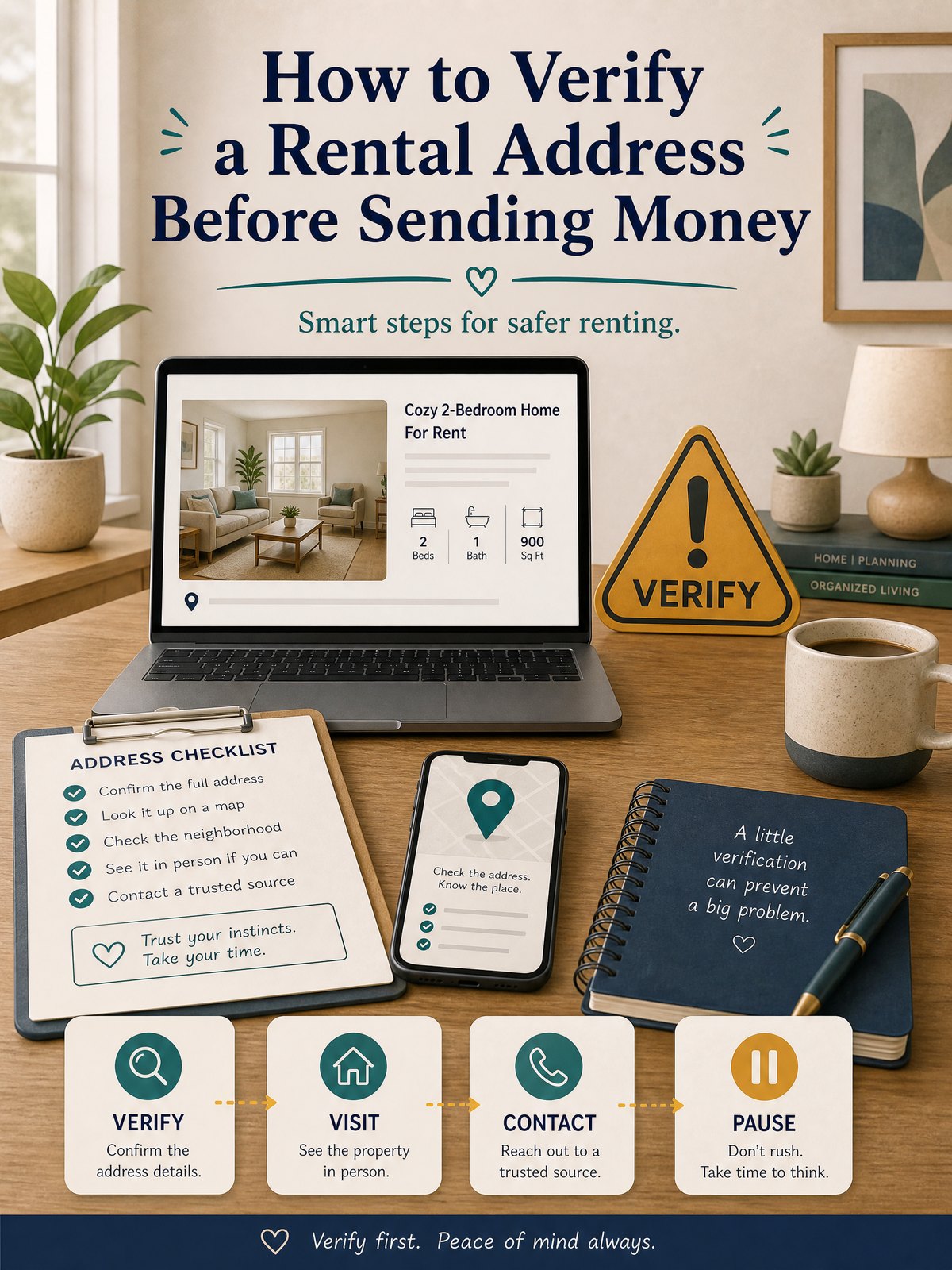
Sending money for a rental you found online is one of the fastest ways to lose your deposit or your move-in funds. Scammers post convincing listings and pressure people to pay quickly, so a few verification steps before you transfer money can protect you.
This article walks through a compact, FTC-aligned checklist and practical verification steps you can use the same day you contact a landlord or listing. The goal is to confirm the rental address and ownership confidence before any payment is made.
Start with the real constraint
The immediate constraint is money: once you send it — especially by gift card, wire transfer, or cryptocurrency — recovery is often impossible. The Federal Trade Commission (FTC) specifically advises verifying a listing and ownership information, being cautious of pressure to pay quickly, and avoiding those payment methods for a rental listing.
Because the payment channel is the irreversible part of the transaction, your verification choices should be judged by how they reduce the chance you’ll be asked to move money in an untraceable way. Practical checks that take a few minutes to a few days can often expose red flags and give you leverage to insist on safer payment arrangements (practical option).
At-a-glance plan
| Step | When to do it | Decision signal | Time to spend |
|---|---|---|---|
| Confirm the address appears in multiple listings | Immediately after first contact | Same address on two reputable sites or local listings = pass | 10–20 minutes |
| Check public records or property tax entry (practical option) | Same day if moving forward | Owner name matches contact or management company = pass | 30–60 minutes |
| Ask for and verify lease or management paperwork | Before any deposit or move-in payment | Signed lease or verifiable management contact = pass | 1–2 days to get and review |
| Refuse risky payment methods and confirm payment route | At deposit negotiation | Seller accepts bank check, escrow, or in-person payment = safer | 5–15 minutes to state preferences |
Build the system step by step
- Search the address on at least two major listing sites and run a web search for the full street address plus the word “for rent” or “rental”. If the same listing appears across different platforms, it lowers the immediate suspicion. If it only appears in one place or the photos look copied from elsewhere, treat it as a red flag (practical option).
- Look up the property in local public records or the county assessor’s site to see the recorded owner or tax account. If the name shown there doesn’t match the person you’re negotiating with, ask for an explanation and documentation. This is a practical option you can do yourself or ask a local contact to confirm.
- Request a copy of the current lease or a rental agreement draft before you pay anything. A legitimate manager or owner should provide a document showing names, dates, and a verifiable contact. If they refuse to provide written terms or insist you pay before seeing a lease, walk away — the FTC warns about pressure to pay quickly.
- Arrange a live verification: a video walkthrough, an in-person visit, or a meeting at a management office. If you can meet at the property or a nearby public space and ask to see identifying details that match the listing, you’ll gain confidence quickly. If the person claims to be out of town and refuses any live proof, treat that as a warning sign (practical option).
- Confirm the payment method and refuse unsafe channels. The FTC advises avoiding gift cards, wire transfers, and cryptocurrency for rental listings. Ask for a payment method you can trace and, if possible, that offers consumer protections — for example, a check or a payment through a recognized property-management portal. If the other party insists on a risky method, do not send money.
These steps form a layered verification system: listing checks reduce obvious fake postings, public records connect names to properties, written leases make terms explicit, live verification confirms physical presence, and safe payment choices protect funds. When in doubt, slow down — that delay is the protection.
Trade-offs to consider
No check is perfect, and different renters balance speed versus certainty differently. Here are three trade-offs you might weigh:
- Speed versus information: insisting on public-record checks and a signed lease adds days but reduces scam risk (personal planning approach).
- Availability versus caution: an in-person meeting is stronger evidence but may be impractical if you are long-distance; a live video walkthrough is a practical compromise (practical option).
- Payment convenience versus traceability: instant digital payments are fast but may be less reversible than a bank check or established portal; choose the method that fits your risk tolerance (personal planning approach).
Keep it workable
Make a short checklist you can reuse: confirm listing presence, check owner name in public records, request a lease draft, get a live verification, and confirm a safe payment route. Save email and text exchanges and take screenshots of listings. If your situation involves terms in your lease or local rules, follow your lease and check with local authorities or tenant resources as needed.
FAQ
What if the landlord says they’re out of the country and can’t meet?
If an owner claims to be abroad, ask for verifiable alternatives such as a management-company contact, a notarized document, or a live video walkthrough and a copy of the ID matching the lease name (practical option). Be especially wary if they also pressure you to pay quickly.
Can I rely on Google Street View or photos alone?
These tools help but are not definitive: photos can be reused or misleading. Use them as one part of a checklist and combine them with records and live verification before any payment is made (practical option).
What payment methods should I avoid because of scams?
The FTC advises avoiding gift cards, wire transfers, or cryptocurrency for a rental listing; these are frequently requested by scammers and are hard to reverse. Ask for a traceable payment method or an established property-management portal instead.
Next, assemble the information from the steps above and decide whether to proceed or pause—if anything feels off, stop and verify further. Keep a copy of all communications and follow your lease and local tenant guidance when finalizing arrangements.
Sources and fact-checking
This guide provides practical editorial guidance. Requirements and safe choices can depend on the product, lease, local rules, and individual situation.
- Federal Trade Commission — Rental Listing Scams — FTC advises verifying a listing and ownership information, being cautious of pressure to pay quickly, and avoiding payment methods such as gift cards, wire transfers, or cryptocurrency for a rental listing.
Fact-checked against the linked official resources on August 27, 2026.