How to Choose Apartment Storage Furniture With Safety in Mind
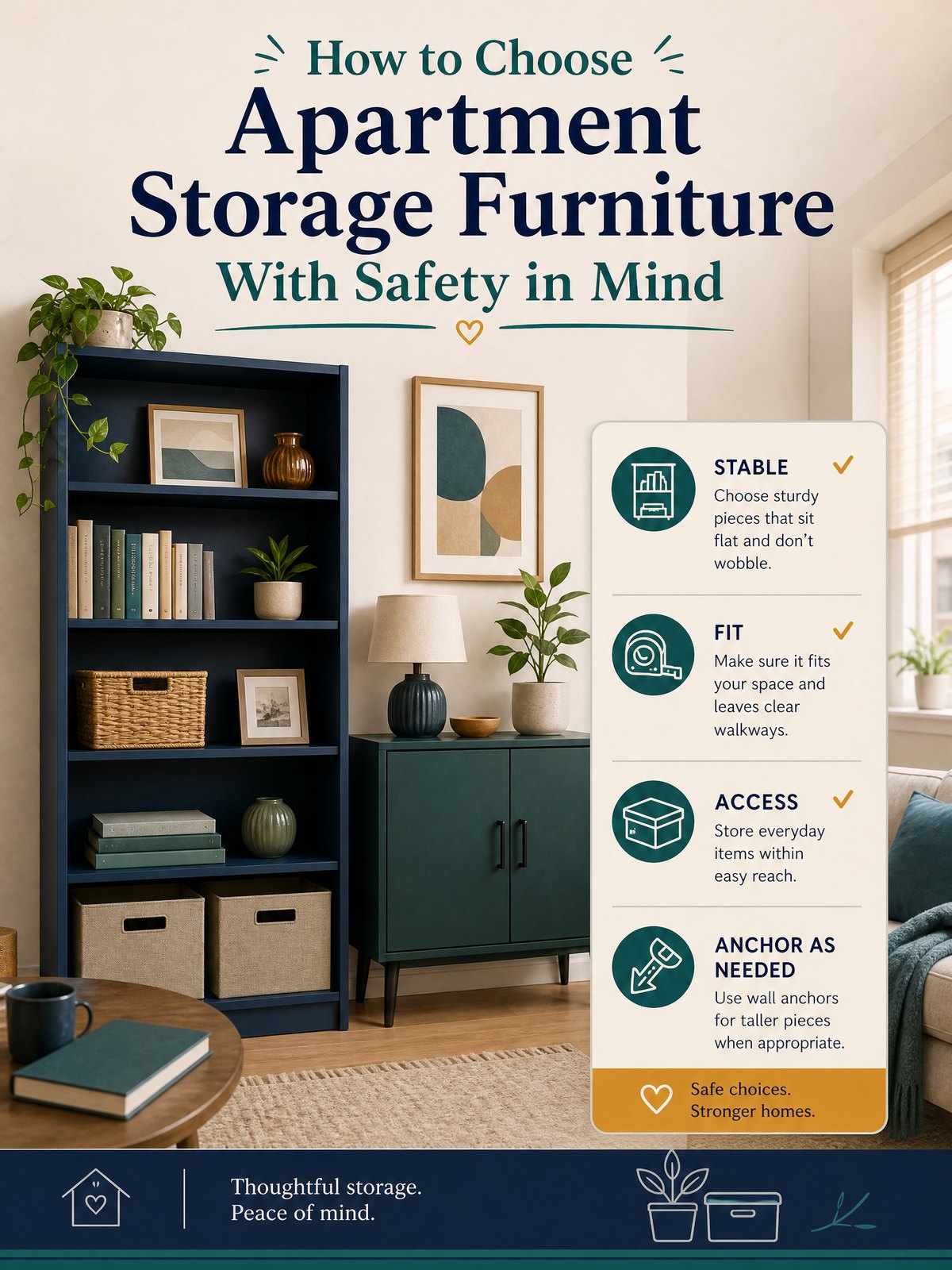
Apartment dwellers often face the same storage puzzle: limited floor space, tall shelving or dressers, and the worry that a top-heavy setup could tip, especially in a small home with kids or pets. Reading a weight-capacity number on a label feels definitive, but that number alone doesn’t guarantee safe use in your layout.
This guide shows a practical renter-focused approach: prioritize stability, placement, and following manufacturer instructions rather than treating maximum-capacity claims as the only safety rule. You’ll get a short plan, a step-by-step system you can adapt to your lease, and maintenance actions you can realistically keep up with.
Start with the real constraint
The real physical constraint in an apartment is not just how many pounds a shelf label claims; it’s how that furniture behaves in your specific space. A tall, light bookshelf can be much more likely to tip than a lower cabinet loaded to the same advertised capacity. Treat capacity figures as one input, not the whole decision.
Also remember renter limitations: your lease may restrict drilling into walls or making permanent changes, and some anchor methods require a stud or specific anchor type to be effective. Always follow your lease and the product’s manufacturer instructions before drilling, modifying, or anchoring furniture. The CPSC advises following manufacturer instructions, securing TVs and top-heavy furniture where appropriate, and keeping climb-attracting items away from the top of furniture.
At-a-glance plan
| Step | What to check or do | Timing / Decision signal |
|---|---|---|
| Inspect the furniture | Look for wobble, loose fasteners, particleboard damage, and how high the center of mass sits | Before first use and after moving it; if it wobbles, stop and reassess |
| Place and test | Position against a wall or corner, load bottom shelves first, and try a gentle push test to check stability | When arranging a room or after adding heavy items; fail the push test = needs securing |
| Secure where needed | Follow the manufacturer instructions for anchors or straps, or use renter-allowed alternatives if anchors are not permitted | Whenever a tall or top-heavy unit will be in a living area or where children/pets are present |
| Label and instruct household | Mark unstable or do-not-climb areas and tell household members where heavy items belong | Immediately after setup and after any reconfiguration |
Build the system step by step
- Choose furniture that has a low center of gravity and solid construction; prefer units with wider bases or legs set near the corners (practical option).
- Inspect and assemble carefully: tighten all fasteners, follow the included assembly guide, and replace missing or damaged hardware (practical option).
- Place units against a load-bearing wall or into a corner where practical; test stability unloaded and loaded starting from the bottom upward (practical option).
- Secure top-heavy units per the manufacturer’s instructions, using wall anchors or straps when allowed by your lease and when the manufacturer specifies such attachment (follow the manufacturer instructions).
- Use load distribution and access habits: keep heavy items on lower shelves and store infrequently used light items higher to reduce top weight (practical option).
These steps create a repeatable setup routine you can apply to every new piece of storage furniture. If your lease forbids certain anchor types, treat step 4 as a decision point and opt for lower-risk furniture or renter-friendly anchoring methods; always verify acceptable methods with your landlord or property manager (question to verify locally).
Trade-offs to consider
Every safer choice has downsides. Make decisions that balance your household’s daily needs with the realities of your lease and available tools.
- Capacity vs. stability: larger, higher units give more storage but often need anchors; choosing shorter units reduces tipping risk but may use more floor space.
- Aesthetics vs. anchoring: visible straps or anchors can affect how a room looks; concealing anchors is a personal styling choice (personal planning approach).
- Permanent fixes vs. renter limits: stud-mounted anchors are often stronger but may violate lease rules; removable anchors are renter-friendly but may have different performance.
Keep it workable
Make maintenance part of your routine: periodically re-check fasteners, pull tests, and straps after moves or heavy use. This is a practical option you can schedule alongside seasonal cleaning to keep stability reliable without creating extra chores.
FAQ
Can I trust the weight-capacity number on a shelf or dresser?
Use the capacity number as one piece of information, not the only one; capacity assumes ideal installation and uniform loading. Because actual safety depends on center-of-gravity, construction quality, and how items are placed, prioritize checking stability and following manufacturer instructions rather than relying solely on a capacity figure (practical option).
Are adhesive or removable anchors safe if my lease forbids drilling?
Some removable anchors or non-penetrating stabilizers are renter-friendly, but their performance varies by product and surface. Verify acceptability with your landlord and follow the product’s manufacturer instructions; consider selecting furniture with a low center of gravity as an alternative if anchors are disallowed (question to verify locally).
What should I do if a child or pet might climb on the furniture?
Keep climb-attracting items—like toys or remote controls—off the top, follow manufacturer instructions for anchoring where appropriate, and choose low or enclosed storage where possible. The CPSC advises following manufacturer instructions, securing TVs and top-heavy furniture where appropriate, and keeping climb-attracting items away from the top of furniture.
Start by testing each piece in place and deciding whether it needs anchoring or a different location; make a short checklist for each new unit you bring home. If you need to confirm allowed fixes, ask your landlord or check your lease before installing anchors or drilling.
Sources and fact-checking
This guide provides practical editorial guidance. Requirements and safe choices can depend on the product, lease, local rules, and individual situation.
- U.S. Consumer Product Safety Commission — Anchor It! — CPSC advises following manufacturer instructions, securing TVs and top-heavy furniture where appropriate, and keeping climb-attracting items away from the top of furniture.
Fact-checked against the linked official resources on August 27, 2026.