15 Things to Declutter Before Moving Into a Smaller Home
Moving into a smaller home is not only a packing project. It is a chance to stop paying to transport, store, and manage items that no longer fit your current life.
The most helpful way to declutter before a move is to make decisions by category rather than wandering from room to room. You do not need to own almost nothing. You need to bring the things you use, value, and have a realistic place to keep. This list focuses on common space-takers that are often easier to evaluate before they enter a new, smaller home.
A good moving box contains something you would choose to unpack within the first month.
Use a Four-Route Decision System
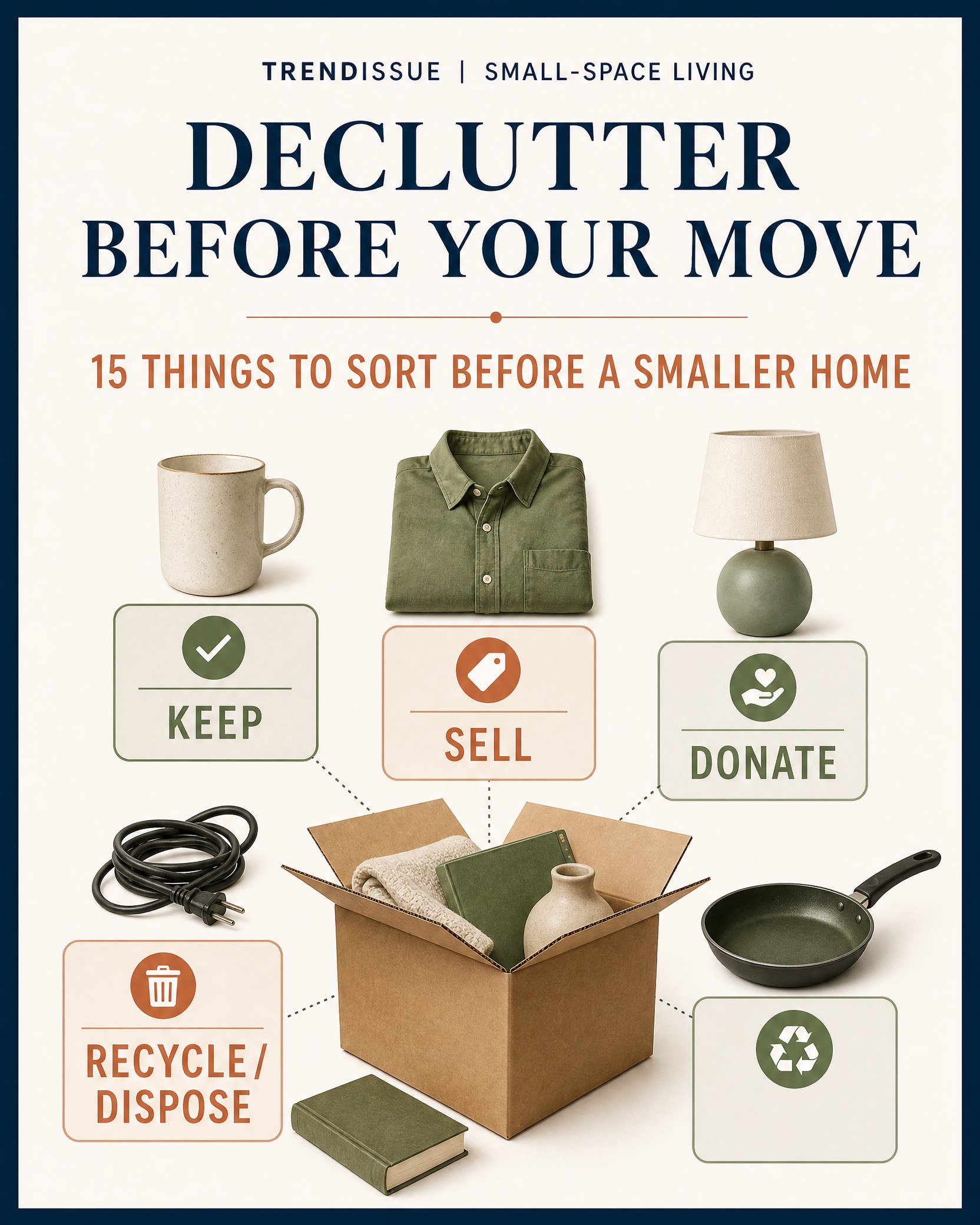
Before you begin, prepare four labeled destinations: keep, sell, donate, and recycle/dispose. The purpose is to prevent the “maybe” pile from becoming a fifth category that survives until moving day.
For every item, ask three questions. Do I use it in my current routine? Does it fit the dimensions and storage plan of the new home? Would I spend money to move it if I did not already own it? A clear “no” to two of these questions is usually enough to choose another route.
At-a-glance reference
| Route | Best for | Practical deadline |
|---|---|---|
| Keep | Useful, meaningful, or difficult-to-replace items with a planned home | Pack after the decision is final |
| Sell | Valuable items in good condition that are worth the listing effort | List 2–3 weeks before the move; donate if unsold by your deadline |
| Donate | Clean, working items that another household can use | Confirm acceptance rules before dropping off |
| Recycle / dispose | Damaged, unsafe, expired, or unsuitable-for-donation items | Check local rules, especially for electronics, batteries, and chemicals |
1. Duplicate Kitchen Tools
A small kitchen rarely benefits from three can openers, two nearly identical frying pans, or a drawer of mismatched measuring spoons. Keep the version that works best and fits your usual cooking. If you bake only a few times a year, choose a compact set of tools rather than every specialized gadget you have collected.
Pack your daily tools together so you can set up the new kitchen quickly. Put occasional-use tools in a clearly labeled box and reconsider them if they remain unopened after several months.
2. Expired Pantry Food and Mystery Freezer Items
Food is heavy to move and easy to forget. Check dates, inspect opened packages, and plan a “use what you have” week before the move. Keep sealed, in-date items that you know you will eat; donate acceptable shelf-stable items only where a local organization confirms it can accept them.
Do not move a freezer full of unlabeled containers simply because sorting feels difficult. Identify it now, enjoy it, or let it go according to local disposal rules.
3. Extra Mugs, Glasses, and Dinnerware
Count what your household uses during an ordinary week. You may need enough settings for family, a few guests, and one backup—not a cabinet full of promotional mugs or chipped glasses. Good-condition pieces can often be donated; damaged pieces may require a different disposal route depending on local guidance.
4. Bedding You Do Not Use
Keep the sheets that fit your current or future mattress and a reasonable backup set. Worn-out bedding, decorative pillows that never leave a closet, and blankets that do not serve your climate or comfort needs are candidates to donate, repurpose, or responsibly dispose of.
5. Clothes That No Longer Match Your Life
Sort by type—shirts, pants, shoes—not by room. Try on uncertain items. If something does not fit, needs an expensive repair, or belongs to a role or lifestyle you no longer have, move it toward donation or sale. Keep a small number of genuinely sentimental garments, but give them a defined container limit.
The objective is not to achieve a specific number of hangers. It is to make every item in a smaller closet easy to see, reach, and wear.
6. Unused Exercise Equipment
Large equipment earns its square footage only when it supports a regular habit. Be honest about the last several months, not the ideal version of next year. If you use a piece often, measure the new space and plan its location. If you do not, consider selling or donating it while it is still in good working condition.
7. Old Cords, Chargers, and Electronics
Gather loose cords in one place and match them to devices you still own. Unidentified cords can be set aside briefly while you check, but do not carry a tangled box of obsolete accessories into a smaller home. Before donating or recycling a phone, computer, or other electronic device, remove personal information. The U.S. Environmental Protection Agency also advises removing batteries; many batteries require separate handling and should not go in regular household trash or recycling bins. [1]
8. Outdated Papers and Manuals
Keep essential identity, tax, property, insurance, and medical records for the appropriate retention period. Shred documents containing personal information when they no longer need to be kept. Appliance manuals can often be found online, but save any document that is necessary for a current warranty or repair.
Avoid declaring a single retention rule for every document; needs vary. If you are unsure about a legal, tax, or medical record, ask a qualified professional rather than discarding it based on a general checklist.
9. Extra Towels and Linen Closet Overflow
Choose towels that are absorbent and in usable condition. A small household may need only enough for regular laundry cycles plus a few guests. Worn towels can sometimes be accepted by animal shelters or textile-recycling programs, but acceptance policies vary—call first.
10. Decorative Items Without a Planned Place
Decor can make a small home feel personal, but it also fills surfaces quickly. Photograph an arrangement you love, then select the pieces that support the new home’s dimensions and style. If you cannot picture where an item will go, place it in a temporary decision box and revisit it after the move rather than packing it by default.
11. Oversized Furniture
Measure doorways, stairwells, elevators, and the new rooms before committing to moving large pieces. A sofa, dining table, or storage cabinet may be perfectly good but still be wrong for the new layout. Selling it before the move can save the cost and stress of transporting an item that will not fit.
If you keep a tall dresser, bookcase, or storage unit, include its location and anchoring needs in your new-home plan. The U.S. Consumer Product Safety Commission recommends securing top-heavy furniture and following the manufacturer’s instructions for anti-tip devices. [2]
12. Hobby Supplies for a Past Season of Life
Hobbies change. Keep materials for the hobbies you actively enjoy or are realistically returning to within a defined period. For unfinished projects, choose one of three routes: schedule it, simplify it, or release it. Your new home should support your current interests, not serve as a warehouse for guilt.
13. Broken Items and Deferred Repairs
Set a repair deadline before the move. If you do not have the time, parts, skill, or budget to fix an item now, it may not be worth transporting. The exception is a valuable or sentimental item for which you have a real repair plan and a safe way to store it.
14. Cleaning Products and Household Chemicals
Do not pour chemicals down a drain or combine products to empty containers faster. Local rules control how many household products should be managed. The EPA notes that items such as paints, solvents, pesticides, and certain other household products may require special handling and recommends checking with the local waste-management agency or collection program. [3]
Use up products safely when possible, keep them in original labeled containers, and arrange correct disposal before moving day.
15. “Just in Case” Storage Bins
A sealed bin can hide a lot of unmade decisions. Open each bin and write a simple label that describes its actual contents. If the label is vague—“miscellaneous,” “old stuff,” or “maybe”—sort it now. Keep only items that clear your questions about use, fit, and moving cost.
Set a Donation and Disposal Deadline
Decluttering is most successful when every category has an exit route. Schedule pickup appointments early, verify hours and accepted items, and leave time for a second option if a donation center cannot take everything. Do not leave disposal research until the final day.
For recyclable materials, local acceptance rules matter. The EPA specifically advises residents to check their local program because materials accepted can vary by community. [4] That is especially important for batteries, electronics, chemicals, paint, and bulky items.
Your Next Step
Choose one category from this list and set a 30-minute timer. Make only four decisions: keep, sell, donate, or recycle/dispose. Then read The Weekend Apartment Reset: A Room-by-Room Plan for Less Clutter for a structured way to set up your new home without unpacking clutter first.
References
[1] U.S. Environmental Protection Agency, “Electronics Donation and Recycling”
[2] U.S. Consumer Product Safety Commission, “AnchorIt.gov”
[3] U.S. Environmental Protection Agency, “How Do I Recycle Common Recyclables” — Household Hazardous Waste
[4] U.S. Environmental Protection Agency, “How Do I Recycle Common Recyclables”
Sources and fact-checking
This article provides practical editorial guidance. Safety, cleaning, disposal, rental, and product decisions can depend on the item, its instructions, and local requirements.
- U.S. Environmental Protection Agency — Household Hazardous Waste — For cleaners, paint, batteries, oils, pesticides, or other potentially hazardous leftovers, follow the product label and local collection guidance.
Fact-checked against the linked official resources on August 27, 2026.