A Power-Outage Food Plan for Apartment Renters
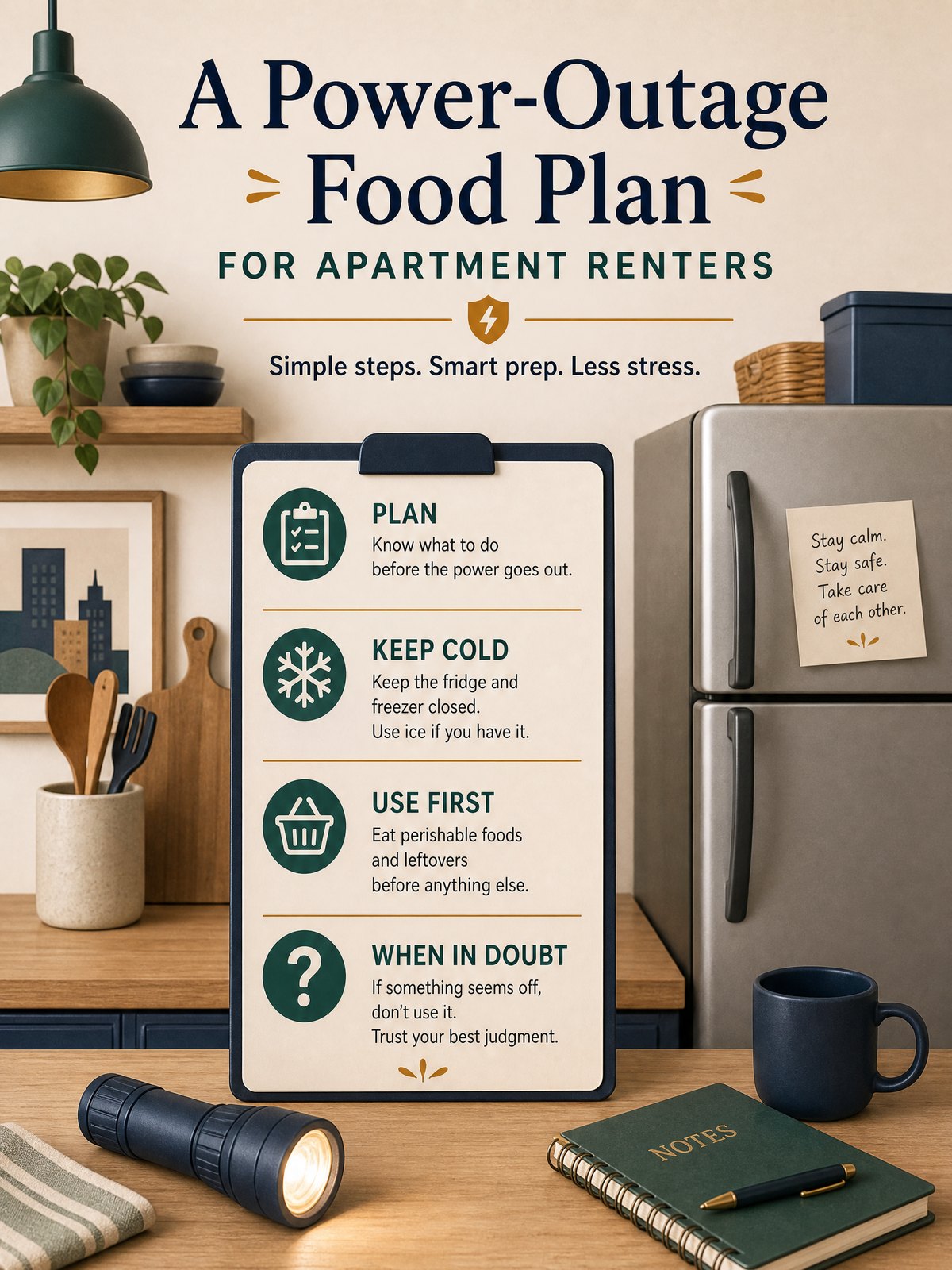
Power outages are a frequent nuisance for apartment renters: limited storage, no garage freezer, and often no easy place to keep coolers. The immediate question is which foods you can reasonably save and which you should discard without risking illness.
This article gives a compact, apartment-focused food plan to use during an outage. It centers on two nonnegotiables from FoodSafety.gov—keep refrigerator and freezer doors closed, and consult the item-specific safety chart rather than tasting food to judge safety—and shows how to turn those principles into simple decisions and small supplies you can keep on hand.
Start with the real constraint
The real constraint for renters is space and control: you usually can’t move large amounts of food to another location, and many buildings limit what you can install. That means your plan must work inside the footprint of a typical apartment and rely on behavior you can realistically maintain—chiefly keeping doors closed and avoiding tasting food as a safety test.
Because official safe-or-not guidance is item-specific, this plan focuses on decision signals you can observe (door status, visible thawing, damaged packaging) and on one trusted source for the final call: the FoodSafety.gov chart. Where you need extra gear, I label it as a practical option so you can decide what fits your apartment and budget.
At-a-glance plan
| Situation | Immediate action | Decision signal | Follow-up |
|---|---|---|---|
| Outage just started; doors have stayed closed | Leave fridge/freezer closed. Check FoodSafety.gov chart when power is restored. | Doors remained closed and items still visibly frozen or cold to touch | Use the official chart to determine safety; do not taste to test. |
| Outage continues; you must access food | Open doors briefly and only take what you need; keep cooler or insulated bag as a practical option. | Food feels warm, or packaging shows liquid or thaw | Refer to the FoodSafety.gov item chart for discard guidance; avoid tasting samples. |
| Freezer items appear thawed or slushy | Keep thawed items separated from still-frozen items and note what thawed first. | Ice crystals mostly gone or items are soft and pliable | Check the chart for each item; when in doubt, follow the chart’s discard advice rather than taste. |
| Perishable food left out or in warm fridge sections | Segregate perishable items and use the FoodSafety.gov chart to check safety; do not taste to decide. | Proteins, dairy, and cooked foods not cold to touch or with changed texture | Discard items the chart indicates unsafe; consider this a personal planning approach to reduce loss next time. |
Build the system step by step
- Prepare a short inventory list. Note highly perishable items (raw meat, soft cheeses, prepared salads) and their usual location in your fridge or freezer.
- Keep a small outage kit in an accessible spot. Make a practical option list: a couple of insulated grocery bags, reusable ice packs, a marker and tape for labeling, and a flashlight.
- During an outage, keep both refrigerator and freezer doors closed as your first priority. Use an interior light or phone light to confirm door seals if needed, but avoid prolonged opening.
- When power returns, use the FoodSafety.gov item-specific safety chart to decide what to keep and what to toss. Follow its guidance instead of tasting samples.
- Note what happened and update your inventory and kit. Record any items that thawed first or were damaged so you can adjust storage or shopping habits.
After the list, the goal is to establish a low-effort routine: keep an outage kit you can grab, keep the inventory short and updated, and make consulting the FoodSafety.gov chart your final decision step. Labeling thawed items and noting symptoms (water in packages, change in texture) helps you apply the chart more quickly.
Trade-offs to consider
No apartment plan is perfect; choosing what to prioritize involves trade-offs between convenience, waste, and upfront cost.
- Buying a small chest freezer or extra cold packs is a practical option that reduces waste but takes up space and may not be allowed under your lease—verify locally.
- Regularly replacing perishable staples (e.g., smaller quantities of dairy) reduces loss but increases shopping frequency and expense.
- Strictly limiting fridge access during outages protects food but can be inconvenient for household routines; balance with realistic needs.
Keep it workable
Once established, a workable system relies on easy habits: a two-minute inventory update when you bring groceries home, the outage kit in one accessible drawer, and a calendar reminder to check supplies seasonally. If your building has shared freezer space or community policies, verify rules with management before planning around them. When an outage happens, the simplest actions—close doors, minimize openings, and consult FoodSafety.gov’s chart—are the most effective for renters.
FAQ
Can I taste food to see if it’s still okay?
No. FoodSafety.gov specifically advises consulting its item-specific safety chart rather than tasting food to judge safety. Tasting is not a reliable safety test and is not part of this plan.
Should I buy extra equipment like a refrigerator thermometer?
Using an appliance thermometer is a practical option that can help you monitor conditions, but it is a personal planning approach; verify what works in your apartment and remember the chart is the authoritative source for safety decisions.
What if my lease restricts appliance changes or extra freezers?
Follow your lease and discuss options with your landlord or building management. If you plan changes that affect the apartment, verify them locally before purchasing or installing equipment.
Next steps: assemble a small outage kit and make a one-page inventory of your most perishable items. Keep the FoodSafety.gov chart URL saved where everyone in your household can find it quickly.
Sources and fact-checking
This guide provides practical editorial guidance. Requirements and safe choices can depend on the product, lease, local rules, and individual situation.
- FoodSafety.gov — Food Safety During Power Outage — FoodSafety.gov advises keeping refrigerator and freezer doors closed during an outage and consulting its item-specific safety chart rather than tasting food to judge safety.
Fact-checked against the linked official resources on August 27, 2026.