
Toilet Tank Lid Clearance for Shelf Installation: A Fit Test
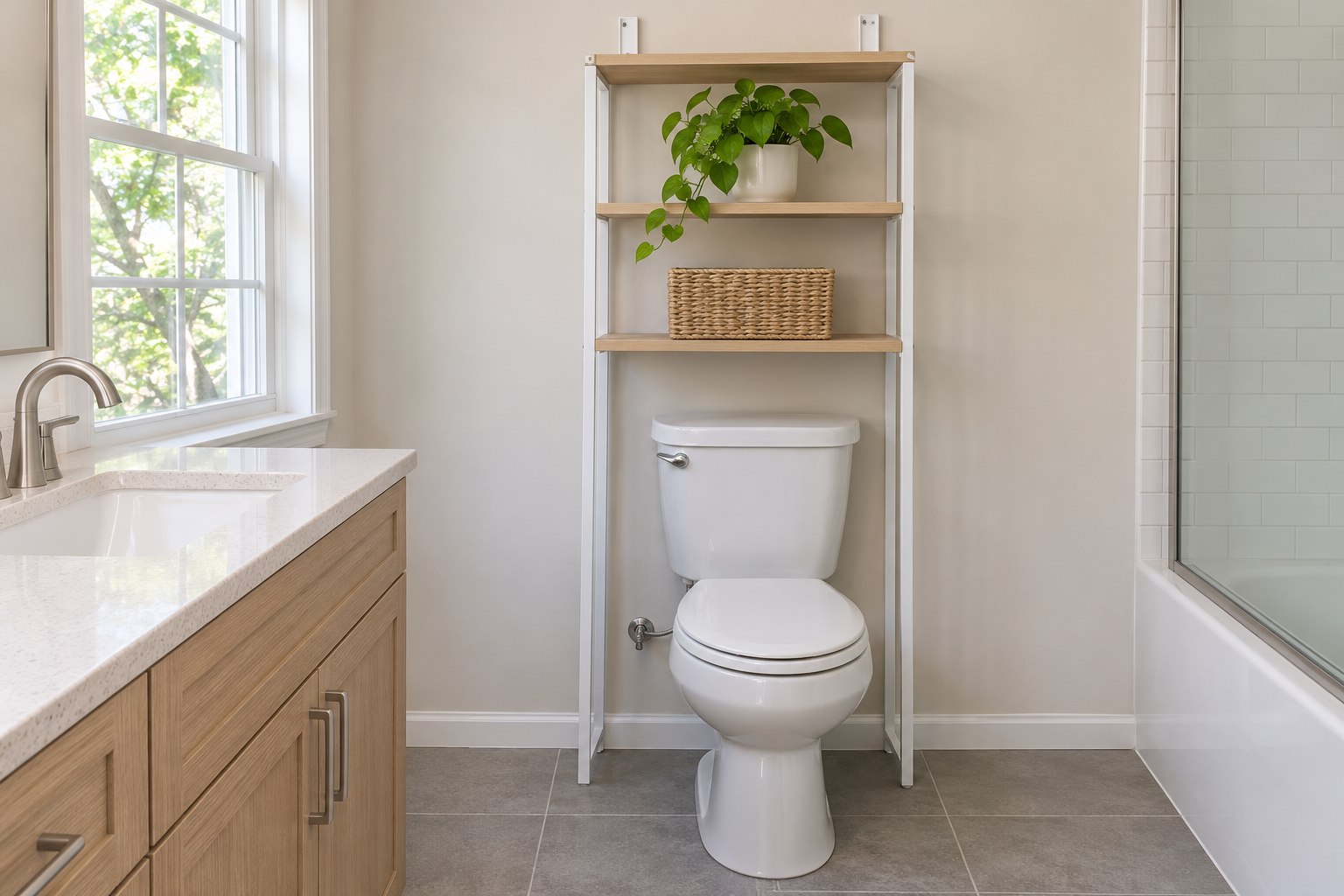
Measure toilet tank lid clearance for shelf installation by tracing how the lid actually comes off, not just measuring from the floor to the closed tank. Buy a unit only if its legs and braces clear the plumbing, you can still reach the shutoff valve, and the required wall attachment is possible. A cabinet that clears the closed tank by a little can still trap its lid.
Start with the drawing, not the product photo
Download the dimension drawing for the exact item. Find the outside width, depth and height, then look separately for the opening between the legs and the height under the lowest shelf. A measurement marked “width” across the outside edges includes the frame itself. It won’t tell you whether a side handle fits between the uprights.
For a concrete example, IKEA US lists its FRÖSJÖN over-the-toilet shelf, article 605.749.05, as 25 5/8 inches wide, 11 3/4 inches deep and 61 3/8 inches tall. Those numbers answer whether the outer frame might fit in the room. None tells you where your water valve falls relative to a brace. If the drawing omits a measurement that decides the purchase, ask for it by article number rather than scaling a lifestyle photo.
Sketch the bathroom from two directions
Face the toilet and draw what you see: tank, lever, baseboards, adjacent vanity and wall. Mark the widest point of the tank, including the lid overhang. Measure from the finished floor to its highest point. Measure the space for each foot individually; a vanity toe kick may leave floor space under an edge that sticks out at tank height. A centered fixture in a photo is no reason to assume yours is centered.
Now draw the side view. From the same back wall, mark the face of the baseboard, front of the tank and front edge of the proposed shelf. A projecting baseboard can push a floor-standing frame forward, changing both where the shelf ends and whether its attachment points meet the wall as designed. Don’t fill an unexplained gap with improvised spacers.
How to measure toilet tank lid clearance for shelf installation
If the toilet instructions allow ordinary lid removal and you can handle the lid comfortably, note how it comes free before furniture is in the way. Does it lift straight up, need to slide, or have a connected button assembly? Don’t force a lid or disconnect a mechanism to get a measurement. Ask maintenance to confirm the removal path if the lid is attached or unfamiliar.
Trace the lid outline on cardboard or use a similar-size sheet. Have someone hold another piece at the proposed shelf’s underside, with its front edge at the planned depth. Use the outline to trace the necessary lift and exit path. Allow room for hands as well as the lid. Think about where the lid could be set down for service without balancing it on the bowl or new shelf. The model that lets the lid move forward may work where a deeper cabinet at the same height does not.
| Bathroom check | Product measurement to request | Rule it out if… |
|---|---|---|
| Flush control and hand | Inside leg spacing and lowest shelf depth | A post blocks the lever stroke or the top buttons are awkward to reach. |
| Lid removal | Floor-to-shelf underside and front projection | The lid lifts but cannot come out with the frame in place. |
| Valve and supply line | Brace heights, thicknesses and foot locations | A brace traps the hose or leaves no hand access to the valve. |
| Room and cabinet doors | Full frame height, depth and open door projection | A door strikes the unit or shuts someone into a narrow corner. |
| Wall connection | Location and type of required attachment | The attachment is not permitted or cannot reach a suitable wall. |
Leave the water shutoff in plain reach
Locate the supply line and its shutoff without turning the valve as a test. Record the valve’s height, its distance from the nearest side wall and how far it projects. Compare that point with the assembled crossbar and both rear legs. A valve visible through a gap may still be impossible to grasp. Check from the side you’d actually approach, not from directly above an empty frame in a showroom.
A slim rear brace can also fit once installed but be impossible to get into position behind the bowl. Read the assembly order. Can the required parts pass around the toilet without disconnecting plumbing, and can you reach the fasteners? If the only plan involves leaving off a rail, compressing the hose or shifting plumbing, cross that model off the list.
Open both doors and stand up normally
Check the full height against the lowest soffit, window trim or sloped ceiling in the frame’s footprint. Look at what opens into that space: the bathroom door, medicine cabinet, window or vanity drawer. For a cabinet with doors, cut a paper strip the width of a door panel and swing it from the proposed hinge position. Include handles and whatever sticks out from the opposite wall.
Use cardboard at the front edge of the shelf to check head and shoulder room while sitting and standing normally. An open shelf avoids a cabinet-door swing, but it doesn’t shorten the frame’s projection. If two designs fit above the tank, choose the one that lets you reach the shelf from the floor without leaning on the toilet.
Make permission part of the measurement sheet
The IKEA listing explicitly requires this model to be secured to the wall with fixings suitable for the wall material. The U.S. Consumer Product Safety Commission also advises securing furniture such as bookcases to the wall to reduce tip-over risk. Furniture standing on feet is not necessarily furniture intended to stay unattached.
In a rental, send management the model, attachment diagram and proposed wall location before buying. Ask who can identify a suitable fixing location near plumbing, who should install it, and what the lease requires at move-out. The guide to anti-tip straps in rentals covers the hardware conversation. If the required attachment isn’t allowed, a promise to store only light items is not a substitute. Try storage inside the bathroom cabinets you already have instead.
Take your two sketches shopping. Mark each candidate “fits,” “conflicts” or “measurement missing.” That gives you a record of both toilet tank lid clearance for shelf placement and the space needed for the rest of the frame. A missing brace dimension is an unanswered question, not a pass.
FAQ
Can I use the toilet seat height instead of the tank height?
No. Measure the tank and controls from the finished floor. Seat height does not locate the tank lid or the space it needs to come off.
What if my flush buttons are on top?
Include the buttons in the tank height and try the hand motion at the proposed shelf depth. Check the toilet instructions before attempting to remove a button-equipped lid.
Will adjustable feet make a short opening tall enough?
Use feet only as the instructions allow. Do not add risers to raise the shelf unless the manufacturer expressly approves that configuration.
Should I choose doors or open shelves near a vanity mirror?
Try the door swing against the mirror or medicine cabinet first. If it conflicts, open shelves remove that swing, but you still need full tank access and the specified anchoring.
Sources and fact-checking
Sources checked November 19, 2026. This is a research-based guide, not a hands-on product test.
- IKEA US: FRÖSJÖN over-the-toilet shelf: Article 605.749.05 lists external dimensions and requires securing to a wall with suitable fixings.
- CPSC: Furniture tip-over prevention: The agency advises anchoring furniture such as bookcases securely to the wall.


댓글 0
첫 댓글을 남겨보세요.