
Vacuum Sealer Storage Position: Should the Lid Stay Latched?
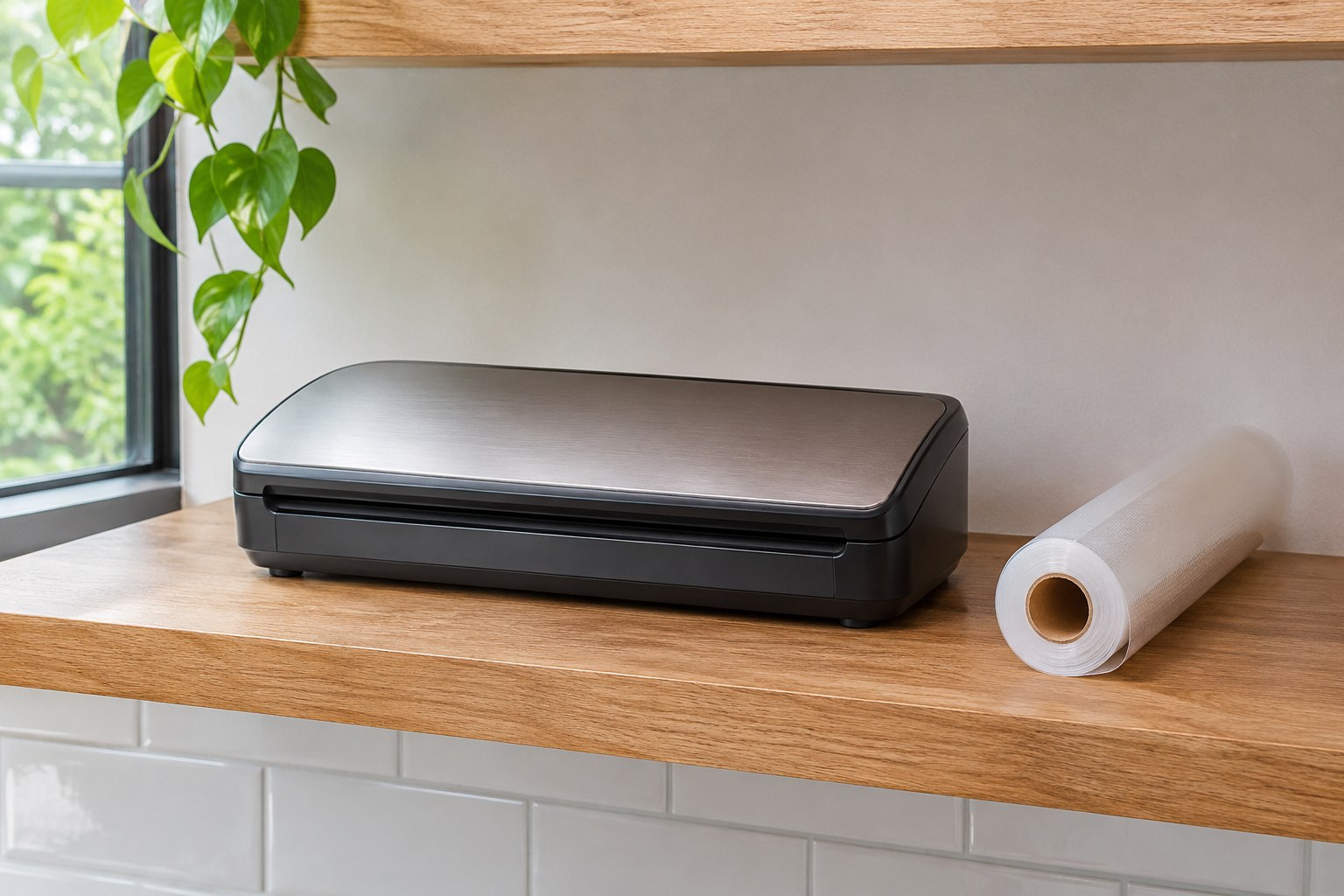
The right vacuum sealer storage position is the one specified for your model, not necessarily the position you use to seal a bag. On FoodSaver’s FM2100, clean and dry the machine, close the lid, and put the latch in the middle position marked STORE, not OPERATE. For another model, check its manual before locking the lid or standing the unit on end. Then choose a dry shelf where that position leaves room for the machine, cord, and your hands. The sealer can go in a cabinet; the perishable food it packages cannot.
Give the machine a parking spot and a work surface
Start with the place where you usually divide groceries into portions. Lay a cutting board there to represent the appliance, with a bag the size you expect to use in front of it. Can the bag rest on the counter without hanging off the edge? Can you reach the controls without leaning on the food? A slim machine backed against a wall can still take up the whole prep area once you put a family-size portion in front of it.
Now measure the storage spot. Record the width of the cabinet opening between the hinges, the depth with the door closed, and the height below the shelf above. Compare those figures with the manufacturer’s dimensions for the assembled machine, not the carton. Allow room for a protruding latch, the plug, and your fingers. In a drawer, check the opening at the top of the drawer front and the depth behind it; sometimes the machine fits inside the box but won’t pass through the gap above the front.
A vacuum sealer storage spot also needs a clear route to the counter. An appliance that has to be lifted over stacked dinnerware or carried past a working burner has an inconvenient home, even if the shelf fits. The rental kitchen cabinet guide can help you move less-used items out of a reachable cabinet without altering its shelves. A closed cabinet is for storing the unplugged machine, not an invitation to run it in place.
| Location | When it makes sense | What to test | What goes elsewhere |
|---|---|---|---|
| Dry counter near prep area | You portion groceries often | Lid opens and the bag stays flat without blocking another task | Spare rolls can stay in a cabinet |
| Reachable cabinet shelf | Counter space is more valuable between sessions | Pull the sealer out without lifting dishes or snagging the cord | Wet parts dry outside the cabinet |
| Deep drawer | A flat-storing model fits through the opening | Drawer closes with the latch in its specified storage position | Rolls that press on the lid need another home |
Watch the lid and cutter move before buying
A closed profile is only half the picture. Read the roll-loading diagram in the manual. On FoodSaver’s FM2100, the appliance door opens to accept a roll, the cutter bar lifts, and the cutter slides across the bar. You also open the appliance lid to position the bag for sealing. Under a wall cabinet, check the height for the open lid and the space for your hand to reach the far end of the slide. On a different machine the lid itself may slide; check where it ends its travel rather than assuming that overhead clearance is the only issue.
If an upper cabinet blocks the lid, see whether the whole machine can come forward while remaining fully supported, with enough counter left for the filled bag. Test the outlet position at that forward spot, too. The cord shouldn’t have to cross the sink or catch the bag as it moves. If the only way to open the lid leaves the bag dangling, keep looking rather than planning to steady a heavy portion with one hand through every seal.
Decide whether the roll deserves space inside the appliance
Built-in roll storage keeps the working roll and cutter together. That’s useful if you pack foods of different lengths and have room for the larger housing. It doesn’t eliminate the need to store a spare or guarantee that the biggest roll sold in a multipack fits the compartment. Verify both the film width the machine accepts and the roll diameter the compartment accommodates. A compatible width doesn’t tell you how thick the wound roll will be.
For predictable lunch portions, compatible precut bags may be a better use of a shallow drawer. Store them in their sleeve so you can identify the size and keep the open edges clean. If you prefer a separate roll, reserve a spot where it won’t roll off as you take out the machine. Keep it away from wet prep and leave the cutting tools where you can reach them without crossing over an open bag of food.
Compare what you would actually replenish. A bargain pack of several widths may leave you storing rolls you never open. Before paying for an accessory bundle, identify a meal that calls for each extra component and a place to keep it. For occasional use, a machine and one well-chosen bag format can make more sense than a crowded collection of hoses, adapters, and rolls.
Check the vacuum sealer storage position after drying
Read the cleaning page, not just the feature list. On the FM2100, FoodSaver instructs users to unplug the machine before cleaning and not to immerse it. Crumbs and liquid can reach the vacuum channel and drip tray. The tray comes out; the manual says to empty it after use, wash it, and dry it thoroughly before reinstalling. It also calls for checking the gaskets for food debris. A removable tray is useful only if there’s somewhere clean to set it while it dries.
In a kitchen with one sink, reserve that spot before opening any food. Keep the drying tray away from raw-food prep and put the electrical base on a dry surface. A one-sink dishwashing routine can help separate dirty items from parts ready to go back. Don’t put a damp assembly straight into a storage bin just to reclaim the counter. The bin should be the last stop, not the drying rack.
Look up the latch position before sliding the appliance onto its shelf. On the FM2100, the clean, fully dry unit is stored with its lid closed and the latch in the middle position marked STORE, not OPERATE. FoodSaver explains that storing it in the operating position can compress the gaskets. That doesn’t mean all sealers must be stored latched, open, or on end. Use the storage instructions for your own model and avoid resting other appliances on its lid.
A tight seal doesn’t change where dinner belongs
Set aside refrigerator or freezer space before you begin portioning. USDA’s mail-order food safety guidance makes the distinction clear: even when a perishable food is vacuum-packed, it still has to be kept cold. The FM2100 manual likewise says vacuum sealing does not replace refrigeration, freezing, or the heat processing used for canning. Label each portion so you know what it is and when it was packed. A close-fitting bag does not establish a new use-by date or make mishandled food safe.
FAQ
Can I store my vacuum sealer on its side like a cutting board?
Only if the manufacturer permits that orientation and the unit can stand securely. A narrow side panel isn’t necessarily a base. If there’s no clear upright-storage instruction, choose a shelf that accommodates its normal position.
Do I need a separate bin for bags and rolls?
No. A working roll in its compartment or a labeled sleeve of precut bags in a clean drawer may be enough. Add a bin only if supplies need protection or roll around when the drawer opens.
Can the vacuum sealer stay under an upper cabinet?
It can be a storage spot if it stays dry. For operation, check that you can load a new roll, fully open the lid, move any cutter, and support the food bag. Move to an open counter if any step is blocked.
Can I put vacuum-sealed leftovers in the pantry?
No. Perishable leftovers still require prompt cold storage. A household food sealer removes air from compatible packaging; it is not a process for making perishable meals shelf stable.
Sources and fact-checking
Sources checked November 19, 2026. This is a research-based guide, not a hands-on product test.
FoodSaver’s FM2100 owner’s manual (PDF) is the source for this model’s roll cutter, drip tray, and STORE latch position. USDA FSIS guidance on perishable deliveries supports the cold-storage distinction, not a promise that vacuum sealing adds a particular number of days.



댓글 0
첫 댓글을 남겨보세요.