
Small Freezer Ventilation Clearance: Will It Fit Your Apartment?
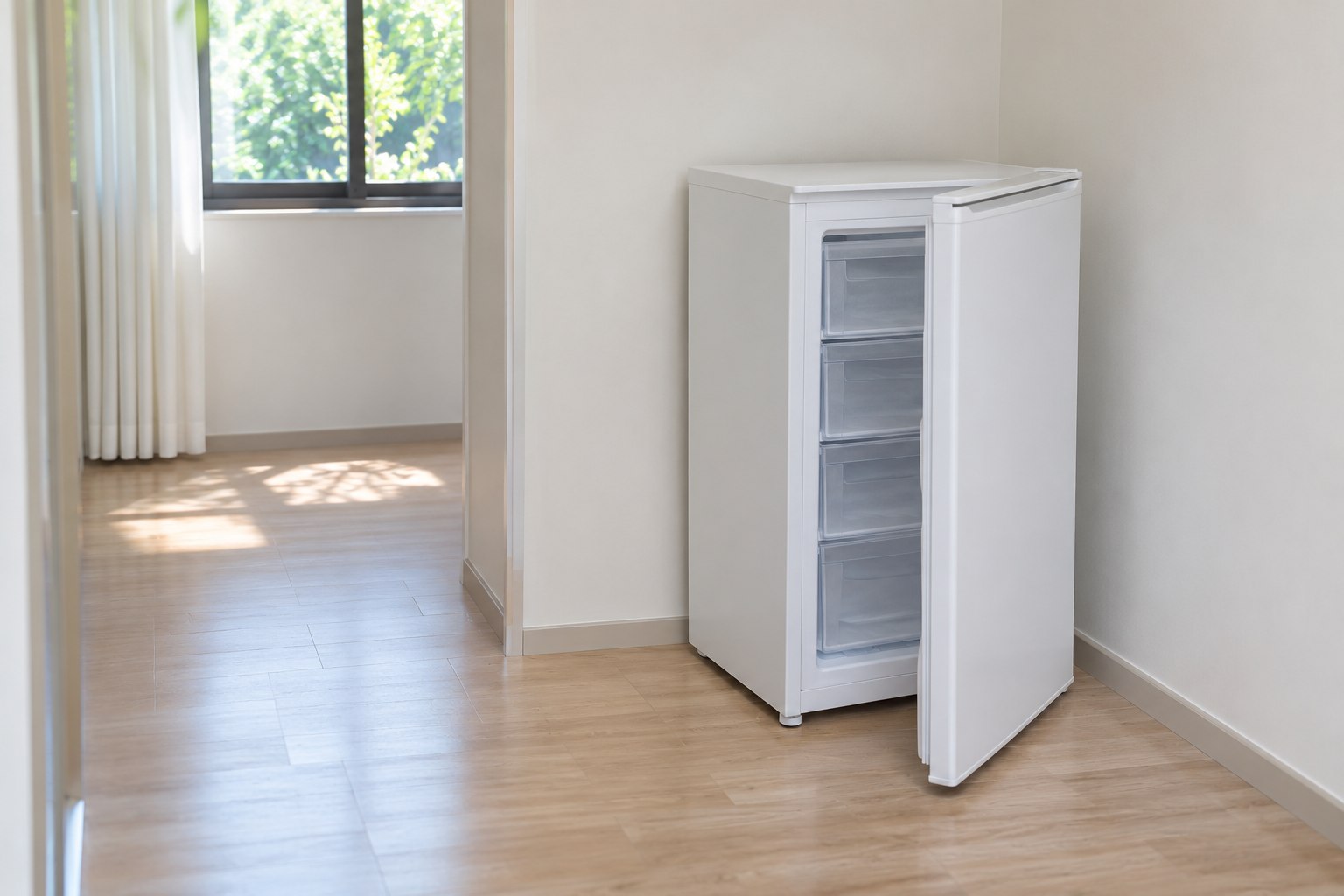
Small freezer ventilation clearance is the air space your model requires around its cabinet. Reserve those gaps first, then measure the extra room needed to open the freezer. A freezer that slides neatly under a shelf can still be unusable if the lid hits the shelf before you can lift out a basket. Before you order, check the exact model in its intended spot, confirm the cord can reach a suitable outlet, and trace the delivery route all the way from the building entrance.
Start With the Food, Then Mark the Floor
Which packages have no home in your current freezer? A stack of flat dinner portions calls for different access than bulky grocery bags. Before giving up a corner of the apartment, try the freezer inventory and meal-zone reset with what you already own. If the same items still spill over on grocery day, take that short list shopping. Cubic feet describe interior capacity, not how easily you can get the bottom package out.
For each candidate, sketch the freezer as seen from above. Mark the hinge, handle, controls and any protruding hardware shown in the dimension drawing. Write each required air gap along the corresponding edge. On the floor, use a piece of cardboard to mark the outside of that whole area, not just the cabinet. Measure from the baseboard where it sticks out, not from the wall above it. Open the nearest pantry door and walk past the outline carrying groceries.
How to Measure Small Freezer Ventilation Clearance
The GE chest freezer manual for the FCM5 and FCM7 series calls for 3 inches of air space at the top, back and each side, plus enough room above to open the lid. For these models, the space between two fixed side obstructions would have to be at least the freezer’s width plus 6 inches. That arithmetic answers the width question only. It does not establish that a closed closet or an opening with a low shelf is suitable. GE specifies a dry, well-ventilated room and a floor strong enough for the freezer when fully loaded.
Write down the distance from the floor to the lowest fixed object above the freezer. Compare it with the manufacturer’s height with the lid fully open, measured from the same starting point. If the drawing gives only closed height, ask for the fully open dimension rather than treating the required top air gap as lid travel. Include anything hanging from the shelf. The shelf bracket, not the shelf itself, may be the first thing the lid hits.
| Space to test | Chest freezer | Upright freezer |
|---|---|---|
| Above the appliance | Check the full lid arc and the path of a basket coming out. | Check the top air gap in the installation instructions. |
| Beside a wall | Reserve the model’s side gaps even if the lid clears the wall. | Check hinge-side clearance and whether drawers slide out with the door open. |
| Across the aisle | Leave a place to stand and reach into the tub. | Trace the door swing, then stand where you would pull a drawer. |
| During upkeep | Find the drain, if fitted, and a place to collect defrost water. | Check how shelves or bins come out for cleaning. |
Try Taking Dinner Out of the Freezer
Imagine putting away a bag of groceries while someone else comes through the room. For a chest freezer, can you stand at the front, raise the lid fully and lift a basket without leaning against the hinge? If the only place for grocery bags is on the lid, where will you put them when you open it? A nearby landing spot can make a modest freezer more useful than a larger one wedged between pieces of furniture.
For an upright, use a strip of cardboard the width of the door to sketch the swing from the hinge side. A door that clears the opposite wall can still stop short of the angle needed to pull a drawer past its gasket or shelves. Check the model drawing or ask the maker about drawer removal. A reversible door can solve a specific hinge conflict only if that feature is documented for the model and the opposite swing works too.
Find the Plug and the Drain While the Corner Is Empty
For the GE example, the manual calls for the freezer’s own properly grounded outlet and prohibits an adapter or extension cord. Check the rating plate and electrical instructions of the freezer you are considering. Mark the outlet on your sketch, including where the plug projects from the wall. The cord should reach without being trapped under the freezer or crushed when the cabinet is moved into position. If the only outlet is unsuitable, ask the property manager about an electrician or choose another location.
A manual-defrost model also needs a way to deal with meltwater. The GE manual locates the drain on the front. In a narrow nook, kneel where the drain would be and see whether you can reach the cap and position a shallow pan. Consider where frozen groceries will go while you work. If defrosting would require dragging a loaded freezer across the floor first, try a different orientation before committing to that corner.
Get Through the Building, Not Just the Kitchen Door
Ask the seller for packaged dimensions and whether the delivery team removes packaging before the tightest turn. Measure the clear opening with the apartment door actually open. Look for the handle projecting into the path, a handrail cutting into a landing, and an elevator too shallow for the freezer and the team moving it. Give the delivery service the tightest measurements; don’t count on tilting the freezer to get past them. GE specifies upright transport for the models discussed here.
For a pickup or move involving stairs, use the appliance dolly and delivery-route checklist before reserving equipment. Confirm any building delivery restrictions with management. If two freezers pass every installation check, compare similar models using the yellow EnergyGuide labels as ENERGY STAR recommends. Energy comparisons are useful at this stage; they cannot make a blocked lid, missing outlet or impossible turn disappear.
FAQ
Can a chest freezer go under a wall shelf?
Only if the location meets its ventilation instructions and the lid can open as intended. Measure the height under brackets too. If you cannot remove the basket or comfortably reach inside, the shelf is too low for practical use even if the lid cracks open.
Can I count an open pantry door as ventilation?
Do not rely on leaving a door ajar to qualify an enclosed space. Check the model’s room and clearance requirements. If you cannot establish that the pantry is allowed, choose an open location or ask the manufacturer about that exact layout.
Is the freezer’s listed depth enough for planning an aisle?
No. Check whether that depth includes hinges and handles, add the required rear gap, and account for the actual plug position. Then test the space in front with the freezer open and someone standing there.
What if the seller wants to transport it on its side?
Look up the moving instructions before agreeing. For the GE models here, upright transport is required. If a freezer has already traveled in a position its manual does not allow, contact the maker before plugging it in rather than guessing at a waiting period.
Sources and fact-checking
Sources checked November 19, 2026. This is a research-based guide, not a hands-on product test.
Installation, electrical, moving and drain details come from GE Appliances’ FCM5/FCM7 manual, pages 4 and 6 through 8. ENERGY STAR’s freezer buying guidance covers size, door style and label comparisons. Use the manual for your exact freezer to set the final dimensions; neither source certifies a particular apartment location.



댓글 0
첫 댓글을 남겨보세요.