
Small Room Humidifier: 8 Checks for Apartment Bedrooms
A small room humidifier should be easy to clean, adjustable enough to avoid wet surfaces, and sized for the room you actually occupy. For an apartment bedroom, the best choice is not automatically the model with the largest tank or the longest advertised runtime. Start with cleaning access, output control, placement, and the cost of water or replacement filters, then compare capacity.
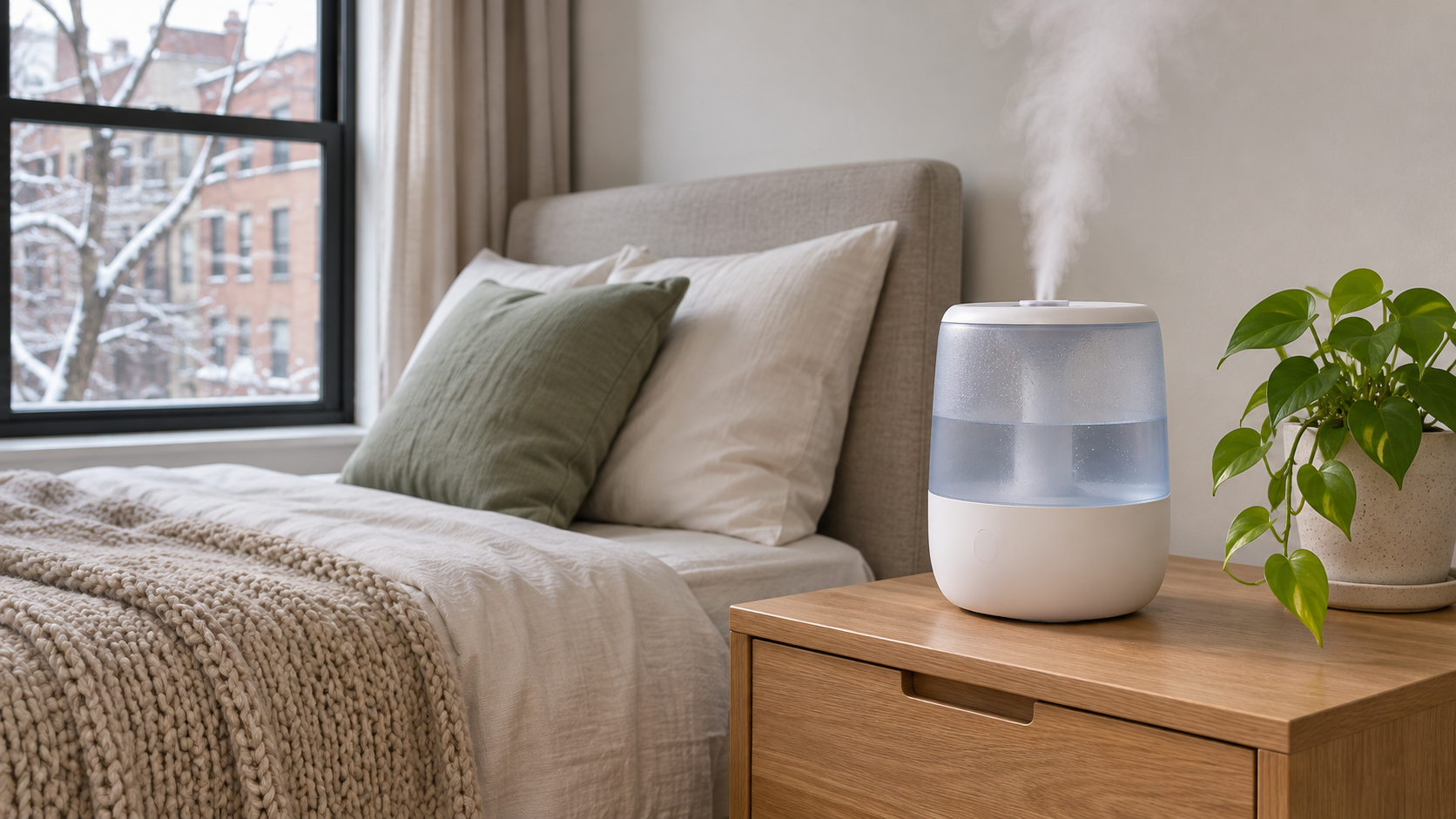
This guide is for renters and small-home residents who want a practical buying checklist rather than a ranked product list. It explains the tradeoffs among common portable humidifier types, how to plan for daily care, and what to verify before paying for a specific model.
Start with the room, not the humidifier tank
Measure the room’s length and width, note whether the door normally stays open, and decide where the unit could sit without mist reaching bedding, curtains, walls, or electronics. A bedroom with the door closed is a different job from an open studio connected to a kitchen and hallway. If your goal is one sleeping area, compare models for that occupied zone instead of trying to humidify the entire apartment from one corner.
Room coverage claims are useful for narrowing the field, but they should not replace output control. Heating cycles, outdoor weather, ventilation, and an open door can all change how quickly indoor humidity rises. A small separate hygrometer or a reliable built-in humidistat gives you a way to check conditions instead of guessing.
The U.S. Environmental Protection Agency advises not exceeding 50% indoor relative humidity. Condensation on windows, walls, or pictures is a clear signal to reduce output, move the unit, or use it less often. That makes adjustable mist or fan levels more valuable than maximum output alone.
Compare the main portable humidifier types
| Type | How it works | Small-room advantage | Main tradeoff to price |
|---|---|---|---|
| Ultrasonic | Uses vibration to create visible cool mist | Often compact and quiet | Minerals can become white dust; daily water care matters |
| Evaporative | A fan moves air through a wet wick or filter | No visible plume and generally less mineral dispersal | Fan noise and replacement-wick cost |
| Warm mist or steam vaporizer | Heats water and releases steam or cooled steam | No wick on many models | Hot water and steam can burn; poor fit around children or pets |
| Impeller cool mist | A rotating disk throws water into a diffuser | Cool output without a heating element | Can disperse minerals and material from standing water |
EPA guidance says ultrasonic and impeller units generally disperse more minerals and microorganisms from their tanks than evaporative or steam types. That does not make every ultrasonic unit a bad purchase. It means the water choice, tank design, cleaning routine, and nearby surfaces deserve more weight in your comparison.
Eight buying checks for a small room humidifier
1. Can you reach every wet surface?
Look past the words “top fill.” A wide opening helps, but the base, channel, float, nozzle, and corners also need cleaning. Check the manual or product photos for removable parts and make sure your hand or a soft brush can reach the water-contact areas. A beautiful narrow tank that is frustrating to dry is a poor everyday choice.
2. Does the lowest setting stay low enough?
In a small bedroom, fine control matters more than maximum mist. Compare the number of output settings, whether a humidistat can cycle the unit, and whether the selected setting returns after a power interruption. A timer can be useful, but it does not replace checking actual humidity.
3. Is the tank manageable when full?
Estimate the filled weight before buying. One U.S. gallon of water weighs a little over eight pounds, before adding the tank itself. Consider the route from sink to bedroom, the grip shape, whether the tank must be turned upside down, and whether it fits under your faucet. A smaller tank that is easy to refill and dry may be more practical than a larger one that is awkward to carry.
4. Does it fit the real placement zone?
Measure the available surface, including clearance around the unit and space to lift a lid or remove a tank. Do not assume it belongs on a crowded nightstand. The surface should be stable and able to tolerate an accidental drip, while the mist path should stay away from absorbent fabrics and walls. Follow the model’s manual for clearance and placement.
5. Can you control sleep disruption?
Check whether indicator lights can be turned off and whether buttons beep during changes. Noise descriptions such as “whisper quiet” are not standardized, so look for an actual sound specification and read return-policy details. Evaporative models add fan noise; ultrasonic models may be quieter but can produce occasional water sounds.
6. What will water and filters cost?
EPA recommends low-mineral water, such as distilled water, to reduce scale and mineral release. That can become a meaningful recurring expense during a dry winter. Evaporative units may use tap water according to their instructions but usually need replacement wicks or filters. Compare the locally available cost of distilled water, cartridges, and model-specific filters before focusing on the purchase price.
7. Does it shut off safely when water is low?
Verify the exact model’s low-water behavior in its manual, not only in a marketplace title. Also check the cord length against the planned outlet location so you are not designing the room around an extension cord. Keep the plug and outlet away from mist and spills, and follow all manufacturer electrical instructions.
8. Can you identify and support the exact model?
Before checkout, record the brand, full model number, warranty length, seller, and replacement-part source. Search that exact identity in the CPSC recalls database, especially when buying used or from a marketplace seller. A family name or a similar product photo is not enough because recalls can apply only to specific model numbers or date codes.
A five-minute pre-purchase worksheet
- Room: length × width, usual door position, and heating schedule.
- Placement: surface width and depth, nearby fabric, wall, outlet, and refill clearance.
- Daily handling: full-tank weight, sink clearance, grip, and drying access.
- Controls: lowest output, humidistat, timer, light-off mode, and low-water shutoff.
- Recurring supplies: distilled water, wick, filter, cartridge, or cleaning tool.
- Identity: exact model number, manual, return window, warranty, and recall result.
If you are also comparing winter appliances, use the outlet and clearance checks in our safe space heater for bedroom guide. For the larger seasonal setup, the small-apartment winter preparation plan helps separate useful purchases from supplies that will only consume storage.
Plan the first week before you buy
A humidifier is not a set-and-forget appliance. EPA recommends emptying the tank, wiping surfaces dry, and refilling portable units daily. It also recommends cleaning portable humidifiers every third day, unplugging the unit first, removing deposits or film, and following the manufacturer’s cleaning directions. If a cleaner or disinfectant is used, the tank must be rinsed thoroughly so chemicals are not dispersed into the room.
Write a simple routine before the box arrives:
- Morning: unplug, empty remaining water, wipe reachable wet surfaces, and let parts dry.
- Refill time: use the water type specified by the manufacturer; choose low-mineral water if you want to reduce scale and white dust.
- Every third day: clean water-contact surfaces as the manual directs and remove visible deposits.
- During operation: check the hygrometer and nearby surfaces. Reduce output if the area becomes damp or condensation appears.
- Before storage: clean, dry every part, discard used consumables as directed, and store the unit dry.
Link this care task to an existing morning or evening reset instead of creating a vague “clean later” promise. If the bedroom already feels crowded, the small bedroom reset routine can help you clear a stable operating spot without turning the nightstand into an appliance shelf.
Common mistakes and real tradeoffs
Buying for advertised runtime alone: long runtime may assume the lowest output and a full tank. It says little about cleaning access or how well the unit controls humidity in your room.
Choosing the largest tank that fits the budget: more water means more weight, more surfaces to clean, and more space required for refilling. Capacity is useful only when you can handle the tank comfortably.
Ignoring the cost of ownership: a low-cost unit can become expensive if it requires hard-to-find filters or daily distilled water. Compare a full season, not only checkout price.
Treating visible mist as proof of performance: a visible plume shows where droplets are moving, not whether the room has reached an appropriate humidity level. Use a humidity reading and inspect the surrounding area.
Assuming essential oils are allowed: add oils, medications, or inhalants only if the exact manual says the unit is designed for them. Putting additives directly into an ordinary water tank can damage the product or release material the unit was not designed to disperse.
Frequently asked questions
Do I need a humidifier for a small room?
Check indoor relative humidity before buying. If the room is already comfortable and within a reasonable range, more moisture may create condensation rather than solve a problem. A basic hygrometer costs less and helps you decide whether the appliance is needed.
Is an ultrasonic or evaporative humidifier better for an apartment bedroom?
Ultrasonic units are often compact and quiet, but water minerals may appear as white dust and careful tank cleaning is important. Evaporative units generally disperse fewer minerals but add fan noise and recurring wick costs. Choose the maintenance pattern you can follow consistently.
Can I use tap water in a small room humidifier?
Follow the product manual. EPA says distilled water has lower mineral content than most tap water and can reduce scale and mineral dispersal, especially in ultrasonic and impeller units. Bottled water labeled spring, artesian, or mineral has not necessarily been demineralized.
Can I run a humidifier overnight?
Only operate the exact model as its manufacturer directs. Use a stable placement, keep surrounding materials dry, verify low-water shutoff, and monitor humidity rather than assuming an all-night setting is appropriate. Reduce or stop use if condensation or dampness appears.
Sources and fact-checking
- U.S. EPA: Use and Care of Home Humidifiers
- U.S. Consumer Product Safety Commission: Dirty Humidifiers May Cause Health Problems
- U.S. Consumer Product Safety Commission: Recalls & Product Safety Warnings
Fact-check completed November 16, 2026. Product features, replacement-part availability, and recall status can change, so verify the exact model and current manual before purchase.




댓글 0
첫 댓글을 남겨보세요.