
Portable Dishwasher on Wheels: Measure Before You Buy
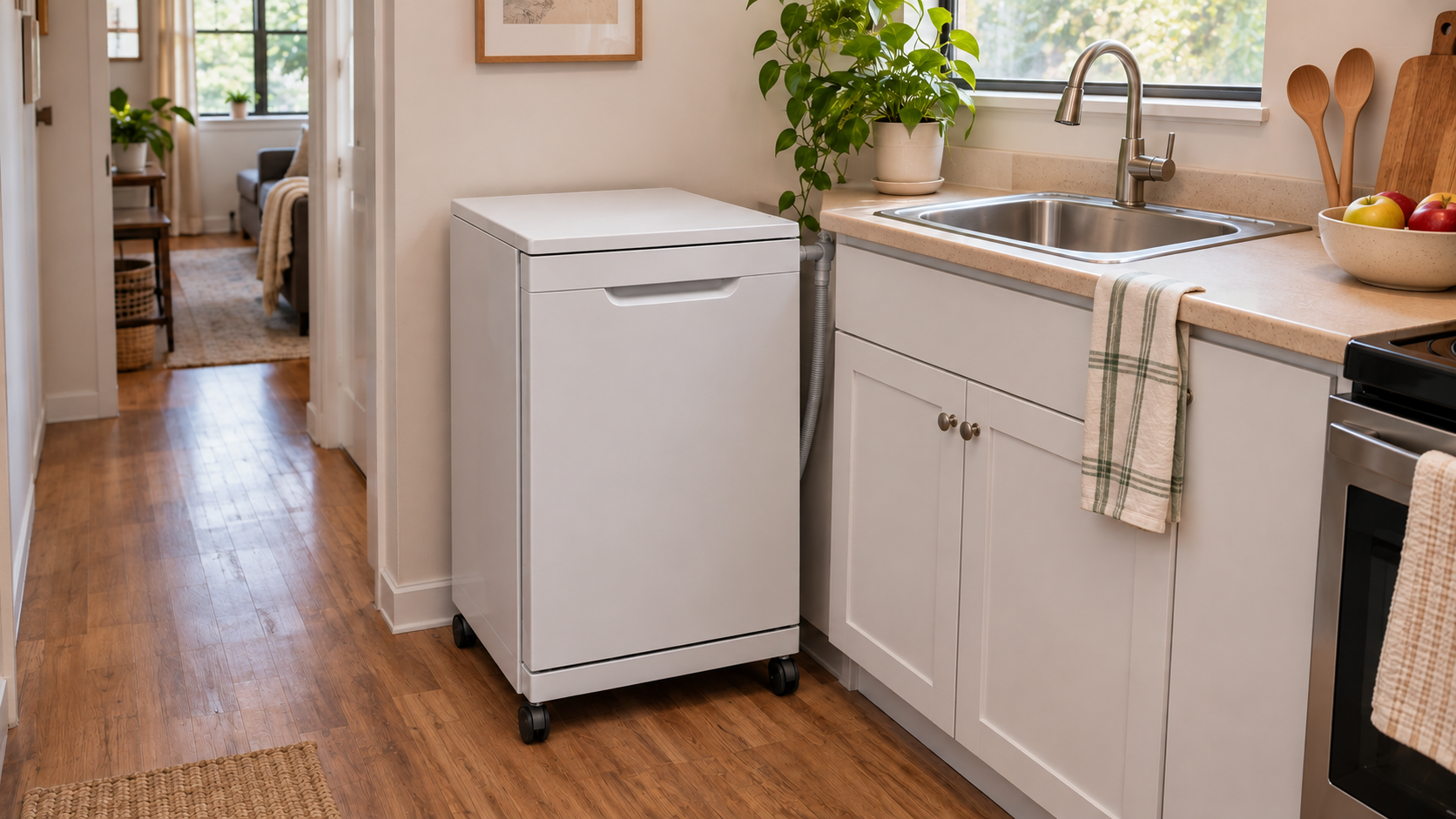
A portable dishwasher on wheels can be a practical upgrade when a rental or small kitchen has no built-in machine, but only if the entire route from storage to sink works. Before buying, measure the parked footprint, rolling path, open-door clearance, faucet connection, drain position, and power location. The best model is not simply the one with the largest rack. It is the one you can connect, run, disconnect, and park without blocking the kitchen.
This guide focuses on the checks that are easy to miss in product photos. It does not assume every faucet, lease, outlet, or floor plan is compatible. Use the model’s current specification sheet and installation instructions as the final authority.
Is a Portable Dishwasher on Wheels Right for Your Kitchen?
A rolling dishwasher is most useful when you have enough floor space for a full-height appliance but cannot install a permanent built-in unit. It normally lives against a wall, cabinet end, or other parking spot and moves to the sink for a wash cycle. That makes it different from a countertop dishwasher, which trades rack capacity for a smaller footprint.
Start by asking whether the routine will be easier than your current dishwashing setup. If moving the appliance would require shifting chairs, lifting a rug, crossing a doorway, or blocking the refrigerator every time, the machine may become storage rather than a daily tool. A renter with a direct, level path to the sink is usually in a stronger position than someone whose only parking spot is across a narrow galley kitchen.
If you are still improving the room layout, first review this small rental kitchen setup. Creating one stable appliance zone before shopping can prevent an expensive fit mistake.
Measure Six Zones Before You Compare Models
Use painter’s tape to mark the proposed footprint on the floor. Then repeat the test with a rectangle representing the open door. Product width alone is not enough because handles, hoses, cords, control panels, and the turning radius can change how the machine behaves in a tight room.
| Fit check | What to measure or verify | Why it changes the decision |
|---|---|---|
| Parking footprint | Actual width, depth, height, handle projection, and hose storage | A nominal size may not describe the space the complete appliance needs. |
| Rolling path | Narrowest passage, corners, thresholds, rugs, and floor transitions | The machine must reach the sink without repeated lifting or furniture moves. |
| Operating position | Space at the sink with the door closed and fully open | Loading should not trap someone in the room or block another appliance. |
| Faucet connection | Aerator type, thread, adapter requirements, hose reach, and sprayer design | Compatibility is model-specific; appearance alone does not prove a connection will fit. |
| Drain setup | Drain-hose position, sink clearance, and whether the basin remains usable | A stretched, pinched, or awkward hose turns every cycle into a spill risk. |
| Power location | Outlet position and the manufacturer’s cord and circuit instructions | Do not plan around an improvised cord arrangement the manual does not permit. |
Do a Real Rolling-Path Test
Check for cabinet pulls, baseboard heaters, trash cans, pet bowls, and the refrigerator door. Also test whether another person can enter or leave the kitchen while the dishwasher is connected. A portable appliance should not become an obstacle in the only practical exit path.
Hard thresholds deserve special attention. Wheels can help on a smooth level floor, but they do not make a heavy appliance easy to lift. If the route crosses a raised transition, confirm the loaded weight and wheel design in the manufacturer’s specifications rather than assuming you can tilt the unit safely.
Faucet Fit Is the Checkout Gate
Do not buy first and investigate the faucet later. Remove or inspect the aerator only if your lease and faucet design allow it, then identify the thread and compare it with the adapter information for the exact model. Pull-down and pull-out spray faucets often need extra scrutiny because their outlet shape and hose assembly may not match a portable-dishwasher connector.
A product listing that says “quick connect” is not enough. Find the manual, read the faucet-connection section, and check whether the required adapter is included. If compatibility is unclear, ask the manufacturer about your faucet model before ordering. A return is more disruptive when the appliance is large and the packaging has already been removed.
Measure hose reach with the dishwasher in its actual operating position. The connection should not depend on stretching a hose across a hot cooktop, sharp cabinet edge, or busy walkway. Plan where the hoses and adapter will dry and store after use, too.
Compare Capacity With Your Actual Dishes
Capacity labels are useful, but your plates, pans, cutting boards, and drinkware may not match the standardized place-setting examples. Measure the diameter and height of the largest items you expect to wash. Then compare those measurements with rack diagrams, interior dimensions, and owner-manual limits.
ENERGY STAR separates standard-capacity dishwashers from compact models by place-setting capacity. Under the current criteria, standard equipment is rated for at least eight place settings plus six serving pieces, while compact equipment is below that threshold. The current efficiency criteria, effective July 19, 2023, set different energy and water limits for those two groups. That is a reason to compare like with like rather than assuming a smaller cabinet automatically means lower operating use.
The federal yellow EnergyGuide label is the better model-to-model comparison tool for estimated yearly electricity use and yearly energy cost. ENERGY STAR also recommends choosing the right capacity and checking cycle options. Read the labels for the exact models on your shortlist rather than relying on a retailer’s “eco” language.
Choose Between an 18-Inch and 24-Inch Style by Workflow
Retailers commonly group rolling dishwashers by nominal width, but actual dimensions and capacities vary. A narrower model may park more easily and leave a better walking path. A wider model may reduce how often you run small loads, but it can be harder to turn, store, or open in a galley kitchen.
Compare these trade-offs:
- Parking space: Can the unit stay in one place without becoming a catch-all surface?
- Load pattern: Do you wash many plates and bowls, or a few bulky pots and pans?
- Sink access: Will the connected machine monopolize the only basin during meal preparation?
- Door swing: Can you load the lower rack without standing in a doorway?
- Moving frequency: Will you roll it once a day, twice a week, or only after gatherings?
If the goal is simply to keep the sink usable, combine the appliance decision with a realistic small-space dishwashing routine. The machine should support the routine rather than create a second backlog on the counter.
Check Energy Labels, Recalls, and the Exact Model Number
Before paying, save the full model number, not just the brand and product-family name. Use it to locate the manufacturer’s current manual, warranty terms, EnergyGuide label, and any recall information. Similar-looking models can have different connectors, dimensions, cycles, and electrical instructions.
Search the U.S. Consumer Product Safety Commission recall database using the brand and model number. A current retail listing or positive review does not replace an exact-model recall check. If a model appears in a recall, follow the remedy on the official notice rather than relying on a marketplace seller’s description.
Renter Checks Before Delivery Day
A portable dishwasher may avoid cabinet work, but that does not automatically make every use lease-safe. Read the lease for appliance, plumbing, water, floor, and alteration clauses. If the rule is unclear, ask the property manager in writing and describe the exact temporary connection rather than calling it simply “portable.”
Plan for water containment without making promises the product cannot support. Keep the floor and hose route visible during the first cycles, follow the manual’s connection and shutdown sequence, and address any leak immediately. Do not leave a new setup running unattended just because the connection worked once.
A Five-Minute Comparison Routine
- Write down the maximum parked footprint and the narrowest point on the rolling path.
- Photograph the faucet outlet and identify the aerator or sprayer style.
- Measure sink-to-appliance hose distance in the operating position.
- List the three largest dishes or pans you want the racks to hold.
- Open each finalist’s manual and EnergyGuide label.
- Search the exact model number in the CPSC recall database.
- Compare warranty service, return logistics, and delivery access before comparing decorative finishes.
This order keeps the decision grounded in fit. It also reduces the chance of buying extra storage products to solve a layout problem. For a broader kitchen audit, use this guide to organize a small kitchen without buying more storage.
Common Buying Mistakes
- Measuring only width: Depth, handle projection, door swing, hoses, and turning space matter just as much.
- Assuming every faucet works: Confirm the exact adapter and faucet configuration in the manual.
- Ignoring the parked position: A dishwasher spends more time stored than rolling.
- Comparing nominal capacity only: Test your real dish sizes against the rack layout.
- Using retailer copy as the manual: Verify connection, power, and operating instructions with the manufacturer.
- Skipping the model-number check: Reviews and recalls may apply to a different revision.
Frequently Asked Questions
Does a portable dishwasher on wheels need permanent plumbing?
Many rolling models are designed for a temporary faucet and sink connection, but the connection method is model-specific. Read the manufacturer’s manual and confirm your faucet, adapter, hose reach, and lease rules before purchase.
Can I connect one to a pull-down kitchen faucet?
Do not assume compatibility. Pull-down and pull-out spray assemblies vary, and some may not accept the connector supplied with a portable dishwasher. Ask the manufacturer about the exact faucet and appliance models if the manual does not give a clear answer.
How should I compare energy use?
Compare the federal EnergyGuide labels for the exact models. The label provides estimated yearly electricity use and estimated yearly operating cost. ENERGY STAR certification is a separate efficiency designation with capacity-specific criteria.
Should I leave the dishwasher connected between cycles?
Follow the appliance manual and any property rules. A portable setup should be connected, operated, disconnected, and stored according to the manufacturer’s instructions. Do not create a permanent arrangement if the product or lease does not allow one.
Sources and Fact-Checking
Verified November 13, 2026. Official references: ENERGY STAR dishwasher key product criteria, ENERGY STAR dishwasher buying guidance, and the U.S. Consumer Product Safety Commission recall database. Product dimensions, connector compatibility, installation instructions, warranties, delivery terms, and lease requirements vary. Confirm the exact appliance model and your property rules before purchase.



댓글 0
첫 댓글을 남겨보세요.