Shelf Organizer Guide for Small Apartments: Capacity Before Clutter
This guide focuses on shelf organizer for U.S. renters and small-home movers, with a practical system for choosing what to buy, what to prepare, and what to verify before moving day.
Flat surfaces in small apartments—entry ledges, kitchen counters, coffee tables, dressers—fill up because they become the default landing spot for every incoming item. That slow accretion turns useful surfaces into cluttered piles that make a small space feel smaller and make daily routines less efficient.
This article shows a simple, repeatable approach: assign a single clear purpose, a strict capacity, and a regular reset time to each high-traffic surface so piles stop forming and your home stays livable without constant heavy decluttering sessions.
Start with the real constraint
Space is the constraint. In a small apartment you won’t magically create more flat surface area, so each remaining surface must earn its keep. The goal is not maximal tidiness; it’s predictability. When every surface has a known role and a repeatable reset, you reduce decision fatigue and avoid the cascade of overflow that creates persistent clutter.
Practical limits—how much an area can hold without feeling crowded—are personal. Treat your limits as testable: pick a conservative capacity at first and relax it only if it consistently feels comfortable. When a surface consistently exceeds its assigned capacity, that is your signal to adjust purpose, relocate items, or add a small storage solution.
At-a-glance plan
| Surface | Primary purpose | Capacity (example) | Reset time | Decision signal |
|---|---|---|---|---|
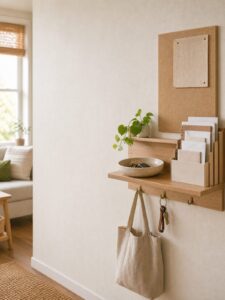
| Entry shelf or console | Outgoing items: keys, wallet, one bag | One flat tray + one hanging hook | Before leaving each day | Anything not in the tray or hanging is overflow |
| Kitchen counter near sink | Active cooking and cleared dishes | One cutting board, one small appliance, cleared dish rack | End of each cooking session or nightly | Appliance left plugged in or dishes piling > one stack |
| Living-room coffee table | Surface for current activities: book, remote, drink | Up to three items in use | Reset at bedtime or when guests arrive | More than three items or loose mail accumulates |
| Bedroom dresser top | Daily wear and immediate accessories | Two outfit pieces + jewelry tray | Morning dressing routine | Stack of clean laundry or paperwork appears |
Build the system step by step
- Identify your high-traffic surfaces. Walk your apartment and list the places that collect stuff within one minute of your door opening.
- Assign a single purpose to each surface. Choose a primary role that supports daily routines (drop zone, active cooking area, current read, outfit staging).
- Set a strict, visible capacity. Use one tray, one hook, or a clear size limit so the capacity is obvious without measuring.
- Pick a reset time tied to an existing habit. Link the reset to a daily action you already do, such as bedtime, morning coffee, or leaving the apartment.
- Use a simple decision signal and enforce it. When the signal appears—overflow, more than allowed items, or an item outside the designated container—take one timed action (60 seconds) to return items to their home.
After you follow these steps for each major surface, spend one week testing the system. During that week, only adjust capacity downwards if a surface feels cluttered; only change purpose if the assigned role consistently creates extra work elsewhere. The goal is a living system you can maintain with small, regular actions rather than occasional deep cleans.
Trade-offs to consider
Every constraint forces a trade-off. The One-Shelf Rule favors routine maintenance over bulk storage and accepts small daily tasks in exchange for a clearer, more functional space.
- Convenience vs. clutter: Keeping essentials on a surface saves time but increases the need to reset daily.
- Strict limits vs. flexibility: A tight capacity reduces mess but may feel restrictive when you’re busier than usual.
- Visible order vs. hidden storage: Using trays and hooks keeps surfaces tidy but may mean buying or repurposing small organizers or using wardrobe space instead.
Keep it workable
Make the reset step short and non-negotiable: a 60–120 second tidy at the chosen reset time keeps surfaces clear without feeling like a chore. Put a small basket or bin near each surface for temporary staging so you can move multiple items back to their homes in one trip. If you rent, check your lease before installing hooks or hardware; follow manufacturer instructions for any anchors or mounts, and follow local guidance when needed.
Choose a Shelf Organizer by the Problem It Solves
A shelf organizer should separate a specific category, improve access, or use vertical clearance that would otherwise be wasted. It should not become a second shelf in front of the first one. Measure the usable shelf opening, including hinges and door frames, then decide whether a riser, divided bin, turntable, drawer, or freestanding insert matches the items.
Keep frequently used items between comfortable reach levels and place heavy items lower. Give the shelf a capacity rule such as one bin per category or one visible row. When the limit is reached, remove or relocate something before adding another item. This is more sustainable than repeatedly buying smaller compartments for an expanding category.
Do not trade clutter for instability
Follow the organizer and furniture manufacturer’s instructions, including load and anchoring guidance. Avoid stacking inserts that were not designed to interlock. If the shelf is part of a tall freestanding unit, review current CPSC tip-over prevention guidance and use hardware appropriate for the wall and furniture.
Pair this method with the storage container measuring guide and the closet downsizing plan. A five-minute daily reset works only when every item has a clear destination and the shelf remains below its practical capacity.
FAQ
What if I run out of room even after assigning purposes?
If surfaces still overflow, consider relocating a purpose off-surface into vertical or hidden storage, like a wall hook, under-bed box, or closet shelf. This is a practical option to keep surfaces functional; check your lease before making permanent changes.
How strict does the reset time need to be?
Reset times work best when tied to a reliable habit you already have. For most people, a nightly or exit-the-apartment reset is realistic; treating the reset as a short, repeatable habit makes the system sustainable rather than perfect.
Are there safety concerns about placing items on furniture?
For safety questions about securing televisions and top-heavy furniture, follow the manufacturer instructions and local guidance; the U.S. Consumer Product Safety Commission advises securing TVs and top-heavy furniture where appropriate and keeping climb-attracting items away from the top of furniture.
Start by identifying one problem surface and assigning it a purpose and a tiny capacity today. If that change feels manageable, apply the same approach to the next two surfaces this week to build a predictable, low-effort routine.
How do I know whether a shelf organizer is overloaded?
Stop adding items when the shelf bows, fasteners loosen, the unit becomes unstable, items project into a walkway, or you cannot remove one item without disturbing the stack. Follow the product’s load instructions.
Sources and fact-checking
This guide provides practical editorial guidance. Requirements and safe choices can depend on the product, lease, local rules, and individual situation.
- U.S. Consumer Product Safety Commission — Anchor It! — CPSC advises following manufacturer instructions, securing TVs and top-heavy furniture where appropriate, and keeping climb-attracting items away from the top of furniture.
Fact-checked against the linked official resources on November 1, 2026.