Small Bathroom Organization: A Renter-Friendly Plan That Keeps Counters Clear
A small bathroom has almost no margin for clutter. One crowded counter, a half-open drawer, or a pile of towels can make the whole room feel harder to use. The solution is not to force every item into a tiny cabinet. It is to separate daily routines from backups and give each category a clear boundary.
This renter-friendly plan does not require renovation or drilling. It begins with what you already own, then shows where a small storage addition may actually help.
If an item is not part of your morning, evening, or weekly routine, it does not need the best spot in the bathroom.
Begin With the Counter and Sink Area
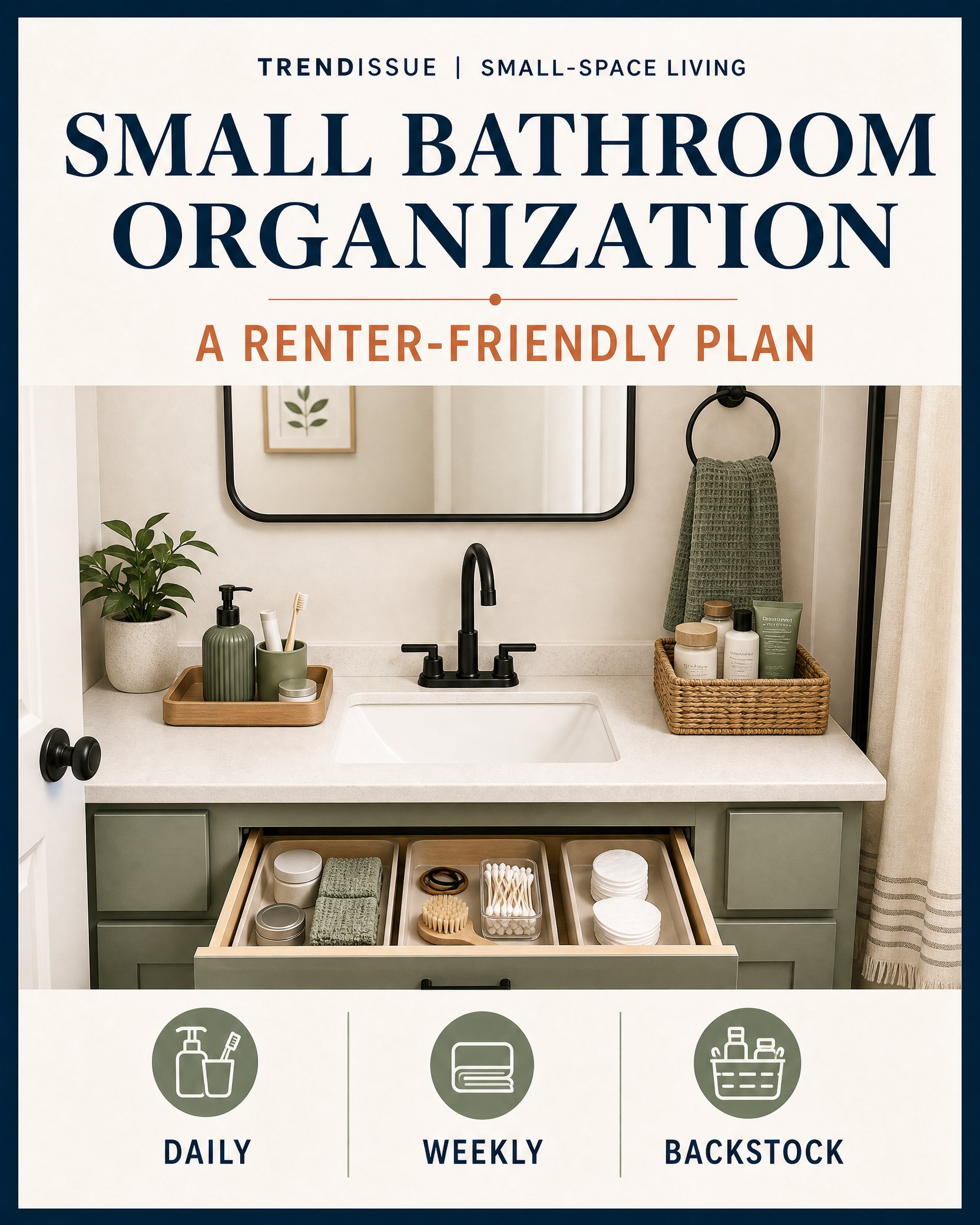
Clear the counter completely except for items that are used almost every day. This may include a toothbrush holder, hand soap, and a small tray for a limited set of skincare products. The exact list will differ by household; the important part is that the list is short and intentional.
A tray can be useful because it makes cleaning faster. Instead of moving six loose bottles one by one, you can lift one group, wipe the surface, and return it. Choose a tray only after you know what needs to stay out. A decorative tray that becomes a parking lot for unused products does not solve the problem.
Keep the sink area clear enough that a guest could wash their hands without navigating personal items. This makes the room more functional and gives you an easy visual signal when the system needs a reset.
Sort Products Into Three Levels of Access
Once the counter is clear, sort personal-care items into daily, weekly, and backup access. This prevents expensive or useful products from being forgotten while still protecting valuable drawer space.
At-a-glance reference
| Access level | Examples | Best location |
|---|---|---|
| Daily | Toothbrush, face wash, medication used at a set time, hairbrush | Counter tray, top drawer, or front of a cabinet |
| Weekly / occasional | Hair tools, masks, nail supplies, travel kit | Lower drawer, small bin, or higher shelf |
| Backup | Unopened toiletries, extra soap, replacement blades, bulk tissue | One labeled bin or shelf outside the daily zone |
The category names are less important than the access rule. When an unopened product lives beside a daily product, the counter slowly becomes a stockroom. Keep backups together and decide how much is reasonable for your household. One or two replacements may be useful; an entire supply-store shelf usually is not necessary in a small bathroom.
Make the Drawer Easy to See at a Glance
Bathroom drawers become frustrating when small items stack on top of one another. Start by removing expired, empty, broken, or unwanted products. Then create loose sections: oral care, skincare, hair accessories, first aid, and grooming. You can use shallow boxes you already have before buying drawer dividers.
Store small categories in open containers inside the drawer so the full category can be lifted out. Avoid deep containers that force you to dig. If you cannot see an item when you open the drawer, it may not belong in the most convenient zone.
Check products periodically. Disposal instructions for medications, batteries, chemicals, and similar items can differ by product and location. Do not assume all items belong in a trash bin or down a drain. When in doubt, check the label and your local disposal guidance.
Use the Area Under the Sink for Supplies, Not Everything
The area under the sink is often awkward because pipes interrupt the usable space. Treat it as a supply zone rather than trying to make it hold every bathroom item. Place frequently used cleaning products where they can be reached without unpacking the entire cabinet, but keep products in their original labeled containers and use child-resistant storage where appropriate.
A small removable caddy can hold the products you use when cleaning the bathroom. This makes it easy to take out what you need and return it after use. Keep backup toiletries in a separate bin so they do not mix with cleaning chemicals.
Never combine cleaners to save space or use a new container that loses the original instructions. Organization should preserve safety information, not hide it.
Keep Towels Within a Defined Limit
Towels can take over a small bathroom when every spare stays within arm’s reach. Count the number your household uses between laundry days, add a reasonable guest backup, and store the rest outside the bathroom if needed.
Fold towels in the same direction so the stack is stable and easy to see. If there is no linen closet, consider a labeled shelf or closed basket in a nearby bedroom rather than forcing too many towels under the sink. The objective is to keep clean towels dry, accessible, and not mixed with items that leak or spill.
Build a Renter-Friendly Vertical Plan
Before adding anything to a wall or door, review your lease and the manufacturer’s instructions. Over-the-door organizers, freestanding narrow shelves, and tension-style solutions can be useful in some rentals, but they must fit securely and should not block ventilation, door movement, or emergency access.
Use vertical storage for lightweight, contained categories such as rolled washcloths, extra toilet paper, or hair tools. Do not overload a door organizer. If you add any tall freestanding storage, consider household safety first. The U.S. Consumer Product Safety Commission advises securing top-heavy furniture and installing supplied anti-tip devices as directed. [1]
For renters, the safest storage choice is often the simplest: a stable piece that fits the room and does not require you to improvise a load-bearing installation.
Give Each Person a Clear Personal Zone
Shared bathrooms feel cluttered when every item is communal by default. Give each household member a small basket, drawer section, or shelf. Personal zones make it easier to find products and reduce arguments about what belongs where.
For children, keep items age-appropriate and within safe reach where suitable. For items that need adult supervision or should be inaccessible to children, use secure storage. Adapt the setup to the household rather than copying a one-size-fits-all image.
End With a Two-Minute Reset
A small bathroom does not require a large cleaning session to look orderly. At the end of the day, return daily products to their tray or drawer, put laundry in the hamper, hang damp towels properly, and remove empty packaging. Two minutes protects the counter and makes the next morning easier.
If the counter repeatedly collects the same items, do not blame yourself. Ask whether those items have a convenient home. The right drawer section or small caddy can eliminate a daily pile better than another decluttering session.
Frequently Asked Questions
What should stay on a small bathroom counter?
Keep only items used every day and items that need to air-dry or remain accessible. Most backups, styling tools, makeup collections, and cleaning supplies should live elsewhere.
How do I organize a bathroom with no drawers?
Use a few small, removable containers: one for daily care, one for hair or grooming, and one for backups. Place them in an accessible cabinet, on a stable shelf, or outside the bathroom if there is not enough safe space inside.
Is over-the-toilet storage a good idea in a rental?
It can be, provided it fits securely, does not create a stability hazard, and does not conflict with lease restrictions. Avoid storing heavy items overhead or using a unit that feels unstable.
Your Next Step
Clear your bathroom counter, choose your daily-use list, and create a single backup boundary. Then use The Weekend Apartment Reset: A Room-by-Room Plan for Less Clutter to fit the bathroom reset into a whole-home routine.
References
[1] U.S. Consumer Product Safety Commission, “AnchorIt.gov”
Sources and fact-checking
This article provides practical editorial guidance. Safety, cleaning, disposal, rental, and product decisions can depend on the item, its instructions, and local requirements.
- U.S. Centers for Disease Control and Prevention — Cleaning and Disinfecting — For everyday home cleaning, use product-label directions; disinfecting may be appropriate when illness circumstances call for it.
Fact-checked against the linked official resources on August 27, 2026.