
Bread Maker Paddle Cleaning: Remove Residue Without Forcing the Shaft
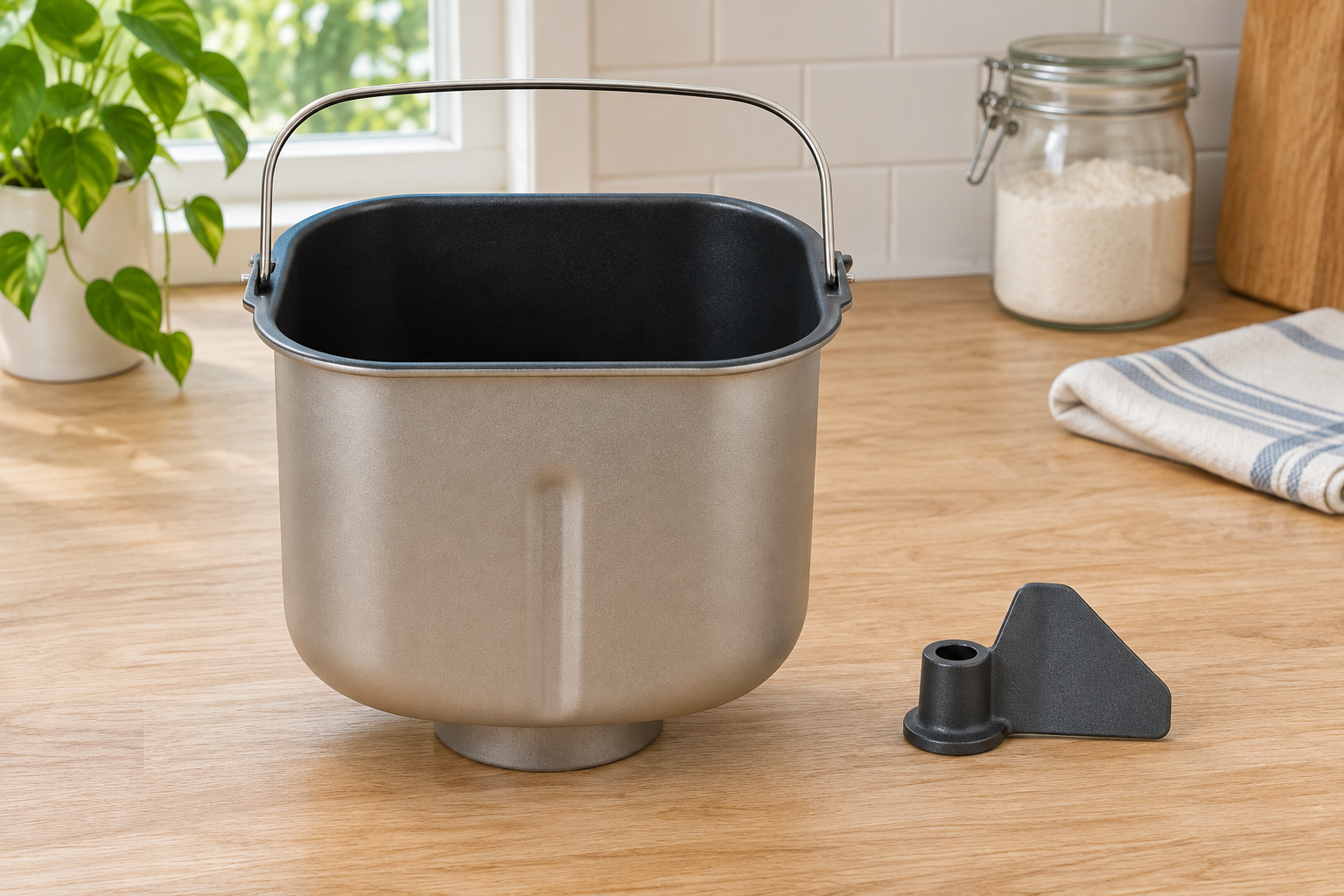
Bread maker paddle cleaning usually starts with softening stuck dough, not prying the blade off its shaft. Unplug the machine, let the pan cool, and remove the pan as the exact manual directs. If residue has locked the paddle in place, use only the method specified for that model. Do not twist, lever, oil, or scrape a stuck paddle unless that manual specifically permits it.
A bread maker pan is not just a small baking dish. The paddle sits on a drive shaft, and the pan may have a nonstick coating, a seal, and a coupling underneath. The useful goal is simple: separate the paddle without turning a dough-removal problem into a damaged-pan problem. The steps below are deliberately model-aware, because dishwasher status, removal directions, and what may be immersed are not universal.
Start with the pan out and the power disconnected
Finish the cycle, unplug the bread maker, and allow the appliance and pan to cool before cleaning. Then remove the pan by the method in its instructions. On the Cuisinart CBK-110, for example, the pan is turned counterclockwise and lifted out; its paddle is removable. Do not work on a paddle while the pan is still seated in the machine. That makes the shaft harder to see and puts the baking chamber, heating element, and finish at risk of stray moisture or tools.
Put the pan on a stable counter with the paddle facing up. Brush away loose crumbs with a soft, dry cloth or soft brush if needed. Look before pulling: is the paddle blocked by a ring of baked dough, or is it simply snug on the shaft? That observation determines the next move.
Use water to soften dough, not force the mechanism
For a Cuisinart CBK-110, the instruction booklet says that warm, soapy water in the bread pan for 10 to 15 minutes will loosen a difficult paddle. After that short soak, hold the pan steady and try to lift the paddle off by hand. Do not use a knife, fork, screwdriver, or other metal lever against the nonstick pan or the paddle opening.
Zojirushi’s BB-PDC20 manual takes a slightly different approach. It directs the owner to fill the pan with room-temperature or warm water to soften dough around the rotating shaft and blades, then remove the blades. For a blade that does not release easily, that model’s manual specifically allows pulling while rotating the blade in both directions, while holding the coupling wing nut under the pan still. That is model-specific guidance, not a general rule for every bread maker. Its manual also says not to leave water in the pan too long and not to immerse the underside that contains the coupling wing nuts.
| What you see | Best next move | What not to assume |
|---|---|---|
| Loose crumbs around the paddle | Remove them with a soft cloth or brush before washing | That the pan may go in a dishwasher |
| Paddle held by dried dough | Use the brief warm-water soak stated for your model | That a sharp tool will safely break it free |
| Paddle still resists after soaking | Check the model’s stuck-paddle instruction and stop if it gives no further method | That rotation, prying, or lubricant is universal |
| Residue at the shaft | Clean gently with a soft sponge as the manual permits | That the seal or underside may be submerged |
| Pan and paddle are clean | Dry and reinstall or store them as your manual directs | That every brand wants the paddle stored the same way |
Clean the paddle, hole, pan, and shaft as separate areas
Once the paddle is off, wash the paddle and the inside of the pan with warm water, mild dish soap, and a soft sponge when those are approved for your model. Cuisinart’s CBK-110 instructs hand-washing the pan and kneading paddle with warm water and soap and warns against metal utensils. Zojirushi likewise specifies mild kitchen detergent and a soft sponge for the pan and blades, not hard nylon sponges or brushes.
Pay attention to the paddle’s center hole. Dough in that hole is often why the next removal is difficult. Zojirushi’s BB-PDC20 manual says a clogged blade hole can be soaked in room-temperature or warm water and cleared with a bamboo skewer or similar utensil. That does not authorize probing any other brand’s shaft or seal. If your manual does not describe cleaning a small opening, use its instructions rather than improvising with a metal pick.
The shaft deserves the lightest touch. The Zojirushi manual calls for a soft sponge to remove baked crumbs from the rotating shaft without damaging the seal. Do not scrape around a seal, flood the pan bottom, or try to lubricate a shaft as part of ordinary cleaning unless the exact manufacturer documentation tells you to. Cleaning residue and servicing a mechanism are different jobs.
Keep the machine body out of the wash routine
The removable pan and paddle are not the same thing as the bread maker body. Cuisinart says not to put the bread maker itself in water or a dishwasher. Its chamber should be cleared of crumbs with a slightly damp cloth or clean pastry brush, without bending the heating element. Zojirushi similarly says not to splash or immerse the appliance. Treat any cleaning method that sends water into the chamber, under buttons, or around electrical parts as a stop sign.
It is also worth checking the bottom of the pan before reassembly. If your model has an exposed underside coupling, follow its specific instruction. For the BB-PDC20, Zojirushi says to wipe the coupling wing nuts with a well-wrung soft cloth rather than immerse that bottom area. This is why generic advice such as “soak the whole pan overnight” is a poor fit for bread makers.
Dry, inspect, and reattach without inventing a repair
Dry the pan and paddle thoroughly before putting them back. Confirm the paddle is free of dough, the shaft area is not packed with crumbs, and no coating appears to have been scratched by a tool. Then follow your manual’s assembly instructions. The CBK-110, for instance, specifies fitting its paddle onto the shaft with the wide base facing down. Zojirushi advises attaching its kneading blades to the pan after cleaning so they are not misplaced.
If the paddle still will not release after the manual’s stated softening method, or if the shaft does not turn normally, stop there. Do not convert a cleaning task into disassembly. Look up the model number and current official manual, then use the manufacturer’s support route if the document does not give a next step.
Two related checks that prevent the wrong cleaning shortcut
When a removable part has a coating, correct cleaning is about the part and the manufacturer’s instructions, not about choosing the strongest scrubber. Our electric griddle cleaning guide is useful if you are comparing how different removable cooking parts are treated, because it reinforces checking the specific part before washing. For another appliance where water boundaries matter, see blender blade assembly cleaning guide. It helps show why a removable part still needs its own disassembly and washing directions.
FAQ
Can I remove a bread maker paddle with pliers?
No general manual rule supports that. Pliers can mark the paddle, shaft, or coating. Start with the manual’s softening method and use a manufacturer-approved next step only if it is stated for your model.
Can the bread pan and paddle go in the dishwasher?
Do not assume so. The Cuisinart CBK-110 calls for hand-washing, and Zojirushi’s BB-PDC20 says not to use a dishwasher or dish-dryer. Check the exact model manual because care directions vary across bread makers.
Why does the paddle stick after a loaf?
Baked dough can remain around the paddle and shaft. A short warm-water soak is the stated remedy in the Cuisinart CBK-110 booklet. Use only the time and method your own manual allows.
Should I oil the shaft after cleaning?
Not as a general cleaning step. Do not add oil or lubricant unless the manual for your exact bread maker instructs it. If a shaft or paddle remains difficult after approved cleaning, use the manufacturer’s support guidance.
Sources and fact-checking
- Cuisinart bread maker manuals, including the CBK-110 instruction booklet: pan and paddle hand-washing, a 10-to-15-minute warm soapy-water method for a stuck paddle, and body-cleaning limits.
- Zojirushi instruction manual listing for BB-PDC20: model identification and manual access. The BB-PDC20 manual was reviewed for its pan, blade, shaft, seal, and coupling guidance.
Research note: This article is based on the cited manufacturer materials, reviewed November 28, 2026. It does not claim hands-on testing. Use the current manual for the exact model in your kitchen.


댓글 0
첫 댓글을 남겨보세요.