
Power Scrubber Charging and Storage: Keep the Charger Dry
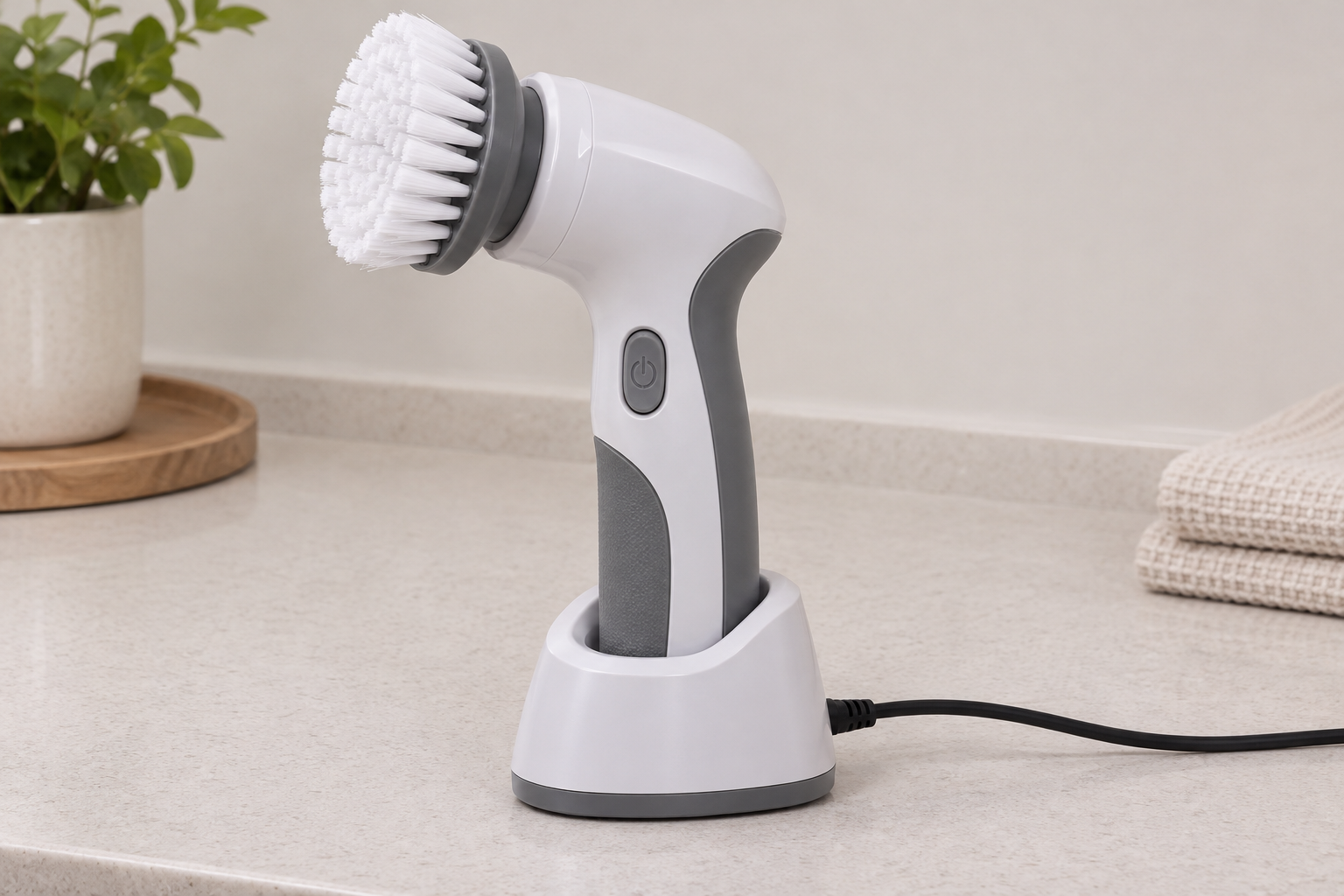
Power scrubber battery charging instructions are model-specific: use the supplied charging system in a dry location and check the exact manual before charging. This guide covers consumer handheld scrubbers, not commercial floor scrubbers.
For BLACK+DECKER BHPC210/BHPC220, switch the appliance off and make sure it is completely dry. Plug the supplied charger directly into a standard 120 V/60 Hz outlet without an extension cord, then place the dry tool on its charging station. The indicator lights while charging and goes out when fully charged. The manual specifies at least 12 hours for the initial charge.
| Charging decision | BHPC210/BHPC220 manual instruction | What to do |
|---|---|---|
| Before docking | Switch off and make the appliance completely dry | Dry the tool before placing it on the station. |
| Power source | Use supplied charger directly in a standard 120 V/60 Hz outlet | Do not use an extension cord. |
| Charging signal | Indicator lights while charging and goes out when full | Use the indicator rather than guessing a routine duration. |
| New appliance | Charge at least 12 hours before first use | Plan the initial charge in a dry location. |
Keep the base and plug dry
The BHPC210/BHPC220 manual says not to put the charging base in water or other liquid, not to handle the charger, plug, or terminals with wet hands, and to place or mount the unit away from sinks. The tool body’s limited wet-use directions do not apply to the base. The manual permits the appliance only, not the station, to be immersed to a maximum depth of 8 inches in water no hotter than 86°F for no more than 30 minutes.
Use the exact manual for charging conditions
The verified U.S. BHPC210/BHPC220 instruction manual is the source for this sequence. It also says to use only the supplied charger, not to charge outdoors, and to unplug the charger before routine cleaning or maintenance. It does not provide a universal routine-charge duration, so use the indicator rather than guessing.
Keep the charger, cable, and stand together. Do not use a damaged cord, loose plug, cracked stand, or a charger from a different product simply because it appears to fit. If the manufacturer’s instructions say the unit or accessory is not serviceable by the user, use authorized service support rather than opening it.
Measure a dry storage space that keeps the kit together
Measure the actual charging stand with the scrubber docked, plus the cord route to an existing outlet. Keep the cord unpinched and the base on a flat, level counter or a suitable wall mount as the manual permits. The manual does not need a retail product-page dimension claim to make this fit test useful.
Keep pads and the pole where they can dry without covering the charger. A utility cabinet can work only if it remains dry and the cord is not pinched by a door. For a broader cord decision, see a safer cord organizer setup. If you need to reduce bathroom clutter first, use this renter-friendly bathroom organization plan.
Know what “submersible” does and does not answer
Instruction manual N515198 permits limited immersion of the BHPC210/BHPC220 tool under its stated conditions. That statement concerns the tool’s cleaning use, not the charging stand, charger, outlet, or an unverified version of the product. Never infer that all powered scrubbers, their charging components, or every accessory can be immersed. When you cannot locate the exact manual, do not invent limits: keep charging components dry and contact the manufacturer.
Inspect the stand before it becomes a storage habit
Before each charging cycle, look at the stand, cable, plug, and tool contacts without handling damaged parts. A cracked housing, exposed wire, loose plug, overheating, unusual odor, or liquid near the charger is a stop signal. Unplug only when it is safe to do so and use the manufacturer’s support route. Do not try to dry, tape, or modify a compromised charging system.
Charging storage should also avoid crowding. Bottles, towels, and spare pads must not push the scrubber off its base or hide the cord. A shelf near an outlet can be practical, but the closest shelf is not automatically the right one if it is inside a wet zone or cannot keep the charger dry.
Store attachments as cleaning items, not electrical items
Washable pads, if your exact model permits washing them, should be cleaned and dried by their separate instructions. Keep them off the stand so moisture cannot migrate to charging contacts. Store the extension pole where it cannot fall into the charging area or strain the tool. Check the attachment lock before each use rather than assuming it stayed engaged after storage.
If you move, pack the power scrubber with its stand, manual, and manufacturer-supplied charger in one labeled container. Do not mix loose chargers from unrelated appliances. On arrival, set up the dry charging location again before putting the tool on the stand. This is especially useful when a temporary bathroom counter has limited safe space.
Check wet-use limits before returning the tool to charge
A bathroom is not automatically a permitted wet-use environment, and a product described as suitable for a wet task may still have model-specific limits. Check the manual for the exact scrubber, its attachments, and its charger before using it around a tub, sink, or shower. Do not infer a water-resistance rating, charging duration, or immersion allowance from a retailer description or from a different BLACK+DECKER product.
Set the dry charging station outside the area where you rinse a pad or splash cleaner. If the route requires crossing a wet floor, dry the tool exterior first and use a towel-free dry landing place. The aim is not to claim an electrical clearance distance that has not been verified; it is to keep charging components dry and to use the manufacturer-provided system.
Plan for a rental bathroom without changing the electrical setup
In a rental, do not move, alter, or add permanent electrical equipment just to create a charging nook. Use the supplied charger at an existing dry location that the manual permits. Keep cleaning chemicals in their original containers and away from the charging stand. If the available storage is consistently damp, store the scrubber elsewhere after it is dry rather than treating the bathroom vanity as the only option.
Keep the manual available before any charging decision.
Frequently asked questions
Can I charge a power scrubber beside the tub?
Choose a dry location and follow the exact manual; do not put charging equipment in a splash zone.
Does “submersible” include the charger?
No. The limited immersion conditions in instruction manual N515198 apply to the tool only, not its charging station or charger.
How long does the BHPC220 take to charge?
Instruction manual N515198 requires at least 12 hours for the initial charge. It does not give a universal routine-charge time; use the indicator and your exact model manual.
Can I use another adapter?
Use the supplied charging system unless the manufacturer explicitly approves an alternative.
Sources and fact-checking
Checked against the official sources below on November 27, 2026. This is research-based guidance, not a claim of hands-on product testing.



댓글 0
첫 댓글을 남겨보세요.