
Cabinet Turntable Diameter: Measure the Tray and the Rotation Path
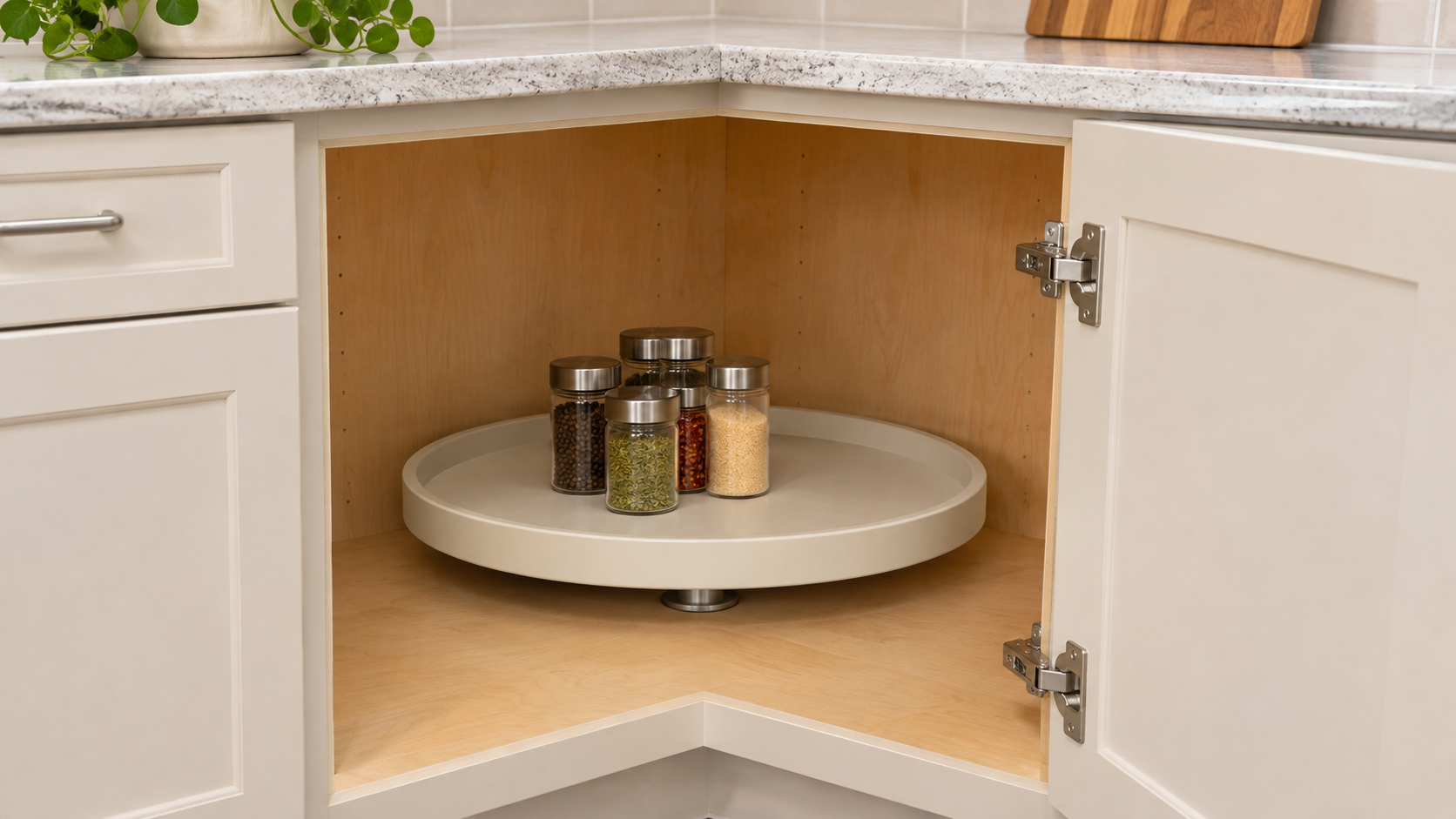
Cabinet turntable diameter is only one part of fit; the tray and its stored-item envelope rotate, while the cabinet opening and door path stay fixed and control usable access. A tray that turns empty can still jam once items extend beyond its rim.
| Rotation check | Measure | Why |
|---|---|---|
| Tray | Actual diameter or width/depth | Must suit cabinet shape |
| Opening | Clear entry width/depth | Must pass tray and contents |
| Door | Full swing and hinge projection | Must allow access |
| Items | Outer edge of stored objects | Defines real turning path |
Name the cabinet shape first
Corner cabinets may be diagonal, angled, wall-mounted, or tall; their doors and openings differ. Rev-A-Shelf distinguishes full circle, D-shape, kidney, and pie-cut solutions. Photograph the open cabinet and configuration before looking at a diameter.
The maker’s minimum-opening field is more useful than a nominal cabinet label, but still check hinges and your belongings. Face frames and inset doors reduce access. Do not move a product dimension from a countertop turntable or different cabinet shape into the selected model.
Measure the stored-item outer circle
Put intended jars, bottles, or small appliances inside a paper outline of the candidate tray. Include handles, pump tops, bag corners, and labels. Rotate that mock-up while accounting for a center post or hub. The widest item envelope, not just the base, is what can strike a door or cabinet.
Keep awkward, leaning, or two-handed items on a stationary shelf if they crowd the rotation. A turntable is useful when a category returns to a predictable zone; movement itself is not a reason to buy one. Leave vertical clearance for lids and the tallest item too.
Use product-specific opening data
Rev-A-Shelf’s 4265-22-52 is a D-shaped, five-shelf tall-cabinet example, not a generic round tray. It lists a 22-inch diameter and a standard face-frame minimum opening of 22 1/4 by 18 1/2 by 56 inches; its inset-face-frame depth is 19 1/4 inches. These values illustrate why diameter alone fails and must not be transferred to a round tray or another cabinet system.
A tray may require a post, door/wall mount, or existing cabinet configuration. Do not drill, remove a shelf, or alter a door from a product photograph. Follow the exact installation sheet and seek approval in a rental. Soft cabinet bases, binding doors, and unclear mounting surfaces are reasons to pause.
Use a fixed organizer when rotation conflicts
A shelf riser, shallow bin, or pull-out can be easier where entry is narrow, plumbing intrudes, or stored items are irregular. Compare opening the door, reaching, returning, and closing rather than treating a lazy Susan as automatically superior.
For a non-rotating second level, see the shelf-riser fit and load checklist. For a rental approach, see no-drill cabinet organization.
Mock up a full rotation before ordering
Use cardboard or paper to mark the candidate tray, then add the actual objects you hope to store. Open the door as far as it normally goes and rotate the mock-up from each reachable position. This exposes a bottle cap, handle, or bag corner that a diameter number cannot show. Repeat at the height where the tray will sit, because a face frame or shelf can change the accessible route.
Leave a little operational space instead of packing the rim to its edge. A cabinet changes as groceries and containers change, and a tight arrangement that only works with today’s jars can become a daily snag. Keep the center hub clear and avoid relying on leaning items to stay in place while the tray turns. If one item requires a special orientation every time, put it in a fixed zone.
Buying decision in plain language
Select a turntable only after cabinet shape, opening, hardware, and stored-item envelope agree with the exact system. When those conditions do not line up, a fixed shelf, bin, or riser can produce simpler access. A rotating tray is a method, not a required upgrade for every corner cabinet.
Use a repeatable final check
Before placing an order, make one short list for the cabinet turntable: cabinet shape, clear opening, turntable rim, center hub, door swing, item envelope. Put a date beside each observation and identify which detail comes from the actual home and which comes from the manufacturer. This separates known conditions from assumptions. It also prevents a popular marketplace title, an old review, or a photograph of another variant from becoming the deciding evidence. If a required figure is absent from the official materials, do not fill the gap with an estimate.
FAQ
Is tray diameter enough?
No. Measure opening, door, center hardware, vertical room, and stored items.
Can objects extend past the rim?
They can interfere during rotation; measure the widest outside edge.
Do all corner cabinets use one style?
No. Door and cabinet geometry choose the appropriate shape.
Can I install one in a rental?
Ask before drilling or altering supplied cabinets, doors, or shelves.
Sources and fact-checking
Checked against the official sources below on November 27, 2026. This is research-based guidance, not a claim of hands-on product testing.



댓글 0
첫 댓글을 남겨보세요.