
Electric Can Opener Cleaning: Detachable Cutter and Small-Kitchen Fit
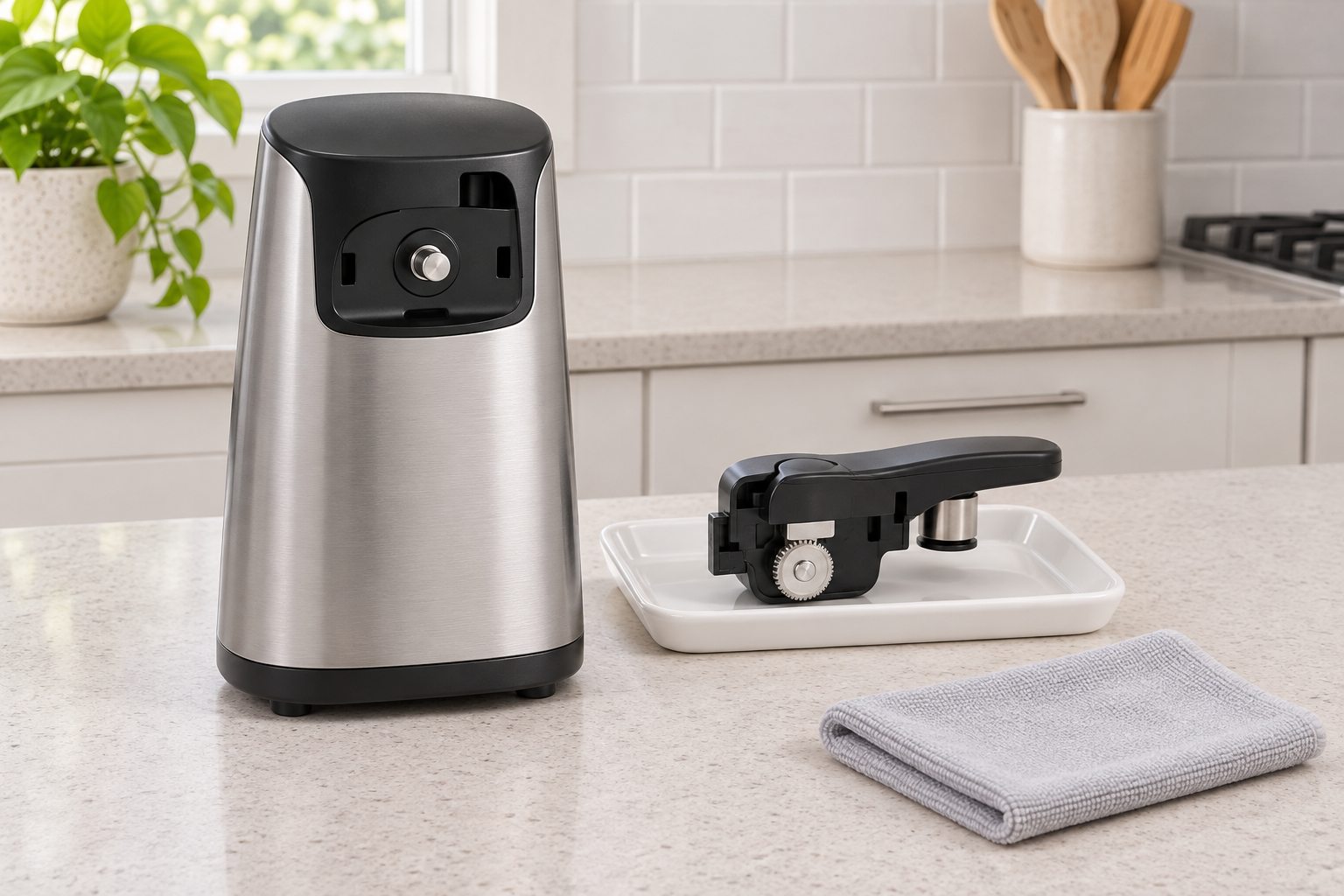
Electric can opener cleaning should be part of the buying decision, not an afterthought. In a compact kitchen, the useful question is whether you can remove the cutting assembly, clean it after use, let it dry, and store the appliance without leaving a bulky corded tool on the counter. A detachable head is a meaningful convenience only if the manufacturer’s instructions show how to release, wash, and reinstall it. The motor base, cord, and plug are a separate matter: they should not be immersed.
Hamilton Beach’s Use & Care manual for model 76778 identifies a detachable can-opener head, cutting assembly, geared wheel, and release button. It also says to release the activation lever and unplug before disassembly or cleaning, warns against immersing the body or cord, and says not to use abrasive cleaners or scouring pads. Treat those as model-specific directions, then read the manual for the exact opener you are considering.
Plan Electric Can Opener Cleaning Before You Buy
Look at the cutter area before looking at secondary features. A removable cutting assembly creates a separate washable piece, which can be easier to handle at a sink than wiping around a fixed blade. It does not make the whole appliance washable. Confirm whether the head comes off with a release button, whether the instructions permit washing it, and how it reattaches. If the manual is unavailable before purchase, that is a reasonable reason to choose another model.
For a fixed-head opener, ask whether the cutting wheel and magnet can be reached without putting fingers near a sharp edge. A small brush or damp cloth may be the practical cleanup route, but use only methods the manual allows. Do not improvise with a scouring pad or immerse the base. A design that looks compact but is hard to clean can be a poor fit for a one-sink kitchen.
| Small-kitchen choice | What to inspect | Cleaning implication | Who it may suit |
|---|---|---|---|
| Detachable cutting head | Release method and reinstalling instructions | Separate part can be cleaned as the manual permits; base still stays dry | Frequent users with a clear drying spot |
| Fixed cutting head | Reach around wheel and magnet | May require careful wipe-down in place | Users with a simple, infrequent routine |
| Multi-tool base | Extra features, cord storage, footprint | More surfaces and crevices to keep clean | People who will use the functions |
| Manual opener instead | Grip, storage, washing method | No powered base, but still a blade to clean safely | Very limited counter space |
Separate the removable cutter from the powered base
Use a deliberate order after opening a can: release the lever, unplug the appliance, remove the detachable head only as directed, then clean and dry the relevant part. The Hamilton Beach manual warns to avoid moving parts and to keep the body, cord, and plug out of water or other liquid. It also says never to pull the plug by the cord. Those basics matter in a small sink where the cord can otherwise cross a wet counter.
Wait until the unit is disconnected before dealing with the cutting area. Keep fingers away from the blade and geared wheel. A can lid can have a sharp edge as well, so discard or recycle it according to local rules rather than leaving it in the sink. Do not clean while a can is still engaged. If the cutting assembly will not release, do not force it; check the exact model manual or contact the manufacturer.
Make room for drying, not just storage
A removable head needs a clean, dry place before it returns to the appliance. In a small kitchen, that may be a small tray away from food-prep clutter rather than the counter edge. Do not put a damp component into a closed drawer or push it back onto the base before it is dry. The right routine is the one that keeps the sink available, the cord out of water, and the sharp area inaccessible to children.
Plan the appliance’s parked position too. Measure its counter footprint, height under any upper cabinet, cord path to the outlet, and the space needed to bring a can to the guide pin. Reserve a drying area as well as a shelf. The small-space dishwashing routine can help you keep a removable head from joining a permanent pile around the sink.
Decide whether an electric opener earns its counter space
An electric opener can be a reasonable choice when opening cans is frequent, the appliance has a stable home, and the user can safely manage the lever and cleanup. It is not automatically the right answer for every small kitchen. If you open a can occasionally, a compact manual opener with a cleaning method you can follow may use less storage. If hand strength or dexterity is part of the decision, try the controls in person where possible and consult product instructions rather than assuming every automatic stop or lid holder works the same way.
Compare it against the items that already compete for the outlet and counter. Do you have space to unplug it after each use? Can the cord route without hanging over an edge or touching a hot surface? Hamilton Beach’s manual specifically cautions against both. If not, store the appliance in a dry, accessible cabinet and bring it out only for use. For a broader cabinet plan, see how to set up a small rental kitchen without changing cabinets.
Skip these shortcuts
- Do not submerge the motor base, plug, or cord.
- Do not use abrasive cleaners or scouring pads when the manual prohibits them.
- Do not leave a detachable cutting head wet in a closed cabinet.
- Do not route the cord across a sink, hot surface, or walkway.
- Do not open pressurized cans or cans of flammable liquid; Hamilton Beach prohibits both for this model.
- Do not assume parts from one brand or model are dishwasher-safe on another.
Set a simple after-use reset before choosing a model
Make the cleanup sequence visible in your kitchen: unplug, remove the permitted cutting part, clean it as directed, dry it, wipe the base without wetting it, and return the cord to its storage. If that sequence requires balancing parts on a crowded drainboard or carrying the appliance across the kitchen with a wet cord, reconsider the location. A compact tray can keep the dry cutting head and manual together without creating a permanent counter pile.
Before the next use, check that the detachable head is correctly seated and the cutting area is clear. Do not try to sharpen, oil, disassemble, or repair the mechanism unless the manufacturer specifically tells you how. The cited manual says its motor is permanently lubricated, which is a useful reminder that a maintenance task appropriate to one kitchen tool may be wrong for another.
FAQ
Can I wash an electric can opener in the sink?
Not as a whole appliance. The Hamilton Beach manual says not to immerse the body, cord, or plug. Follow the exact model’s instructions for any detachable part.
Why does a detachable cutting head matter?
It can make the cutter area easier to clean separately, but it does not change the water limits for the powered base.
Should I keep an electric can opener on the counter?
Only if it has a dry, stable spot, an appropriate outlet, and a cord route that does not hang over an edge or reach a hot surface. Otherwise, cabinet storage may be better.
Can I use a scouring pad on the cutting wheel?
Not for the Hamilton Beach model cited here. Its manual says not to use abrasive cleaners or scouring pads; check your own manual.
Sources and fact-checking
The detachable-head parts and cleaning precautions come from the Hamilton Beach 76778 Use & Care manual, read November 25, 2026. Its water, cord, abrasive-cleaner, and lubrication instructions apply to that model. I have not tested the opener; verify the current instructions for any different cutting assembly.




댓글 0
첫 댓글을 남겨보세요.