
Tilt-Head Mixer Cabinet Fit: Measure Open-Head Working Space
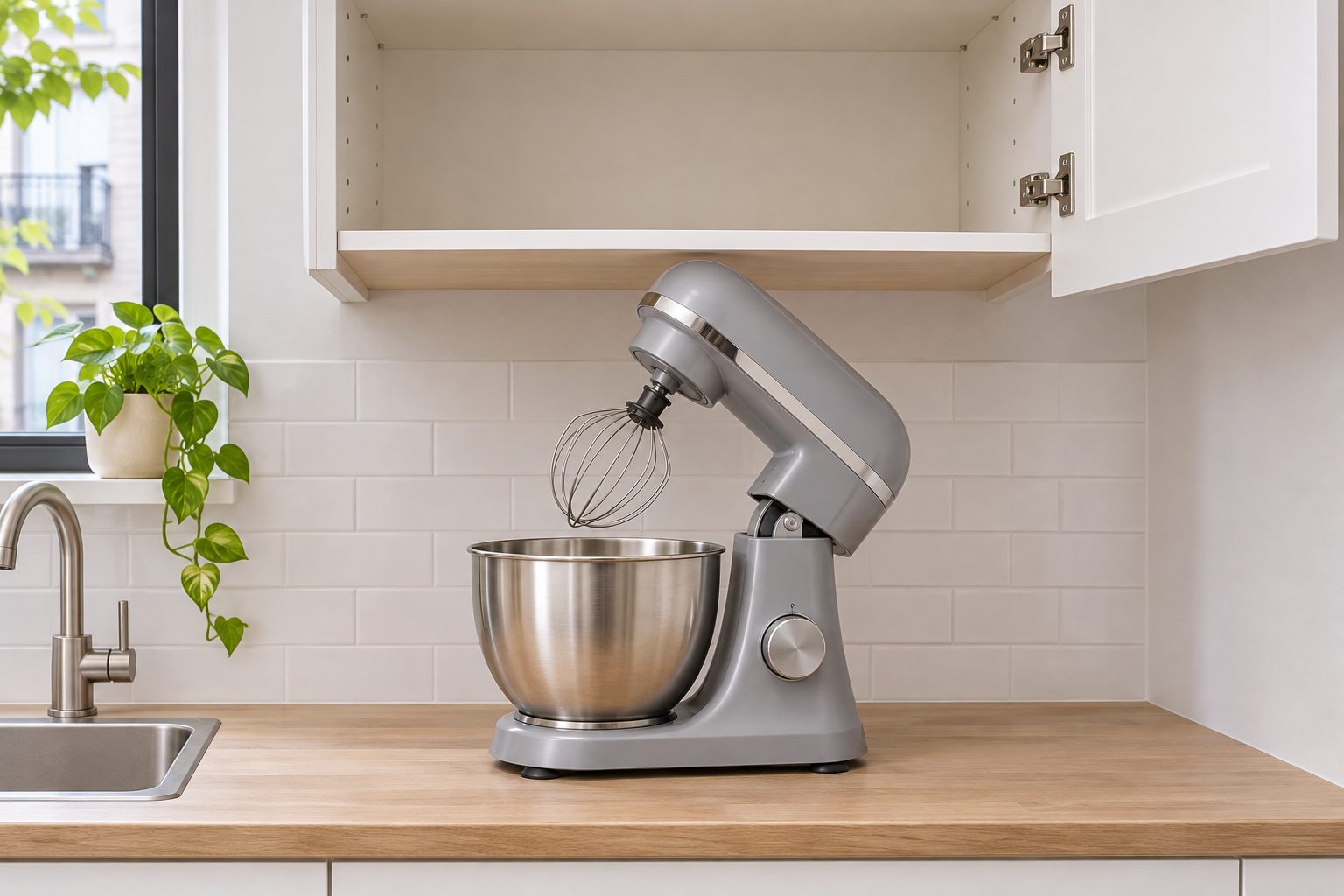
Tilt-head mixer cabinet fit is not determined by the closed height printed on a product listing. It has two separate tests: whether the closed machine can be stored and whether its full access motion works on an approved operating surface. A tilt-head mixer needs open space above the motor head when you tilt it back. A bowl-lift mixer does not hinge upward, but it still needs room to lower the bowl, add ingredients, and remove the bowl without scraping a shelf. If either motion is blocked, the cabinet is storage only, not a usable mixing station.
Measure the appliance you are considering, then measure the cabinet at its narrowest usable point: floor or shelf to the underside of the next shelf, back to front, and side to side. Do not use a generic “standard mixer height.” Models, bowls, attachments, and the cabinet’s face frame can change the result. KitchenAid describes the basic distinction clearly: a tilt-head’s top hinges back for bowl and accessory access, while a bowl-lift model has a fixed head and uses a lever to raise and lower the bowl.
Choose a tilt-head mixer cabinet fit by the access motion
Start by deciding how the mixer will leave or work in the cabinet. For a tilt-head model, place a tape measure at the shelf where the mixer will stand. With the machine unplugged and empty, raise its head as you normally would for attaching a beater or clearing the bowl. Measure from that shelf to the highest point of the open head. That is the working height, not the closed height. Also leave enough forward space to reach the lock, bowl, and attachment hub. A cabinet may be tall enough yet still awkward if a door or face frame blocks your hand.
For a bowl-lift model, do the same exercise differently. Measure its closed overall height for storage, then test the clearance needed to lower the bowl, lift the bowl off its locating pins, and add ingredients. KitchenAid’s bowl-lift manual says to turn the mixer off and unplug it before removing the bowl, lower the bowl with the lever, then lift it straight up and off the locating pins. That sequence is a practical reason not to pack a close-fitting cubby with jars or a fixed shelf immediately in front of the bowl.
| Cabinet question | Tilt-head mixer | Bowl-lift mixer | Decision |
|---|---|---|---|
| Height to record | Closed height and the highest point with head tilted | Closed height plus bowl travel and removal path | Use the larger working requirement |
| Access you must test | Head lock, bowl twist, beater change | Lift lever, bowl pins, beater change | Test with cabinet door open |
| Best cabinet role | Open shelf or pull-out with overhead clearance | Deep base cabinet or open shelf with bowl access | Do not infer one style fits like the other |
| Storage-only warning | Head cannot fully tilt | Bowl cannot lower or lift out | Move it before buying a cabinet solution |
Measure the shelf, door, and route before comparing mixers
Interior measurements matter more than the cabinet’s catalog width. Face frames, hinges, pull-out hardware, and shelf-lip trim can reduce usable space. Measure the shelf’s clear width and depth. Then measure the door opening, not just the outer cabinet. If you will carry the mixer to the counter, measure the route: the gap beside an island, the counter landing area, and any turn near the pantry. A heavy appliance that fits one shelf but has no comfortable lifting route can become an appliance that remains unused.
Check the shelf construction as well. The cabinet manufacturer or installer is the right source for shelf load limits; a mixer maker cannot confirm what an existing particleboard shelf, shelf pins, or pull-out can carry. Put the appliance on a continuous, level surface rather than balancing it across a gap. Keep the manual and any mixer-specific electrical instructions available. KitchenAid’s manual identifies the bowl-lift lever and locating pins, but its dimensions and setup instructions apply only to the covered models, not every stand mixer.
Decide whether the mixer stays in the cabinet while you work
A permanently open shelf can be convenient, but only when the manufacturer permits operation there and the area offers a stable surface, suitable outlet, and unrestricted ventilation and access. This article is a cabinet-fit guide, not a recommendation to run a mixer inside a closed cabinet. If the doors, shelves, or appliance cord interfere with normal setup, lift the mixer to an appropriate counter before use. Never pull the appliance by its cord.
For many small kitchens, the simpler decision is “storage below, mixing above.” A base cabinet can hold the closed mixer and attachments in a bin; the counter becomes the work surface. That eliminates the tilt-head height issue but adds a carrying decision. Compare that routine with your actual baking frequency. The related kitchen cabinet organization plan for renters can help reserve one accessible zone rather than scattering parts through several shelves.
Use accessories to test the real storage envelope
A mixer rarely travels alone. A wire whip, dough hook, pouring shield, bowl handle, and attachment hub accessory may need their own protected space. Test the tallest item that will remain attached and the longest accessory that must be stored nearby. Do not store a beater on the shaft merely to make a cabinet look organized; follow the care instructions for the specific model. KitchenAid’s manual directs owners to turn the machine off and unplug it before attaching or removing accessories and to keep the bowl securely snapped into place before use.
Separate frequently used pieces from occasional ones. A shallow bin beside the mixer can prevent loose attachments from rolling behind it, while a labeled upper shelf may suit seasonal cutters or a pasta attachment. Keep the cabinet dry and avoid stacking heavy cookware on a bowl or pouring shield. If you are reorganizing an entire small kitchen, our rental kitchen setup guide can help you reserve a counter work zone before buying cabinet add-ons.
Rule out a cabinet fit when these tests fail
- The tilt-head will not reach its normal open position.
- The bowl-lift lever cannot travel normally or the bowl cannot come off the pins.
- The door opening is narrower than the mixer’s actual removal path.
- The shelf rating or support is unknown for the loaded appliance.
- You would need to operate the mixer with a pinched cord, blocked controls, or closed doors.
- There is no clear counter or other manufacturer-suitable location for mixing.
None of those problems is solved by forcing the hinge, removing a shelf without confirming structural consequences, or choosing a mixer based on one headline dimension. Change the storage location, choose a different model, or keep the appliance on a suitable counter only if its own instructions support that use.
FAQ
How much height does a tilt-head stand mixer need in a cabinet?
Record two measurements: the overall closed height for storage and the total height from the work surface to the highest point with the head fully raised. Do not add those two heights together. Confirm the exact model’s access motion; there is no universal allowance.
Can a bowl-lift mixer go under a low upper cabinet?
Possibly. Its fixed head avoids the upward hinge motion, but you still need enough room to lower, remove, and replace the bowl and access the controls.
Can I run a stand mixer inside a cabinet?
Do not assume so. Use the appliance only as its manufacturer instructs, with normal access to the plug and controls. A storage fit does not establish a safe operating location.
Should I use a pull-out shelf for a stand mixer?
Only after confirming the pull-out’s load rating, full extension, locking behavior, and the mixer maker’s operating instructions. A pull-out is not automatically an approved operating surface.
Sources and fact-checking
KitchenAid’s bowl-lift manual supplies the bowl-removal sequence, while its tilt-head versus bowl-lift comparison explains the two access designs. Both were read November 25, 2026. Neither supplies an open-head height for every mixer. The room-measurement checks here are planning advice, not a tested cabinet installation.


댓글 0
첫 댓글을 남겨보세요.